Rob Adams a Painter's Blog painter's progress

February 24, 2014

On Beauty

A risky topic I suspect and rather an unfashionable one too. Roger Scruton wrote a book on it recently which I must read. You cannot say what beauty is any more than you can define joy,  love or indeed art. Concepts that are intensely personal are prone to be abused by people in arguments because due to the flexibility and nebulousness of their definitions they can be used to make points that cannot be argued against. The argument will go for example that in a particular circumstance anything can be beautiful. The weakness in these arguments is I think that a cleanly defined beautiful/not-beautiful, art/not-art boundary is assumed. However such phantasms of the human spirit can be brought more into focus even if they are not subject to an outright definition. We can for example say that for the most part we find regular faces more pleasing than ones deformed from the norm. There is a lot of research in that area that shows we like the facial features to be symmetrical and averaged. The images of many faces overlaid and blended are disconcertingly beautiful and show that we are looking for differences from the norm as a way of deciding genetic worthiness/unworthiness.

This does not always follow with real encounters of course. Someone might have a face that is transformed by character and animation. Nonetheless perhaps our underlying assessments of beauty are slanted towards the reassuring. We might admire a verdant and peaceful landscape or a dramatic mountain scene, but we might assign them differing types of beauty. For an arable farmer the verdant land would be attractive as a home whereas the rugged mountain less so. Our farmer might find them both beautiful but in contrasting ways. It is quite plain to me that the early cave painters found beauty in the animals they hunted that went beyond the straight forward desire for a successful hunt.

Thus we are immediately mired in the boggy land of the aesthetic. Hurrying on the heels of aesthetics come those who would tell us what is fitting/fashionable and what is not. Currently beauty and decoration are very much off the menu. We are supposed to like the sparse. Our dream apartments have empty spaces, plain surfaces and white walls. I cannot help but wonder if this is perhaps a choice caused by hoovers rather than aesthetic concerns! When designing exhibitions of decorative items from historical times we place them in sparse minimal cases. To me they always look a little sad in such soulless arrays, like butterflies pinned in drawers. They seem like items in a shop rather than exhibits in a museum intended to fire our imaginations.

In architecture beauty has been completely outlawed it sometimes seems. There is little built that moves beyond the grim utilitarianism of financial objectives and cupidity. When decorative items are used they are plastic panel doors with cartoon graining, the result is depressing rather than uplifting. Architects generally seem to be comfortable with repetition but not rhythm. Being uplifting and enriching our daily lives is, we seem to have forgotten, the whole point of decoration. In furniture we are in the thrall of anally retentive Scandinavians or those who wish to emulate them. I am not totally in disagreement, bad decoration is indeed often worse than none. Alas because we don’t do much training in the area of decoration the few examples that do appear are for the most part weak pastiche cobbled together from found images using photoshop. The decorative arts were once a big thing and lauded, why this is no longer true is a puzzle.

The only real thing I can think of is the advent of mechanical production. We have adjusted our aesthetic to suit the available means of production, maintenance and distribution rather than the other way round. We perhaps associate the hand made with the crudeness of DIY, some hand made objects seem to need to advertise their handmadeness by adding rusticity or similar.

We also tend to confuse beauty in a seen thing such as a mountain or an object made with no visual intent such as a worn wall with the beauty inherent in an object made by a human being who has laboured to gain a skill. If you splash paint randomly or even semi randomly on a canvas it will be nice to look at. If I wet some watercolour paper and pour colour on it I may well get a very attractive and interesting surface. This however is mostly the same sort of beauty as we get from admiring the patterns on a beach. The beauty in an art object is different because of the skill and the fact that a person has sacrificed part of their life in order to achieve the ability. Due to the arguments put forwards in the 20th century we tend to conflate these kinds of beauty. The weathered wall is not of any real cultural significance even if torn from its place and put in a gallery.

Music mostly does not suffer from this confusion. We might get an emotional surge when we listen to the wind in the trees, but we do not confuse that, except in moments of poetic hyperbole, with music. We do not confuse a person noodling on the piano in a random untrained manner with music either… the difference to a concert pianist is obvious and no one would say that the random noodling is art of the same order as the pianist’s bravura performance.

The statement that everyone is an artist is very much not true. To be an artist you must firstly be a fully formed craftsperson, only then should a small proportion of the resultant work be deemed “Art”.

.

henley on Thames, Thames, flood, river, plein air, oil painting


This is the recent floods at Henley. Some fascinating transformations of familiar scenes. We were lucky to get some brilliant light and a mostly dry day.

.

henley upon Thames, Thames, Plein air, oil painting


Another from the same day. The shadows were only momentarily thrown across the road. 8in by 10in oils.

.

Thames Henley, river flood, oil painting


Last one of the day, we found a flooded road that reflected the last light. I had to paint this very rapidly! 12in by 12in oils. The first use of my new 12in by 20 in pochade… I will add pictures of it at the end for the painting gear nerds!

.

interior, oil painting


The next day was very wet and windy so we went to and painted an interior in a friend of Steven Alexander’s wonderfully cluttered cottage. 10in by 12in oils.

.

Jermyn St, Mayfair, London, street, oil painting


This is Jermyn Street in Mayfair painted on an expedition with the Brass Monkeys. Not quite sure what to do with this one, it is a bit like an empty stage waiting for the actors to arrive! 10in by 16in oils.

.

Jermyn St, Mayfair, London, Brass Monkeys, oil painting


Another from Jermyn St. I had to add a figure to reduce the dominance of the car. 8in by 10in oils.

.

Kent, track, Aylesford, oil painting.


A day out painting with friends. This is a track above Aylesford in Kent… we went to paint the dramatic wide view of the Medway valley and ended up painting a muddy track! 10in by 10in oils.

.

East Farleigh, Kent, oil painting


This is East Farleigh, the river was in full flood but I found the light in this very attractive. I was nearly run over a few times but really enjoyed trying to make something of the split composition. Painting up a hill always produces challenges to as you have to make sure that the cues are there to explain your view point. 10in by 16in oils.

.

Trafalgar Square, London


I don’t often do this kind of sketch, but as it was a Brass Monkey day and I also had to attend the Wapping Group private view I needed to wear clothes ungarnished with oil paint! So pen and wash was the order of the day. pen and wash is a great combination and I really should do more of them.

.

St Martins Lane, London, watercolour

Last one before heading to the Mall Galleries. The day was very flat but St Martins Lane always supplies some contrast due to the height of the buildings and the narrowness of the street. 5in by 7in watercolour.

.
pochade

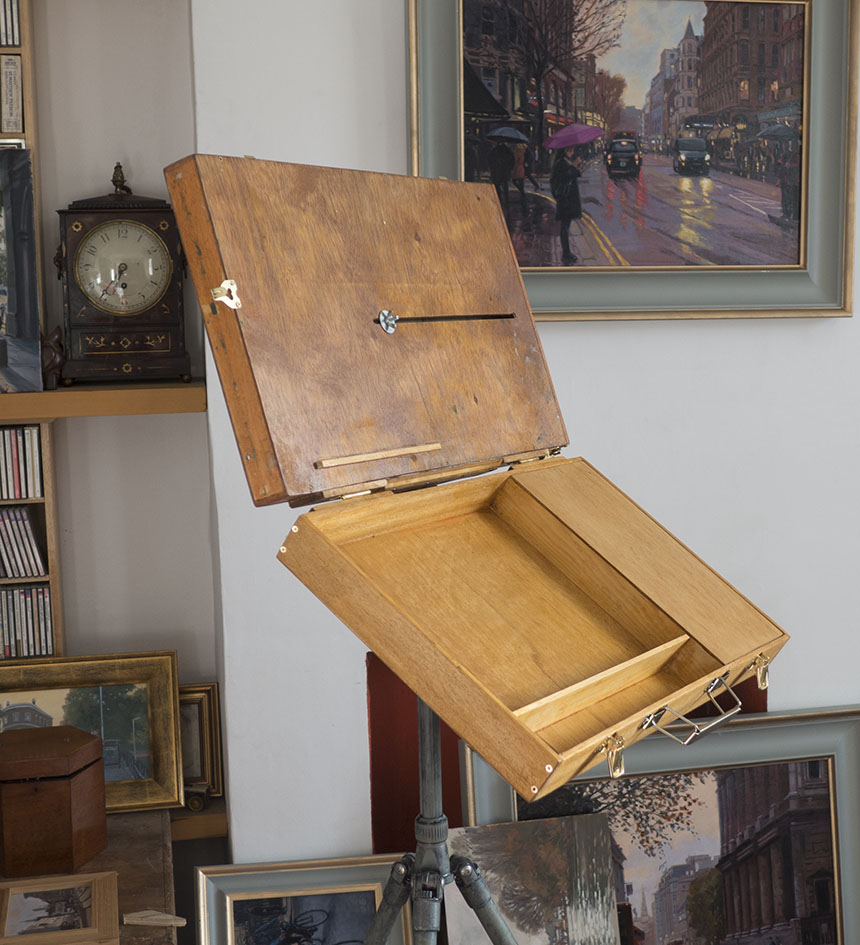
Here it is… a mighty 12in by 20in. It is still light, but would be a bit of a handful in the wind! Due to the size it has some storage so I should be able just carry this and the tripos which will make quite a light set up for its size. Next I need to work out something for 16in by 20in canvasses…

.
pochade

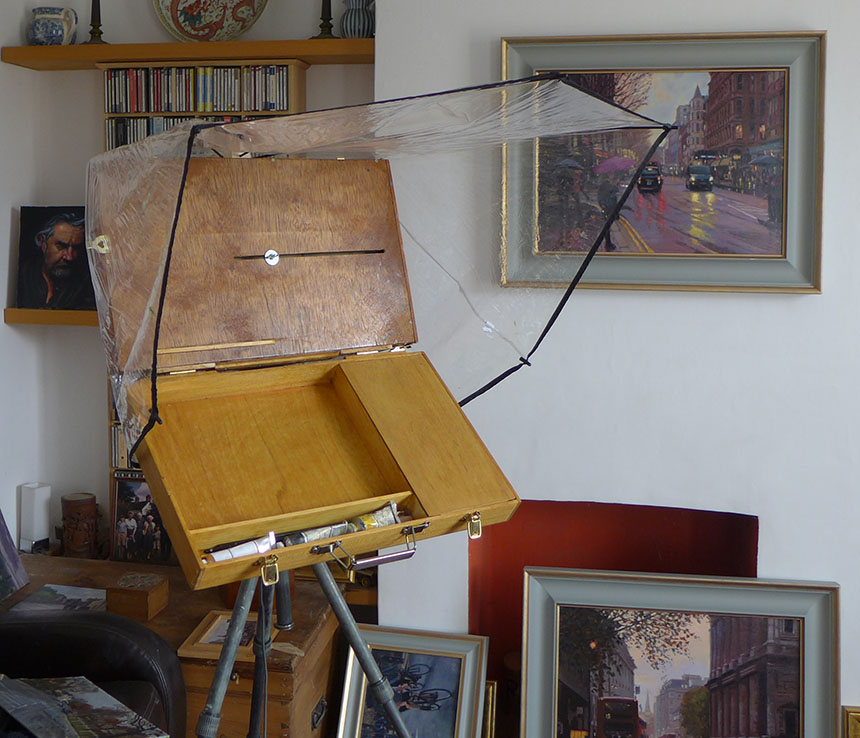
I also created some rain protection from the brolly that bit the dust in Dulwich a week or so ago.

January 13, 2014

Of Convention and the Abstract Nirvana

Filed under: Essex,Ireland,Painting,Thames,Uncategorized — Tags: , , , , , , , , , , , , — Rob Adams @ 12:33 pm

Oh what high reasons we must have to put paint brush to paper nowadays. Looking at a bit of blurb on the Royal Institute of Watercolour Painters one person was reassessing the landscape, they don’t appear to have been referring to any previous assessment which seemed odd. Another presented what looked like a bit of old wall which was really a worried bit of overworked painted paper. He was concerned about almost invisible scuffs and scrapes, pleasant enough in a polite Ben Nicholson, don’t scare the sheep sort of way, but hardly plumbing the intellectual depths. One was keen to be challenging convention, seemingly unaware that the conventions she was challenging had died the death 50 years ago and that almost every artist since has been self-righteously kicking the long cold corpse ever since. Also she seemed to be challenging convention by sticking firmly to the current set of conventions, which as I keep on saying are getting quite long in the tooth.

Yes artists revolted against the stultifying grip of academicism and the history painters and rightly so, but that was a hundred years ago as I have mentioned before. That battle has been fought and won. To present yourself as still fighting the forces of “traditionalism” today in the 21st century is absurd one would think. It all comes I think from the lovely feeling of kicking against the traces. The Bauhaus the Blau Richter and a plethora of others were kicking against real traces not ones long broken by the efforts of others! How easy it is to revolt against something that is long gone and a mere ghost. You can be revolting but still gathered into the bosom of the establishment which thinks that revolution (of the right sort) is the bees knees.

The triumph of contemporary art as we term it is an odd thing at first glance. Most of the practitioners do the most dreary of day to day actions. In fact the drearier the better, so arranging a few thousand tyres into a big submarine or painting a thousand individual dots is just the thing. Personally I would rather spend all day putting the walnuts on a never-ending line of walnut whips as they would give the public more potential joy, but each to their own. Much of it is so little fun it can be safely farmed out to assistants and art facilitators of various kinds. While you as the artist are left to do the meeting and greeting, marketing and partying that are I suspect the mainstay of the artistic life. It is only when you look at it this way you realise what a strong hand modern and post-modern art has.

You don’t have to spend years and years getting skilful at something and then realise you still have an endless amount still to learn. You stand very little chance of being sneered at for your lack of talent. It  brings job opportunities where doing bugger all but appearing mysteriously superior is the mainstay of your day. You have a secure but slightly racy position in the social hierarchy. You have a simple answer to the “What do you do?” question at parties that prompts interest and conversation. You are freed from lots of tiresome social requirements such as consideration of others, modesty and any dress code. All of this and you are also a cool subversive revolutionary storming the barricades of tradition and convention! As the troops that once defended these barricades are long dead you don’t even need take any risk. All in all, what’s not to like?

Well there is a downside. You cannot assess your own progress, as that is decided by others. Nobody really wants what you do except as maybe a counter in a financial game or a notch on a collectors bedpost. You have really not helped anyone much except yourself, which makes for the emptiest of lives. In John Carrel’s “Smallcreeps Day” the protagonist seeks to find out what the part he has been assembling his whole life was actually for. He traces it through the huge factory and eventually discovers that the other half of the factory is devoted to disassembling what has been already made. Returning the parts to bins to be taken for reassembly once more in a futile endless circle. That is why artists talk of reassessing and exploring, they want somehow to feel they are doing work of some social import. Well an artist might cheer an individual life here and there, but to change, reassess or reform society itself is aiming perhaps a little too high. Though taking up the stance that you might be spreading some important message must be good for the ego I suppose.

Another underlying trend is the jealousness towards science. Ever since science has been such a success everybody tries to steal its clothes. The snake oil and cosmetic firms, the nutritionalists and quacks all seek to talk up their work with sciencey words. Even religion wants a piece of the action despite the self evident risks. Art suffers in much the same way. Scientific terms such as investigation, experimental and so forth litter artists statements. As if they are undertaking some portentous and important work of discovery or exploration which will further the wisdom of mankind for the benefit of all. Well I am pretty sure that is not the case. I feel however to make something humble that brings a little light or joy momentarily into somebody’s life is a worthwhile act. But science it ain’t.

Art Historians seem to have suffered from the science bug from early on. Art history became presented as a series of discoveries and advancements to ape the progress of science. So we have the “discovery” of perspective, and the imposition of the progress towards abstraction via the Impressionists. Almost as if abstraction had not existed before, ignoring the fact that patterning and the arranging of shapes was likely the first sort of art mankind made. There is not even the slightest reason indeed why abstraction should be considered an advance. Still artists and  art writers like to plot progress towards abstraction as if by casting off of shallow representational concerns the artist is  reaching towards nirvana and a true purity of expression.

I suppose at some time in the past an artist was a seer. I dare say religion, art and even power shared the same bed in prehistoric times. Even in the Renaissance artists held a special position responsible for encouraging the troops. The power had long since been stripped from the profession of course, but they had a real place in the hierarchy. Oh how we are fallen now. We purvey decorative items for the home and investment items for the rich and gullible. This is not altogether a sneer. I feel making something beautiful that has a place in someone’s home that they may glance at now and again in a pleasurable manner is a very worthwhile activity. Even if the feeling of the owner is partly made up of pride of possession. I have items like that of my own. I have an 18th century watercolour that hangs in my bedroom. I may not notice it for months at a time, but every now and again it catches my eye and brings a little pleasure. What more could an artist ask?

.

Leigh on Sea, Thames, Essex, Brass Monkeys, Plein air, oil painting

Somewhat short on paintings this post, I have been rather busy with commercial work. I have at some stage to stop doing paid work but at least

I have reduced it to a quite small number of days that I like to get out of the way early in the year! The picture above is from the first outing for

the Brass Monkeys this year. It is the glorious mud of Leigh on Sea in Essex. I have put a photo below which shows how easy it is to be over-

whelmed by the scene before you! When presented by such a vista it is very easy to become paralysed by the sheer immensity of it. Also while you

paint it is hard to see your own effort as anything other than a very dim reflection of the real thing. here I tried to get down the feel of the light

first and foremost. The arrangement of boats etc was very secondary.  10in by 16in oils.

.

Leigh on Sea

As you can see my poor wee painting is swamped by the glorious scene! Interesting how the camera sees the whole thing in more cool tones

than my eye. People often say how much better the eye is but I have to say I often like what both see. I often peer at the little screen of my camera

to see what the technological seer makes of the view I am about to paint. Indeed it often gives a very good idea of the main tonal divisions. This is

because the eye had a built in constantly updating tonal adjustment that varies over the whole scene before us. It is like a multiple exposure but can

have a flattening effect because we very often get the mid to dark areas too light. Here we tend to see the mud as bright as the sky, but in reality it is not.

.

Leigh on Sea, Essex, plein air, Brass Monkeys, oil painting

I narrowed the focus for this one. I reality the blues ranged from Turquoise to Ultramarine, but I made them all Cobalt based to give harmony.

I have painted this view before and made a bit of a mess of it so was glad to make a better fist of it this time. I shall do a studio picture from

this day but it probably won’t have the charm and immediacy of these 45min sketches. 8in by 10in oils.

.

Leigh on sea, Essex, Brass Monkeys, oil painting

Last one from Leigh on Sea. The sky had been fantastic all day, I could easily have just done repeated sky studies. The wide horizons make Leigh

a perfect venue for the activity. 8in by 10in oils.

.

Gleninagh, Castle, Burren, Ireland, Plein air, oils

Some of the backlog from Ireland. I didn’t get the chance to do many oils. This is Gleninagh Castle on the wild Atlantic shore of the Burren.

I have painted the distinctive rock formations of the Burren a lot of times now and am beginning to get the hang of the stuff. The blues of

the sky went muddy on site so had to be freshened later. 8in by 10in oils.

.

Camus Bridge, Tipperary, Ireland, plein air, oil painting

This is an un-named castle at Camus Bridge on the Suir. I had only a very brief go at this only half an hour. Though it looks a peaceful scene

I was standing with my pochade on a wall with traffic whizzing past my backside! After a lorry nearly took me out I decided to retreat…

8in by 10in oils.

« Newer PostsOlder Posts »

Powered by WordPress

error: Content is protected !!