Rob Adams a Painter's Blog painter's progress

September 5, 2012

Sun and Rain, Watercolour and Oil

Filed under: Drawing,Life Drawing,London,Painting,Thames,Watercolour — Tags: , , , , , , , — Rob Adams @ 9:57 am

Hurrah, my ‘orrible throat problems have eased enough so that the turps (or any of the so called non smelly solvents) don’t reduce me to a coughing wreck. Such a relief to dump the Acrylics which are I find much harder to paint with. Oils produce a beautiful mark of almost of their own accord, whereas with Acrylics everything has to be worked for. You do mostly get there in the end but it is a fair bit slower.

One bonus of the ailment is that it has forced me to work hard at the watercolours which have taken I feel a step forward. On the negative side reminders of mortality get more worrying as you age. When you are twenty if you get ill you assume that in a week or so you will be better, but as you near sixty you tend to wonder if this is the one that will carry you off! I very much wish I had stopped commercial work a decade earlier, it is more and more apparent that I won’t get all that I want done before I start to decline. Being alive is the strangest of things I’m sure, I don’t understand it a bit. Painting is the thing I find most worthwhile in life after friendship and that in itself is enough reason to persevere. In an odd way painting has taught me more about our very strange existence than all the philosophy books or scientific tracts I have pored over. Though alas it has taught me not one single thing I can really put into words, nor do I think any of those insights are embedded in what I paint. They have of course influenced how I make paintings, but the world around me has given me my best subjects and they don’t really need a subtext or “deeper” meaning. It is I sometimes think the misguided attempt to imbue paintings with significance outside of their simple visual aspect that has caused the painted  works of our age to be to my eye of such poor overall aesthetic quality.

It all comes down I feel to the idea that the emotional state of the artist when creating the object will somehow imbue the thing produced with aura of metaphysical energy. I don’t see very much weight of evidence to support the idea I have to say. Does the vigour of application of paint to canvas or paper really matter to the final result? Artists often give the impression that the painting just “flew” off the brush, but if that appearance is there it is usually a contrived effect, not the result of slapdash application. If anything a painting that has the appearance of bravura application of paint takes more planning than a picture that looks to have been completed in a more sedate manner. It’s mostly Hollywood’s fault of course, the tortured artist struggling with his inner demons is such a great story. So with Michelangelo we get moments of high emotion and arguments with the Pope, but none of the hours and hours of calm quiet chiseling of stone and brushing of paint that must have filled 99.5% of his creative days.

In my own experience emotional turmoil has a deleterious effect on the work produced. Calm confident and focused is the order of the day, not frenzied passion; even if the appearance of frenzied passion is the required end result! So I think that even Van Gogh, the patron saint of the tortured artist, would have been engrossed when painting, if anything finding relief from his mental difficulty in the calming process. Looking back over art history the number of emotional wrecks appears to be quite low, only increasing in modern times due to artists having been brainwashed by overwrought and mostly fallacious descriptions of art being created out of emotional train wrecks and overwhelming nihilism. I think we confuse being inspired by the memory of emotional turmoil and the turmoil itself. During such upsets we mostly cannot paint, but in the calm after we can maybe express something of what we felt.

When I started this blog I thought to mostly write about the practical aspects of painting. I am quite surprised by the direction the written part has actually taken. To some degree it is the difficulty of passing on useful and honest information. Mostly when I come up with any technical tips I can also think of  circumstances where the advice would be wrong. Although I have many tracts on the art of painting I don’t think there is very much I have taken from them. I have flirted with restricted palettes, triadic schemes etc, but at the end of the day I don’t adhere to any of these principles. I just use as many colours as I need and no more. The best guide I have ever read is James Gurney’s “Color and Light” which is very wide ranging an unprescriptive. His excellent blog Gurney Journey is better and more wide ranging than nearly all the instructional books I have seen.

I will try and do more step by steps though they are a bit painful to do. I dislike them because they never seem to show the slips between cup and lip. I might do one where the whole thing goes horribly wrong and end it with a photo of the painting in the bin! I have not been productive enough really, though I have been doing a lot of pre-planning for upcoming paintings, also designing roller coasters for a bit of dinner money!

.

hammersmith, bridge, thames, river, london, plein air, oil painting

Her we are my first outing with the oils for many a moon. This was an outing with the Wapping Group, and the weather prospects were not good. The

forecast was for a clear morning however so I dragged myself out of bed and on to the train at 6.30 AM. I only just got there in time the sky was already

clouding over and the light past its best. With no time to spare searching for a motif I settled down to paint this 16in by 10in effort. The tones were muted

and I resisted the temptation to overdramatise the light and loose the still morning mood. I might do another studio painting of this as there is a good

picture in there somewhere between this and what the camera saw. This is Hammersmith Bridge.

.

chiswick,thames, london, river, barge, plein air

I walked from Hammersmith along the Thames path to Chiswick with the clouds thickening. When I stared this there was a flash of sun which looked

lovely, so I set about painting the shadow tones bearing in mind I was hoping for the light to return. It did so several times as I worked and each time

I quickly added brights where I saw them. I was not helped by the tide driving me up the foreshore and inquisitive swans trying to eat my brushes!

14in by 10in.

.

Chiswick, pub, plein air, london

Here you see the approaching storm. I had to leave this as a very rough sketch as Derek Daniells and I were caught napping and had to flee to the pub

in a deluge. We dried out for a while hoping for a break but it was a long time coming. Eventually I went out and tried painting the park from beneath

the trees on my last board but it wasn’t much of a subject so I decided to head home.

.

Hammersmith, bridge, London, thames, river, plein air

Once I reahed the bridge again I was faced with this. I vacillated for a bit as I was very tired from my early start but it was easily the best subject of the

day so having no more boards I ragged out my park painting and started on this. As is often the case a strong subject is relatively easy to paint and I had

this finished in under an hour. Looking at it now I think it would make a very good watercolour so I might do another version. 10in by 14in.

.

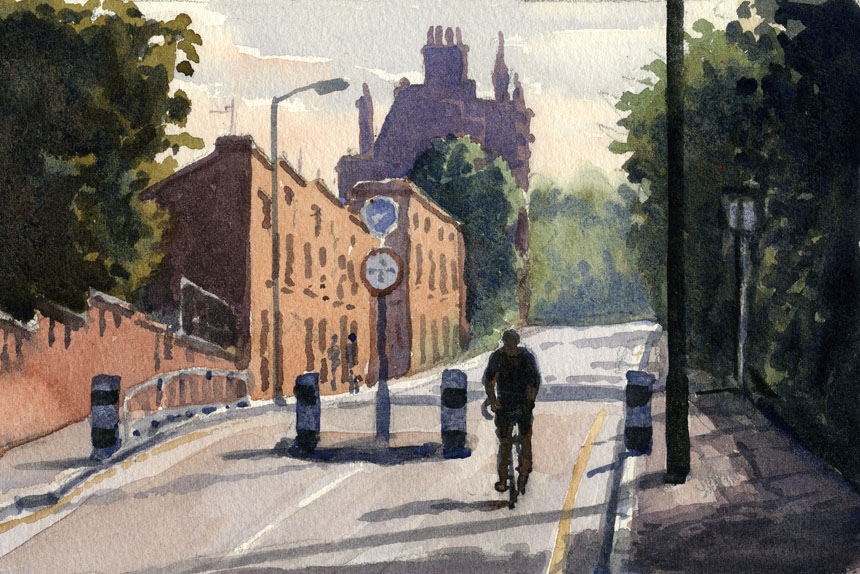
deptford, st johns, london, watercolour, plein air

Sunshine at last! I am trying to do slightly bigger paintings en plein air with the watercolours. This took a little longer than I would like at nearly 2hrs.

I was pretty much guessing at the end. This is St Johns Deptford a few streets away from home. I snapped the cyclists on my iPad and then drew them out

from the screen. They were a gift and perfect for the scene. I have a feeling I am doomed to buy an iPhone as the iPad is a little heavy and I’m terrified

of dropping it. 1/4 sheet Arches not.

.
St Johns, deptford, london, watercolour, plein air

Another St Johns painting done straight after in my little 7in by 5in sketchbook. I am getting addicted to cyclists!

.
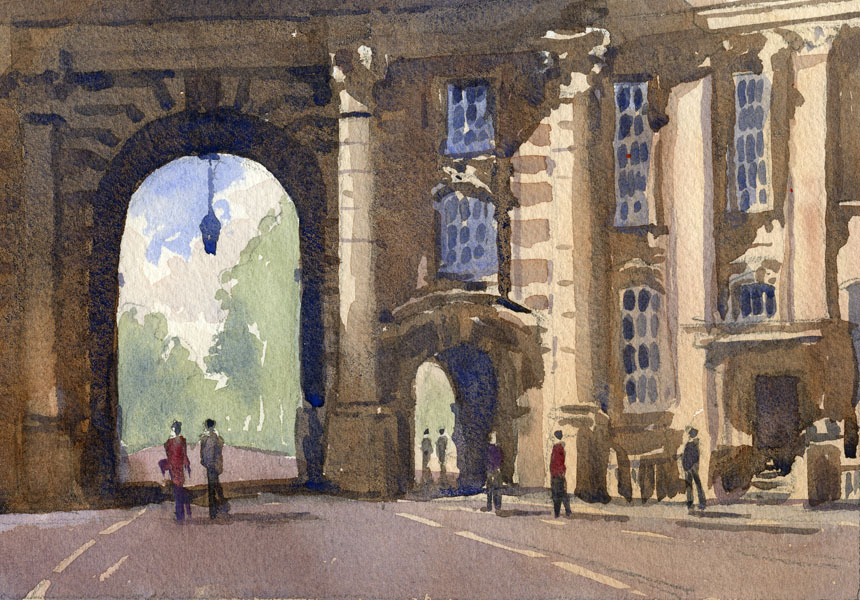
london, watercolour, mall

A trip up to town to buy paint. I had intended to do another study in St Martins Lane but was lured into painting this as the light was perfect. By the time

I was done the light was gone so it will have to wait for another day. This is Admiralty Arch looking down the Mall. 7in by 5in.

.
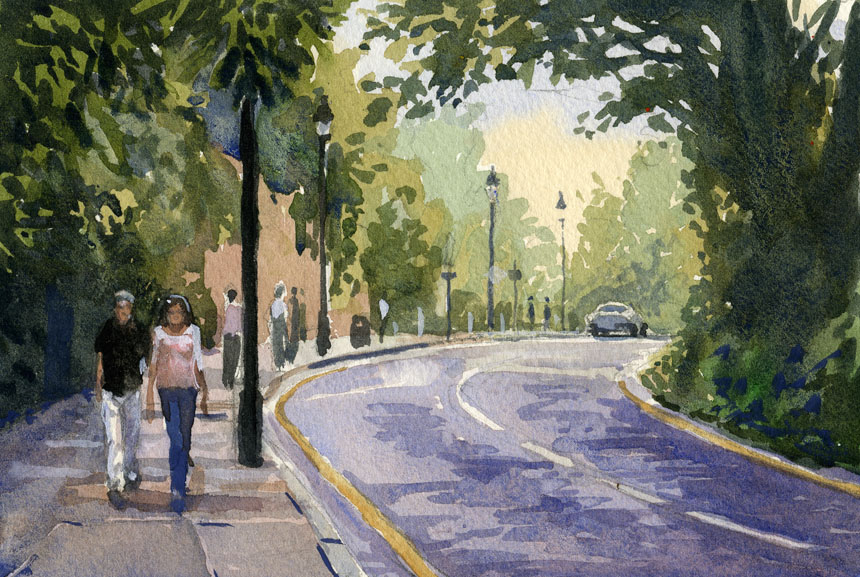
Greenwich, hill, crooms, watercolour

Last one, this is Crooms Hill in Greenwich. With the path in the park closed for the Olympics there is a lot of foot traffic up and down the hill. I am

using my tripod so I can paint standing but it is feels a little over the top for a 7in by 5in sketch book so I must come up with a neater solution to be

able to sketch standing in the street. Also there are many places where a tripod is not practical so another way needs to be found.

.

August 19, 2012

Being Yourself

Filed under: France,Kent,London,Painting,Thames,Watercolour — Rob Adams @ 3:51 pm

A subject I have been struggling to think how to deal with without causing unintentional offence… to my fellow painters I often see the influence of other artists in many a painter’s work. It is often not to hard to guess which painters an artist admires just by looking at their work. There is a point however when inspiration turns to emulation which I have come to think is maybe not such a good thing for the artists concerned. Often I like the work done but it somehow never quite stands up when you see it side by side with the “master” they are following. Why do some artists inspire followers? Two watercolour supremos Alvaro Castagnet and Joseph Zbukvic, both of whom are very fine painters in a similar idiom, are a case in point. There is a spread of artists emulating the style of these two. I assume perhaps wrongly that there is a connection between them as they both lived in Melbourne. Both artists make videos and take many courses, but so do others. Another artist that inspires droves of followers is Edward Wesson another interesting and poetic painter. I don’t think he made any books himself but his follower Steve Hill has published a fair few books and videos, such as “Watercolour The Wesson Way”. A very good painter and friend refers to the many artists who aspire as “The Wesson Clones”!

Artists who inspire such followings are nothing new we can track them throughout art history. But with the advent of teaching and demonstration videos has focused the result away from being inspired by, towards emulation. Being inspired by assumes to my mind the ambition to surpass your master. Whereas to emulate seems to mean follow in the footsteps without perhaps the ambition to out do. The difference between “I want to be better than” and “I want to be as good as” maybe. One thing that strikes me about the styles that inspire a following is that they are demonstrable, by which I mean an artist can produce a painting while the cameras are rolling or the students are watching. Also the painting methods have a degree of what I call conjuring. I remember being entranced as a child by Rolf Harris doing big broad brush paintings and asking “Can you see what it is yet?”.

I have had many influences myself, some good some not so, from Frank Frazetta,  Edmud Dulac, Rackham, Alex Raymond, Chris Foss, Alan Lee, many Marvel comic strip artists, and book Sci Fi jacket illustrators and onward to Singer Sargent and Sorolla by way of Trevor Chamberlain. In each case however they have all gone into the mix, and been mostly assimilated. I might have done a few “in the style of” at the height of my interest, but once the lessons that seemed relevant to me had been learnt, I tended to move on. Some of the influences were perhaps negative. I was over fond of dragons, castles and languid maidens. Which in my hands became rather kitsch. I could very likely make a better job of such subjects now but the desire to do so has somewhat faded.

I bring this subject up as I am trying to decide how much I wish to take from other watercolourists. I do I feel need to refine some of my techniques so looking at how others do it is a sensible first port of call. On Joseph Zbukvic’s site there is a great video and interview of him doing a painting which demonstrates the reasons for some of my ambivalence. Both he and Castagnet are in some respects technique driven artists. That is to say the method of carrying out the work is determining what kind of work is done in the first place. They both paint in very wet, large washes with a quite limited and mostly unvarying palette and therefore tend to mostly tackle subjects where this technique will work well. Despite the limitations this is an interesting method that I can see many uses for. I have actually gone through a previous period of experimentation in this area but I didn’t find it suited the sort of architectural studies I was painting at the time. If you are painting a picture where the ambiance, light and activity of the whole scene are preeminent then this broad brush approach works well as it reduces any architecture to stage props. But if you are painting the facade of a gothic cathedral where the architecture is the focus then having all the windows blurry blobs is not such a good idea. Although I quite admire the painters I have mentioned and they paint some gorgeous pictures; I find their repeated insistence on passion and looseness a little confusing. As far as I can see they are selling technique and their style requires technical excellence more than almost any other. This is not necessarily a bad thing to my mind, but it is their stress on expressiveness and confidence I find a concern. Such confidence comes from technical expertise and experience, so it must be built up by many hours or more likely decades of practice. This facility is unlikely I feel be be developed by watching a couple of DVDs or going on a painting holiday!

There are plenty of videos on uTube of people splashing the paint around in this mode, the accent is mostly on simplification another over stressed area of desire in my opinion. Simplification or reducing to the essence , it is true, is a hard thing to learn, but complication is a tool also and a powerful one in the hands of such as JMW Turner or Alan Lee. The trick is to use both simplicity and complexity in ways that help the whole picture. I tend to think of this now as “telling” detail.

So my advice to any aspiring watercolourist or any other medium, is to be inspired by another artist and steal what ever you wish. But don’t try to paint pictures that ape another’s style too closely, always try to absorb what you need into your own style. To that end it is maybe good to take from many varied artists rather than proponents of single narrow styles.

That’s the chat over with… a few pictures.

.

france, waterclour,ships, boats

This is a studio painting from my Brittany trip. This is called a marine railway and is used to get the fishing boats out of the water for repair. I’m working

on stretched Arches not 140lb, which I rather like for this kind of subject.

.

dog, rain, watercolour

Stretched paper allows very wet working which I have exploited here. I am as I said above trying to absorb the very wet process into my work but without

letting the technique turn into a collection of slick tricks.

.

thames, river, watercolour

Another from my afternoon in Richmond. This is Isleworth seen from across the river Thames. Painted with the paper stretched on my Keba Artmate.

The device stretched the paper tight as a drum, as there is nothing behind the paper it has a pleasant bounce to paint on. Arches not again.

.

city, london, waterclour

Here is a cityscape using a deliberately loose style. The method does suit this sort of scene and is good at expressing bustle and the transitory moment.

I drew out quite accurately then painted the whole thing with my enormous 14 squirrel mop. Done on stretched Arches rough 140lb.

.

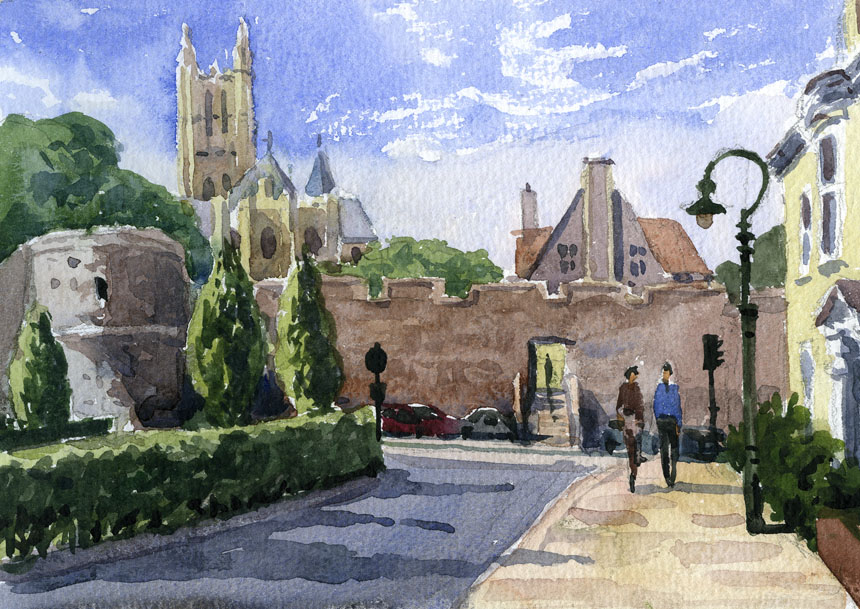
cathedral, canterbury

As it was a lovely day I decided to visit Canterbury. A lovely town destroyed by tourism alas. I rather disconsolately wandered around and was in the end

forced to paint away from the centre as it was impossible to paint amongst the throngs of visitors and the hucksters that prey upon them.

The cathedral is surrounded by a high wall and ten quid to get in… I rather rushed this as it was blowing an absolute gale which made it very tricky.

9in by 6in.

.

bicycle, canterbury, watercolour

A back street in Canterbury. I was a bit cross with myself for rushing the last one so I took my time here I drew out the cyclist in my little sketchbook before

drawing her in I really must force myself to do that more often as it makes a big difference. 9in by 6in.

.

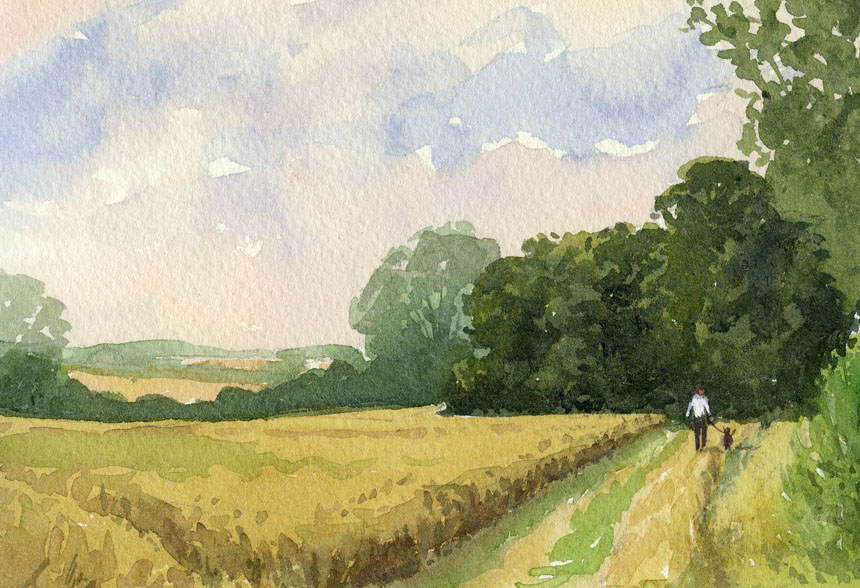
dog walker, north downs

I escaped Canterbury as it was just too busy and drove along the North Downs, did this in my little sketchbook 7in by 5in.

.

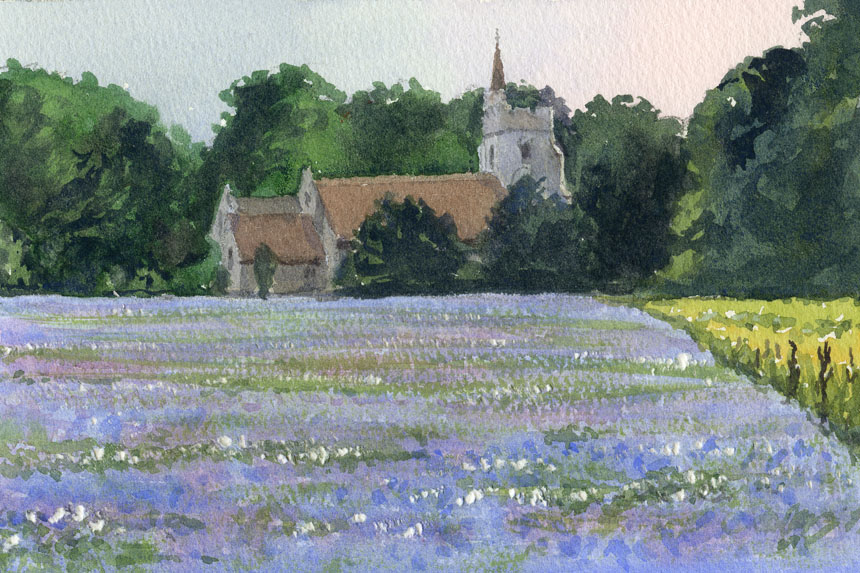
Kent, Sheldwich, flowers, field

I drove through the lanes to get home and couldn’t resist this scene of St James’ at Sheldwich, the meadow was a riot of blue mauve and white flowers.

7in by 5in.

.

car, girl waterclour chilham, kent

This is Chilham done next day an almost too perfect English village scene saved by having a flash car in it!
1/4 Sheet Arches Not.

.

london, charing cross, street, watercolour

Another big brush effort. This is Charing Cross Road basking in the afternoon heat. One of the advantages of the style is that this only took about

40 minutes. 6 a day I could be rich! More seriously becoming more adept at this style will allow larger plein airs to be done. At present unless the subject is

quite simple I struggle to get a 1/4 sheet done before the light has moved on. Arches rough 1/4 sheet.

« Newer PostsOlder Posts »

Powered by WordPress

error: Content is protected !!