Here we are again. I am trying to increase the frequency of painting to 5 paintings in a week. It doesn’t seem much to ask but somehow I seem to miss 10 days have gone by but only 6 watercolours seem to have got done. There has been a conflict of interests though as I also decided I had to attempt to raise my game quality wise too. This is altogether a harder thing than just knocking out paintings. I have been painting long enough that with most scenes I can pretty much always get a decent painting done, say 1 in 10 has to be binned as an epic fail. However some paintings fall into the worthy but a little dull bracket. That said I don’t much like pictures that reach out and grab you as they often pall with longer acquaintance. Inevitably much I see in exhibitions falls into the grab you category for obvious and entirely sensible reasons. What I am attempting of late is to inject a little more storytelling into a picture, what is termed “narrative”. I had thought I could move no further from fashionable tastes, but this allows a step deeper into the critical void I suspect!
Initially works of art were all narrative really, like comic strips. The discovery that such things were decorative came next and potentially moving last of all. Todays painter grapples with the problem that primarily a work must engage with the emotions and thoughts of the viewer. You must not tell them so much that there is no room for interpretation, indeed the spaces left for interpretation must be carefully considered as it is these that trigger the emotional response. A figure in a painting always provides a “hook” as we automatically start to make up stories about any human figure if we are allowed room. Allowing room is something groups in the 19th century for example especially failed to do, with paintings designed to carry a definite moral lesson and propel the viewer into righteous thought. As a result we don’t really respond to these works as a Victorian would have. Unfortunately vapid sentimentality seems popular in any age, but I’d rather take up professional scrabble that go down that route.
So I have decided to be somewhat more focussed on what is going on in certain of my studio paintings. That in turn means more work in the initial drawing stage. For me that has been what I was taking a holiday from in some respects. As an illustrator fulfilling a brief the drawing stage plus amendments could turn out to be a very long drawn out and tedious affair. It could go on so long that much of the pleasure of doing the final was dulled. There is a real danger that in over doing the planning stage you deaden the final result. So I want to try and find a balance between decisions that need to be made first and planned and one that need to happen as the final picture progresses. There are actually quite a few decisions that need to be made as the picture progresses since you need to have the progress so far to see clearly what needs to be done or not as the case may be.
When painting from reference this is how I see the process (I am just thinking this out as I type!):
1. Seeing a potential picture. This happens at the photographing or sketching moment. There is something however slight that makes you stop and draw or press the shutter. I look for pictures all the time by reflex. It is easier in some places than others which is why they are called picturesque! I like this sort of picture less and less though. What I hope to find is a moment when the atmosphere is memorable in an unexpected but still beautiful way. A lovely scene on a lovely day will always look much the same, there is an example of one of these later in the post. A different day might transform the same scene entirely giving it a completely different emotional resonance.
2. Reviewing the candidate. Most fall at this fence. When you look at the image away from the place itself you see if it will stand up as an independent picture. Some are just not going to cut the mustard, others need adjusting and editing. It is here where sketching out helps. I just bring the image up on screen and scribble over the top in Photoshop. I also do a few small tone scribbles on paper if I need to.
3. Deciding what the feeling of the picture should be and how to compose it to maximise the desired atmosphere. You don’t always want a composition to be balanced. Sometimes tension can be introduced by conflicting draws to the eye. An elysian scene might want perfect equilibrium in it but a picture of a dirty backstreet might need an uncomfortable edge. Or these relationships can even be inverted with a perfect scene given a disturbing air either by a visually jarring inclusion, or an uncomfortable arrangement of otherwise cosy elements. Or a gritty urban scene transfigured for a moment into an unexpected beauty.
4. Assembling the elements. If I am working on a street scene this is obviously more important than in a topographical picture and so takes longer. With a scene where the people are going to be an important element a great deal of thought has to be put in. Firstly figures have to be found that are right for the scene and also not clumsy. Most photographed images of passers by are caught in inelegant poses. What I look for is a good silhouette, if the figure is understandable from just the outline then it will probably work fine in a painting. Then the key elements need arranging within the scene and adjusted so that they have an interesting arrangement. Once that is done any supporting figures and props such as cars, street furniture can be placed.
5. Editing. I now look for anything that is not needed. This is one of the hardest parts but generally if an item can be removed without harming the story it should be taken out. Similarly if a supporting figure is too prominent then it can be weakened by adding others to make a group. I look at this moment to introduce some “quiet” areas where nothing much is going on. Conversely I might also look to “busy” up an area to add rhythm and texture.
3 . 4 & 5 sort of all happen at the same time, I have just attempted to split them up for clarity. When I am writing these spiels I am usually attempting to put over something I have never needed to translate into words before. I often find that in the process of trying to express what I mean I need to reevaluate what I had thought in the first place, which is really quite useful and an unexpected bonus from blogging. First a new crop of paintings then a step by step… which are quite the most off putting things to do as you can’t lose yourself in the painting, which in turn means the chances of them going pear shaped are all the more!!
.


Here we are in beautiful Faversham. From a snap taken on my last visit. As you might imagine it rained in buckets shortly after! Here I wanted three conflicting points of interest. A tonal interest, the contrasting edge of the white building. A colour interest , the red van. Lastly a human interest, the girls. If you do this the eye can’t really settle, which in turn hopefully means a better appreciation of the threatening sky which is the defining ingredient of the painting. This painting got slightly changed after this scan as I connected the dark tree down to the blue car because I didn’t like the break which isolated the tree.
.
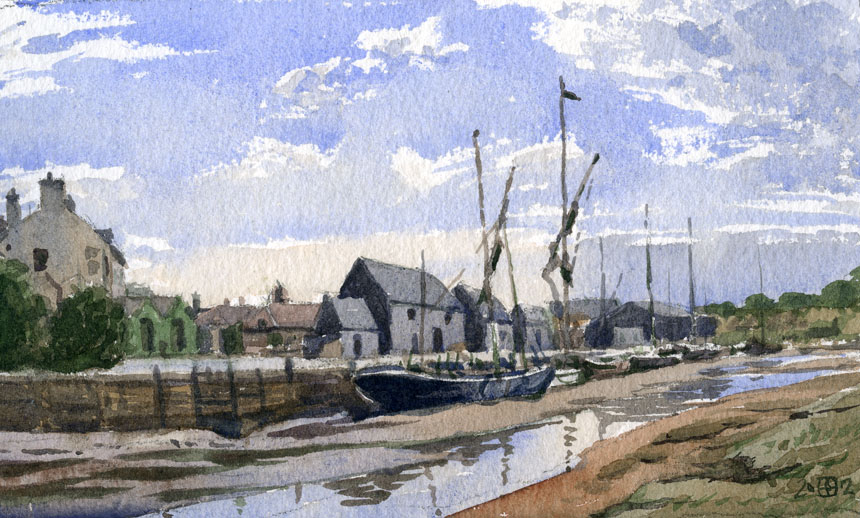
Faversham Creek, a rain stopped play watercolour that I just got round to finishing. 10in by 6in.
.

Here is one of those famous “picturesque” views I mentioned earlier. I sat with a pint of Guinness from the nearby pub and painted this in about an hour. A passer by bought me another pint which made the closing stages a little wobbly! Although it is a lovely scene, I would like to paint it in more unusual light or do something more with the composition, not anything you can do plein air however. The view is of course the Thames from Richmond Hill as painted by Turner and a host of others. The foreground needs sorting to allow a better flow. I did add the break and reposition the path but it needs more.
.

This is the White Cross pub in Richmond. The Thames regularly comes up and maroons the clientele, not that they seem to mind. I stood shin deep in water to paint which was novel. I didn’t get finished though, I just got the drawing and the first broad washes in to establish the mood then took photos of the people until I thought I had enough likely suspects to populate the painting. I know I’m a wimp but despite it being July that water was cold!
.

This is a complicated one, I had great fun arranging all the different elements. It is a restaurant in Cancale France. I ate my lunch there and sneakily took pictures of diners and passers by as I ate. The lady with the dog was so wonderful I had to make her the star. Unfortunately there was no sun when she passed by so I had to invent the lighting. Arches Rough 18in by 10in
.

This is also from my Brittany trip, I am slowly working through the studio paintings I have planned. I loved the contrast between the very grand St Malo, destination of the very wealthy and their yachts, with the very unglamorous day and small car. Keeping control of the first wash was all important here.
.
Now a step by step… I don’t often do these as I mentioned above, they are very annoying to do.
.

Here is my starting point. It is a stage with out actors at the moment. What took my eye was the light streaming across from the top left and the lovely shadows. As I carried on I kept turning and snapping cars and cyclists as they came past on their way home. Once I got all this on screen I made a very rough montage and then a simple line drawing from that. I keep the line drawing as basic as possible the tonal information will be based on the photo so is not needed in the drawing.
.

Here it is, I only want to transfer key lines to the paper. You can see the various changes I have made. I have tried to arrange the components to enhance the feeling of going home on a fine evening. The cyclist is the focus and is fixed to bottom of the picture by his shadow. The man and the other traffic act as blocks preventing the eye escaping down the road. The drive cutting the pavement on the right does the same job by cutting off escape via the right hand corner.
.

Here it is laid down on the paper. In this case I have traced it using tracedown as it is a very clean way of transferring the image. Sometimes I use a grid sometimes I just draw by eye, sometimes I just jump in with the paint… who the hell cares! You should however develop the skill to do a painting by any of those means.
.

Here is my first wash. Many purists go on about wet into wet as if it is the holy grail, but once again you should master that and any other technique they are all just tools in the box ready to be got out when needed. The worst reason for painting a painting in a particular way is to fit in with some style or other. Judging this first wash is very important and I tested it against my possible tree tones on a spare bit of paper. I was careful not to leave any hard edges.
.

Next up is the road which is the biggest area. This is done with wet into wet, lifting out and then dry brushing. These are the lightest tones But I don’t want more than two more washes on top of any area and ideally only one. I protected the highlights on the cyclist and the road markings with masking fluid.
.
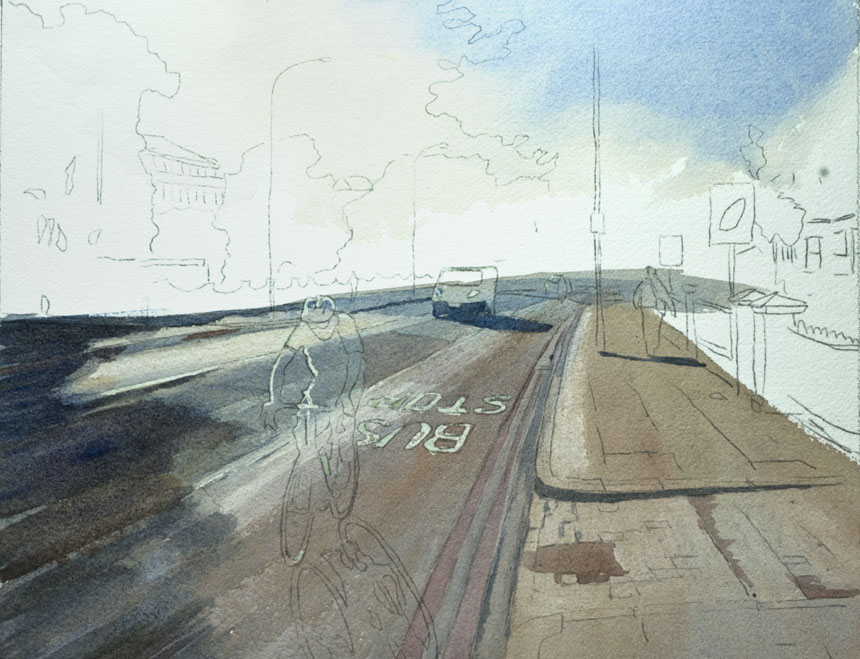
I have carried on here getting the variety of tone in while the wash is still drying. I drop darks into the tree shadow in stages building up the density but trying to hang on to the transparency and not allow it to go “dead”. I don’t worry too much about the boundaries as these areas are quite dark. I add the first of the shadows to cheer myself up as paintings look pretty grim at this stage!
.

Here come our darks. again wet into wet on the left, becoming crisper and dryer as we go to the right. I am keeping in mind the light burning out the top left by washing back with a dilute blue.
.
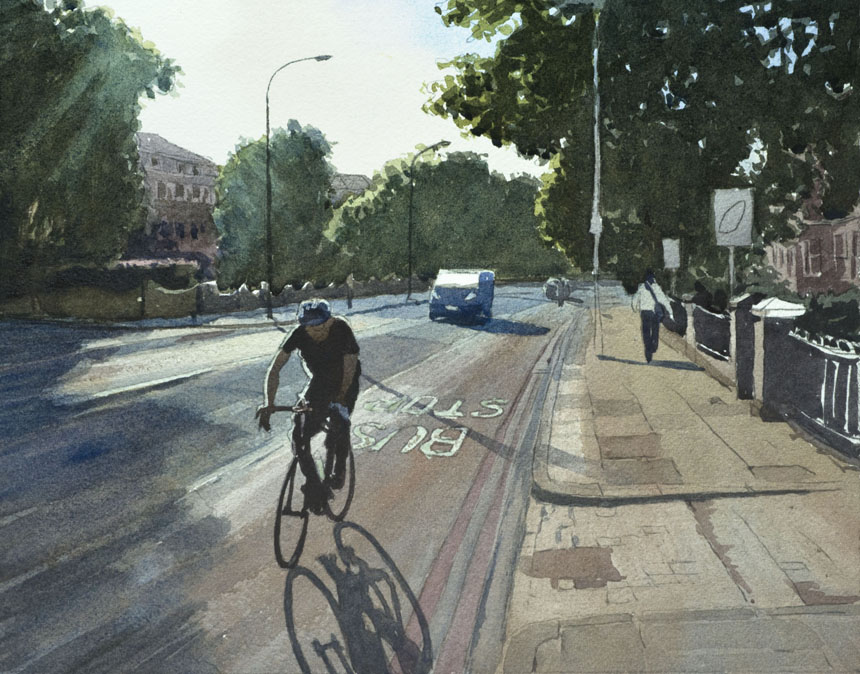
Time to get rid of those pesky last bits of white paper! At last we can see what we have. In some ways this sort of painting is much harder than a wet into wet process. With that method you can see the whole painting from the start, the St Malo painting above was done that way, but once you start breaking the work into areas that have to go in cleanly without too much alteration then your tonal decisions have to be very accurate. To much change to an area will kill the surface quality and make the painting go dull and lifeless especially on the Not Arches that this is painted on. I try my best to keep the painting accurate but not tight so the cyclist and his shadow are painted mostly with single strokes guiding the wet paint with as little “filling in” as possible.
.

Here we are, all done. I am careful to stop as soon as an area feels described enough. I could have added more detail in the cobbles for example and would have really enjoyed doing it. But over painted cobbles would have detracted from the whole so restraint is needed! There is a touch of red Gouache on the lines and some scratching out to add sparkle to the road. Beware of overdoing scratching out it can easily ruin a painting but it is a very useful method if used with discretion.