Rob Adams a Painter's Blog painter's progress

June 15, 2015

The curse of the category

Filed under: Drawing,London,Painting,Surrey,Thames,Uncategorized — Tags: , , , , , , , — Rob Adams @ 10:18 am

I am of course going to consider the penchant we have of pigeonholing. We love to sort things into groups and give them names. Then we can ascribe other qualities with a broad and uncaring brush. With life forms we call this taxonomy. With paintings we use  categories based on style, content, historical period, use, intent etc. So if we have a painting it might be an illustration or a decoration or fine art and so forth. With taxonomy the rules are clear a life form cannot be a member of more than one genus. With paintings however a work might be comfortably placed in several. So one of Raphael’s frescos in the Vatican might be a) a work of art, b) illustrating a theme, c) decorating a room. d) an example of renaissance painting. Not so easy here to differentiate and put into discrete categories.

In conversation with other artists they all seem to agree with the current wisdom that contemporary illustration cannot be considered fine art. However if I ask, “Is Rembrandt’s “Feast of Balthazar” fine art?” they say yes it is. I then say but it is an illustration of a biblical event. I might get the reply that it was a personal response to a story by the artist. I add that actually it was a commission. Then the conversation usually goes down hill from there. Despite it being true in earlier times artists today generally seem unwilling to allow illustration up on the pedestal of fine art, but do wish to share the pedestal with great works of previous eras that I think fall comfortably into the illustration category. I have had this conversation many times now always with the same result, people believe that illustration is somehow inferior in the aesthetic stakes, but cannot come up with any cogent argument as to why that should be true now but not in the past.

So what is going on? This post is as much to pick the arguments apart for my own benefit as to promote any views on the matter. I have been both sides of the divide, so maybe that gives me a perspective on the conundrum that gives some small insight. Another area where this effect is seen is literature. A book can be a work of literature, or a genre. If it is genre, say a detective story, then the Booker people are not going to be interested whatever the literary merits. All genres are not equal of course, “historical” is above “mystery” which is in turn above “science fiction” which is above “romance”. These categories are to do with marketing not the end product not with the quality of the wordsmithing in-between the covers. However critics and most readers appear to use the marketing category to assign aesthetic worth. I have lost count of the number of times  have recommended a book only to have someone say, “I don’t like science fiction.” I ask have you read any? They say “No” I say have you read “Brave new world” They say, “Yes.” I say “Aha! That’s science fiction!” and once more the conversation goes downhill from there. One thing is always the same, no one will reconsider their opinion and when they have the basis of that opinion questioned and find they cannot justify it they seem to hold that opinion even more firmly that before.

If you think I am going to give the impression I am above this trait then you would be wrong. If you read Daniel Kahneman’s “Thinking, Fast and Slow” you might reluctantly have to admit as I did that many of our opinions and most of our intuitively held views are very poorly founded and often wrong entirely. What Kahneman shows is that even when this is pointed out to us we still cleave to our previous opinion because it is programmed in at a lower level. This part of our minds delivers snap judgements on anything and everything without the need for cogitation. In everyday life this is wonderful as it gives us a way of dealing with a hugely complex world that would overwhelm us otherwise. We could not possibly take the time to reason through everything in life.

This process works with pictures too. People often say that they don’t like this or that sort of painting. Choose your genre, say Pre Raphaelites. This is one that has caused me a deal of difficulty. One of my first experiences with paintings in galleries was at the Birmingham Art Gallery. Is a boy of twelve or so I was entranced by the glowing colours and did not know to dislike the sickly sweet emotions portrayed. Later when doing a degree in fine art I learnt to dislike them as was de-rigueur in a college of that period. So I had two opposing instinctive responses to that kind of work. If I was a computer I would crash and need to be rebooted, but humans are made of sterner stuff and can believe both opposing views at the same time! If I stand back and am analytic then I would have to say most of the Pre-raph output is average to poor, but I can find some gold amongst the spoil as well. IE exactly the same as any other genre or period of work. Nonetheless despite knowing that when I first glance at one of their paintings it is the unconscious assessments all be it conflicting that are first through the gate.

This also works with positives. We might be educated that this or that artist is “important” this in turn makes us see the works in a different way that has less to do with the actual visual stimulus being received than we might imagine. This was brought into focus for me a few years back when I saw a huge Van Gogh exhibition in Basel. I arrived with the learnt and unquestioned opinion that he was one of the all time greats and a pivotal figure in painting. I believe there were 14 rooms in total in strict chronological order. I was entranced by room 13 where his works take on a visionary glow, then less impressed by room 14 where derangement sets in. Puzzled I went back and did the first rooms again. When I really thought and looked as dispassionately as I was able the early rooms were almost entirely between dreadful through to dull but worthy with the odd bright spark of things to come. Looking at the time line it would seem that Gaugin’s influence was the key to Van Gogh’s brief transcendent moment. Van Gogh’s paintings from that period are lovely and decorative, but did they inspire later painters to paint in that manner..? Well like most idiosyncratic artists such as Blake, not really as the manner is so personal.

It is very hard for anyone including myself to separate out the received wisdom on Van Gogh as our subconscious has been so well primed. This is not really a problem for a gallery visitor, as they will enjoy the works and not be concerned as to the genesis of their reactions. For an artist it is a different matter, we need to be able to pick out concrete factors that might lift our own work a step up. I am afraid that the knee jerk assessments of our subconscious really do not help in this regard. My intellect tells me that all types of painting from illustration to portraiture to abstraction will throw up up high peaks on the graph of excellence, however personal and intangible the factors that make such judgements are. For myself I try to look out for these highs wherever they might be found. As we all do I will inevitably miss many that might hold useful inspiration merely because my lazy conscious mind is on autopilot and being steered by the unthinking and largely unfounded judgements delivered up by my unconscious. I feel sure this trope will have neither  convinced nor unconvinced anybody, but any contrary argument not founded on opinion would be welcome, especially if it confounds me!

Only a few paintings since last post, I am gearing up to go to France, so the next post will have a continental flavour!

Fulham Palace, London, Plein air, Brass Monkeys

This is the gate to the walled garden at Fulham Palace. It was drizzling and very quiet so I was happy painting away. I loved the soft tones that the rain gave. 8in by 10in oils.


Fulham Palace, oil painting, London, plein air

The rain really set in after we had had a leisurely sandwich and coffee. I was lucky, sheltered under a substantial tree, others of The Brass monkeys were out in the full downpour… This is the main entrance to the palace, it is a lovely place that the tourists don’t seem to find. 10in by 8in oils.


Hampshire, Fordingbridge, plein air, oil painting

It is hard to believe that this is the same day! After leaving Fulham I drove back to Dorset via the New Forest. This is Fordingbridge, this scene looked so lovely I decided to stop and paint. Hard to get a good viewpoint, in the end I parked my car conveniently for me and inconveniently for everyone else and painted from in front of it. I was forced to be very quick so this is about 30 minutes worth. 10in by 7.5in Oils.


Richmond, surrey, oil painting, plein air

This is Richmond Green on a day out with The Wappers, I have painted this corner a few times before. This time I really struggled, the first one from a different angle I wiped off. Then I started this but just could not get it to gel, I had bollards across the foreground and some near figures. I had it up on my kitchen dresser for a few days and decided in the end the story was about the line of activity running across the lower third. I took out everything that conflicted with that and suddenly I had a picture. It is always gratifying to rescue a painting that goes astray! 10in by 14in Oils.


Richmond Hill, Pen and Ink, Wapping Group

Before I did the last painting I did a couple of pen drawings. This is Richmond Hill, I love the simplicity of the medium. I have a lot of these drawings now and wonder what to do with them. People don’t buy drawings really nowadays, I might get some printed up into cards.
 

Richmond Bridge, Pen and ink, drawing

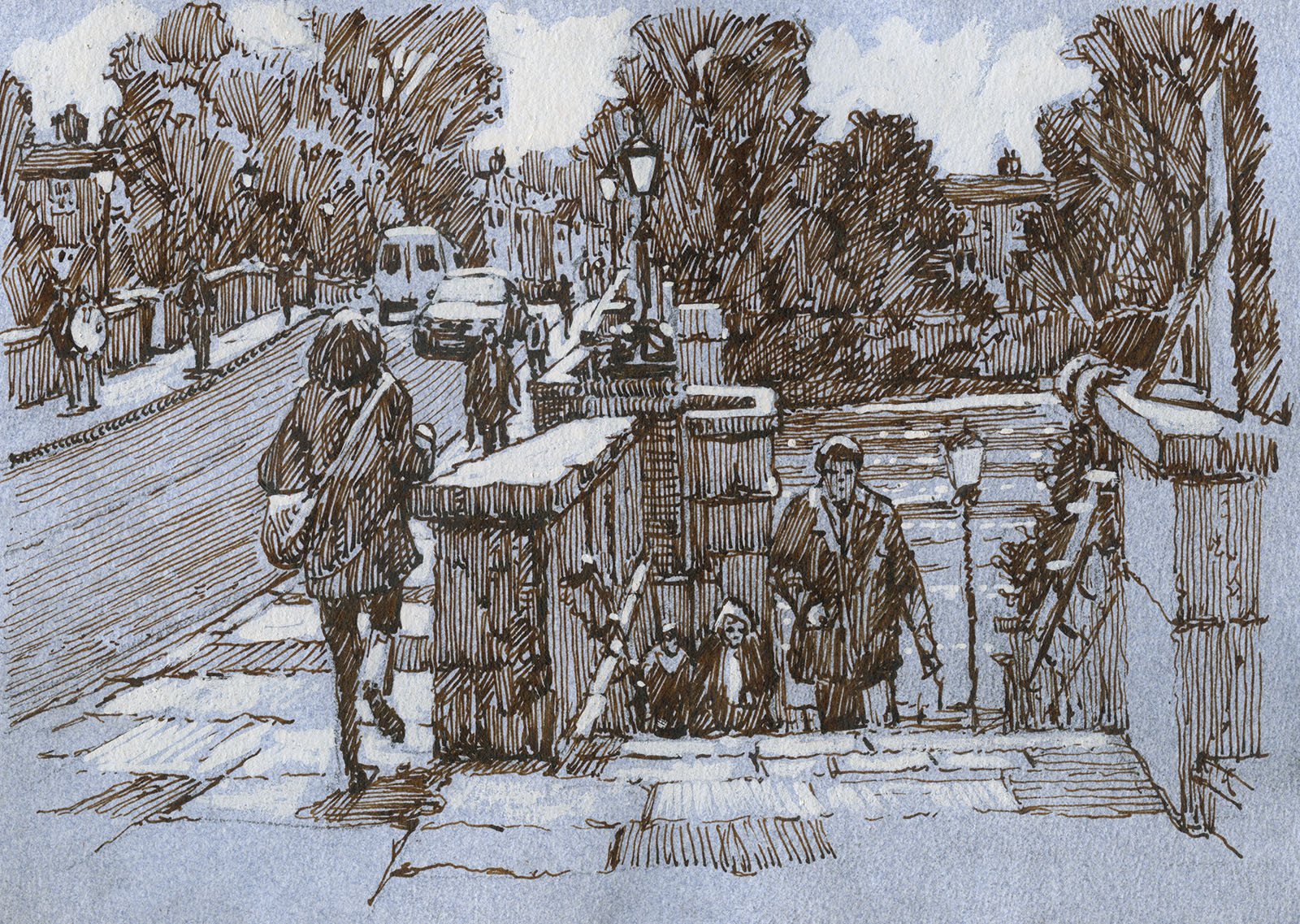
Last one. This is Richmond Bridge. It is quite hard to find new views on the River front. This one had taken my eye a few years ago so I decided to have a go at it. Though it looks simple it was avery difficult subject with lots of elements that needed to be right. I did a much more careful pencil layout than normal. I shall do a painting of this at some stage.

May 7, 2014

Why bother?

Having been a commercial artist, illustrator and designer for 35 years or more it was with a certain amount of relief that I gave up most of my paid work. I told myself that I would retire and just paint. I am not hugely wealthy but my career was pretty successful and I am a saver rather than a spender, so painting does not need to bring in large earnings. However as you can see by looking back through this blog I have not exactly settled down to a life of relaxation and leisure.

My question to myself is: Why not?

Not as easy to answer as you might expect. Yes I love painting. Also the connections and society that comes with swimming with the other intriguing fish in the art pond. It is without doubt the pivot around which my life turns. On the other hand it also is the source of most of my feelings of inadequacy and frustration at vainly groping for seemingly unreachable goals. Painting is after all a banquet of repeated failures garnished with a few sprigs of success that all too quickly wilt.

I don’t think I am lured on by success and the possibility of “making it” as a painter. I am a bit old for that I fear! I care not a fig for posterity or whether my work lives on. I have no belief in afterlives so it is only the here and now that matters. I don’t need it as a prop to my identity, indeed I only reluctantly and uncomfortably admit to others I am an artist. It is true a major ingredient in the mixture that comprises and has shaped my “self” has been art and the getting of skills related to it.

Much of it of course comes down the unavoidability of being alive. There is no escape from you own thought processes. They even bubble away when you are mostly unconscious at night. We cannot take a sabbatical from living, existence offers no possibility of respite whatsoever.  The river of being might flow slowly, churn into rapids or fling itself in a turmoil over falls, but the movement downstream never ceases until it reaches the sea. You must therefore navigate its currents and eddies in your fleshly canoe desperately paddling to avoid rocks and whirlpools or drifting through gentle backwaters. Whatever course your river takes there is no stopping, if your canoe is grounded or you draw it up on the bank there is no relaunching into the stream.

All of this is obvious I realise and I do not complain. I don’t wish as eastern thinkers do to stop the flow. It is not possible in any case, you might sit still with little or no mental chatter, but pretending to be merely a stone is just that… pretence and perhaps just another form of vanity. Sticking to the now rather stretched river analogy we each perhaps to a greater and lesser extent follow different flows and cross currents in the general flood. Some might drift in quiet waters near the bank while others toss and churn in the white water. So painting perhaps provides me with a means of navigating the wider stream, a discernible course around which the darts and eddies of the rest of my life can form.

In turn this gives me maybe some insight as to the benefits painting brings to the painter. Painting gives you a platform from which you can observe the world. You are looking for pattern and structure both actual and emotional and in looking, breaking down and sorting you gain small insights into more general things. Learning to draw and paint in short supplies the intellect with a glass through which to view things. However once that glass has been put into place all other things are inevitably seen through it.

Any learning has the problem that it cannot be unlearned very easily. Having learned what a cat is you can never view the animal as an unknown thing again. This is why the common artistic aim to “see like a child” is rather foolish. If I try I will not see like a child. I will merely illustrate how an adult imagines it might look if they could possibly once again see like one. I don’t want to pretend any other view point other than the one I have. Just attempting to understand who and what is around me is more than enough.

So, why bother? Well by looking and striving to set down what I see, I become more perceptive in my particular form of study. I hone my abilities to look and distil meaning from the sensed world. Because I have gone through this process I see things, small wonders, that others might miss. By attempting to paint them there is the occasional chance that others can see for a moment through my eyes and share in that beauty. Indeed, now I think of it, that is exactly what I get from the paintings of others that hit the spot.

It also gives me a measure for judging works of so called art. There is a difference from an aesthetically pleasing object to one made with hard won insight and skill. Almost anything can be rewarding to consider and look at. You can look at almost any object and have an aesthetic, educational or meditative experience. These feelings however come from within, the object is just the initial stimulus, a catalyst if you will. A real work of art hopefully lets you see for a moment through another’s eyes, share in another’s perception, stand briefly in a place you could not have arrived at by yourself. The artist has by years of effort mapped the terrain over which they have travelled and set down their findings upon a surface so that others can appreciate and take pleasure in it.

To illustrate the divide, take a work that is hailed as high art that I rather like. Anthony Gormley’s “Field” . I saw this in the flesh and that myriad of little eyes staring blankly at you was very effective. It made his name so a success by most measures. It did however not take any particular skill to make. Once given the instructions another just as effective could be made. It is also a one hit wonder, after the initial surprise you just wonder how many hours the whole thing took to make. You essentially get the whole story in a glance and all the impact is made by your own instinctive reaction to being observed by a horde. If you had a small version in your house it would not move you every time you saw it, nor would it reveal any hidden subtleties.

Then take a painting by Velasquez. “Las Meninas”  The making of this in comparison certainly could not be delegated. To do anything comparable would take a lifetime’s effort and even then be almost certainly doomed to failure. If you hung it in your house it would I think fascinate and reveal a different aspect that you had missed before for years if not a life time. An object is only I feel imbued with this quality through the application of many years of acquired skill and insight. The other thing that distinguishes it from Field are its flaws. There are no errors or miscalculations, no lapses of concentration in “Field”. Whereas there are parts of “Las Meninas” where Velasquez plainly falls short. The dog’s head position is unconvincing and the far right figure misjudged and cursory. The lady in waiting to the right of the Infanta has a gaze that is oddly directed. The work has just so many questions it asks but does not answer.

Field on the other hand only asks us a simple question about multiple gazes and our reactions to unwavering attention, after the initial jolt there is not to much to be gained from it. Don’t assume I dismiss or dislike it, on the contrary I thought it very good of its kind. However for a work from the hand of a human to be at the absolute peak of possible achievement all aspects need to be present: skill, understanding, learning, dexterity, perceptiveness, intuition and restraint… to name but a few. Gormley has many of these but Velasquez has all of them which is why in my opinion Las Meninas towers above.

So,why bother? Well, because it is worthwhile of course!

I can only apologise for another dose of art theory… a few pictures to finish off.

Dorset, watercolour, painting, Kington Magna

This is Al Saints Church in Kington Magna, parts of which date from Norman times. A great position over looking the Oxford plain. I am considering a figure approaching the lych gate but am wavering. Watercolour 9in by 15in.


Isleworth, Dutch barge, boat, river, thames, watercolour

This is a dutch barge hauled up at Isleworth in the early morning. I did a plein air to the left but as the tide retreated this better view came available. A studio picture from reference but the mood and light was taken from the plein air… which by the way I won’t post as it went pear shaped! Not all due to my incompetence though, I was using paper in an Arches block which is just horrible with all the washes drying dull and dead. This was done on purportedly identical paper from a roll. I would dispute this though. Here I lifted out by scrubbing with a bristle brush, on the block paper I attempted to lift out by gently using a sable and the paper surface broke up. I have complained to Canson but they have not replied as yet. 10in by 15in Watercolour.


Greenwich, London, St Alfege, church, pen drawing

I am hooked on the pen drawing at present. This is St Alfege in Greenwich a peaceful spot the tourists never seem to find.


Queens House, greenwich, london, pen drawing

Slightly out of order I did this earlier on the same day. It is great fun to try and get as much information from as few a strokes as possible. It is of the Queen’s House seen from Greenwich park.


Life drawing, nude

Some life work to finish off, I have been chopping and changing which media I use.


Life drawing, nude

One with a very small palette and brushed line. It is interesting how variations in media allow you to home in on different aspects of the pose.


Life drawing, nude

Pastel pencil, so good for expressing the subtle changes of tone.


Figure drawing

Nice to draw the clothed figure occasionally. I tried to keep this as simple as possible.


Life drawing, nude

Lovely light on the torso here, I was very much looking for the terminators between light and dark. Many artists love to accentuate these but I don’t like to over state them.


life drawing

Standing or stretched out poses are always I find the hardest. Due I think to the parts being harder to relate.


nude, life drawing

Lastly a quickie of 7min. If you catch it right these are always my favourites!

« Newer PostsOlder Posts »

Powered by WordPress

error: Content is protected !!