I am mostly a landscape painter, but my other passion is the human figure. It is a harder one to satisfy than the taste for painting landscapes. For a start you need the cooperation of another human being! In the past most paintings were of people. Those upstarts still life and landscape were later developments. As a painter I find it hard to imagine being such and not wanting to paint my fellow humans. Also if I were to make a list of my absolute fave paintings most would be of figures. There is the odd fact though, today people for the most part wouldn’t buy a picture of someone they did not know. Unless it was an attractive young lady on the beach who was having trouble with her clothes falling off of course.
One interesting area is the difference in painting a figure and painting a person. We call painting a person a portrait, I would class it under figure painting though. Figure painting can include people who are just contributing to the mood and atmosphere of a work, not necessarily the focus. Or the figures can be like actors in a play as in paintings of Biblical or Mythic subjects. Another possibility is when the figure just supplies a decorative form to be embellished as in Alphonse Mucha or Gustav Klimt. Of these variations it is interesting to note that the painting of self contained paintings where the figures act a part in a story has almost gone. They are only done for some use such as film design or publication. A pity really as several of those would have made it into my favourites.
Why is it hard to paint such a picture now, and make it relevant to our times? History paintings are out too. Why is there no celebratory picture of Churchill with his foot on the throat of the defeated Hitler? The answer is in your reaction to that description, you would find it absurd! I just did a search on the discovery of DNA, but no painting of Crick and Watson with the famous helix only the photo. Should I do a picture of the Nobel laureates garbed in Greek dress leaning on a plinth where lies their famous discovery carved in marble? I could hire models, props etc, I don’t see why I could not paint a perfectly acceptable picture. However good the painting was however the first reaction would be a laugh, it might be an interesting challenge to paint one where the first reaction was aesthetic admiration, but even if you achieved that it would be followed by a chuckle.
Yet the history of art is stuffed with examples of just that sort of picture. Biblical characters often scurry about dressed in Greek togs and we take the images perfectly seriously, even today. You don’t see people entering the Sistine chapel and cracking up at the extremely beautiful but deeply silly pictures on that ceiling. We solemnly admire the astonishingly daft pictures by Rubens, such as the one with James I being whisked off to heaven in Whitehall. You may say that they were painted for a different age, but that doesn’t explain why we admire them now and why for the most part we don’t break into a fit of the giggles.
I don’t really have an answer to these questions. We have paintings of Napoleon conquering Austria, but none of the Beatles conquering America! Once you start you can think of all sorts of delicious subjects that would get people’s blood boiling. How about Margaret Thatcher dressed as Britannia triumphing over fallen Argentinians on the Falkland Islands? Or maybe closer to home over the miners. I’m astonished that none of the contemporary art shock jocks haven’t plucked this ripe plum of potential self advertisement.
That we can’t paint such pictures anymore says something about our culture perhaps. Other problems abound with the figure. Sex for example. If you paint a picture of an attractive girl or boy, one who fits the cruel ideals of desire, then your picture will be first put through the automatic assessment that our subconscious minds deliver. Would I or wouldn’t I? Crass yes, but the process is beyond conscious control so we must live with it. This is why Manet’s Olympia is such a clever picture, we make the assessment and then recoil faced with our own assumptions and shallowness. It is thank heaven quite possible to sidestep this knee-jerk reaction. We don’t look at Degas’ intimate pastels of women bathing in the way we would have looked at earlier “classical” pictures that were only a thinly disguised excuse to ogle.
Why we don’t is hard to assess. In life drawing I don’t find myself gazing at the model in a lascivious manner. I am of course aware of the sexual desirability or not, but if anything less so than when that same person is clothed. Indeed I am sometimes struck by how attractive the model looks when in her robe during a break. Why did I not have that feeling when she was naked? Others feel the same. At our drawing group we all laughed when we discussed why non artists thought that drawing and painting the nude might somehow be a bit racy. “If only they knew!” was the comment. There have of course been successful sexually charged drawings and paintings such as Lautrec and Scheile the first perhaps sexual regret and the other the dispassionate gaze of the post coital male. I even like some 50’s style “Pin Ups” oddly enough for their innocence, like naughty seaside postcards they don’t produce any real feeling of desire in the viewer.
I don’t in any case wish to have such an element in my own work, which is harder than you might think to exclude. Degas is I think my inspiration. I don’t want my figures to be uncaring and purely admiring the beauty of surface and form. The figure clothed or not has to be a person, moving through time, with feelings and sensations, hopes and fears. In short there has to be enough there for some empathy and some of that mystery that all of us contain even to ourselves. I want in short the viewer reaction to be mostly aesthetic and empathic and not overtly hormonal!
For an artist another great benefit of working from the figure is that there is nowhere to hide. If a figure is wrong there is no way of hiding it. Everyone artist and observer is an expert in the human form. We are automatically sensitive the most subtle nuances in the human form. We recognise friends at a distance from the most tenuous of clues. All of this means that life work is the hardest and most demanding of the painter if you can successfully delineate the human form then any other subject is going to be simple compared.
I have I feel been drawing quite well of late, one of those unexpected incremental improvements had occurred. So I was quite fired up for a session where just 4 of us were to work from the model all day. The results were depressing but educational. I produced two quite poor 16in by 20in oil studies, neither anywhere near as good as the half hour drawings in the weekly session. Whenever this sort of thing happens it is good after a short spell curled up weeping bitterly in the wardrobe to take stock and work out what exactly went wrong.
Firstly I tried to make finished paintings. Two decent finished 16 by 20 oil paintings of the model was very over ambitious. The pictures came out as you can see below rushed and rather crude with too many errors in the underlying drawing. I should have spent an hour at least just drawing and correcting. The other big hole that I should have known better than to fall in to was that I did not premix my colours. I do this if painting a portrait, but here I rushed in and as a result the colouring on the figure is muddy and inconsistent. The correct procedure is to get the major tone groups for the figure mixed in decent quantity so that paint strokes can be consistently made without the delay caused by furious mixing and testing of colour.
So next time I will only do one pose in the day and follow these simple rules which irritatingly I already was aware of!
.

The best of the two, the soft furnishings are not too bad but the brushwork and modelling on the figure is very inconsistent. This is because I was having to
remix constantly and was constantly laying incorrect tones which needed modifying.
.

The second effort. I nearly didn’t post this but it can stay here as a warning to me and others! Keep calm, don’t rush and do not make any mark on the
canvas unless you have a specific purpose in mind! If this had half the amount of brush strokes each better considered then the resulting painting would
have been far better! Each of these was about 2hrs. So next time just one pose in the day I think and simpler more muted throws.
.

Whew glad those are out of the way! This took a mere half an hour but says more because it does not try to
say everything, only edited highlights.
.

Two seven minute. These always remind me of the rule that if anything is missing then it is at least not there looking wrong! If a drawing is an incomplete
array of well considered marks it will always be better than one that is a blizzard of inaccurate scribbles.
.
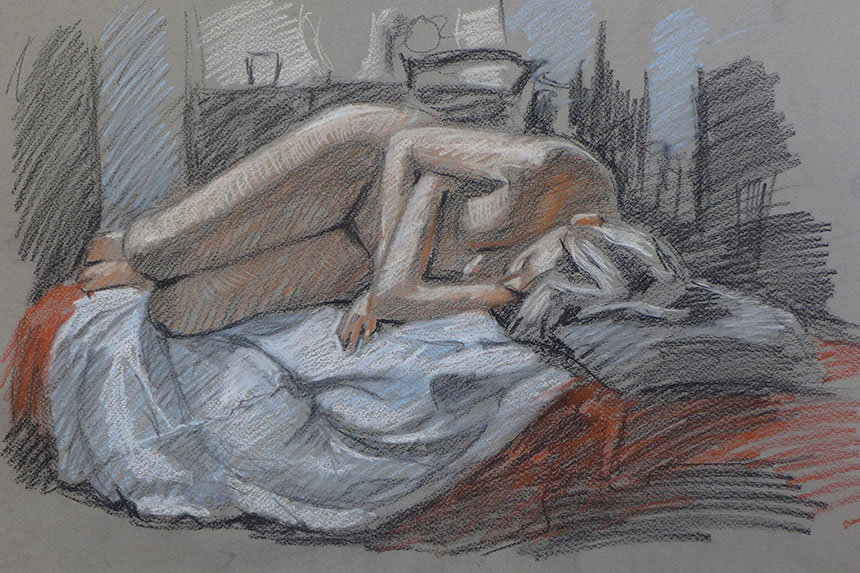
Another half hour. I am trying to leave more edges lost.
.

A great model, African skin tones can be difficult but I love the softer contrasts.
.
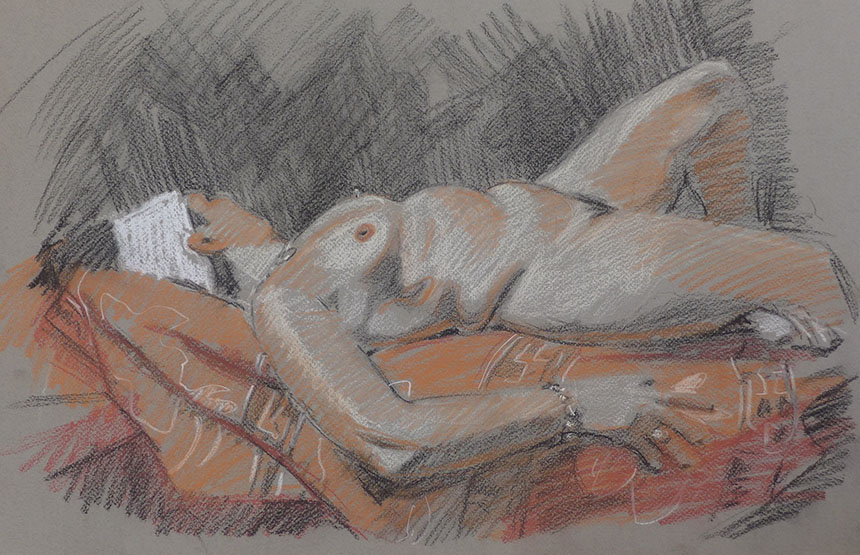
I was sitting rather too close to the model so the foreshortening even in a side view was very hard. I so rarely see people measure in life sessions. I don’t
know how they imagine they will get a decent result without. I occasionally hear other people telling each other that accuracy is not important. I keep my peace
mostly, but oh how wrong they are! They feel that such attention to a merely technical issue is going to hold back their creativity, if they only knew the freedom
such skills actually bring they would feel differently I suspect. Whatever style, expressionistic, abstractive or classical learning accuracy will amplify your creative
forces not diminish them.
.
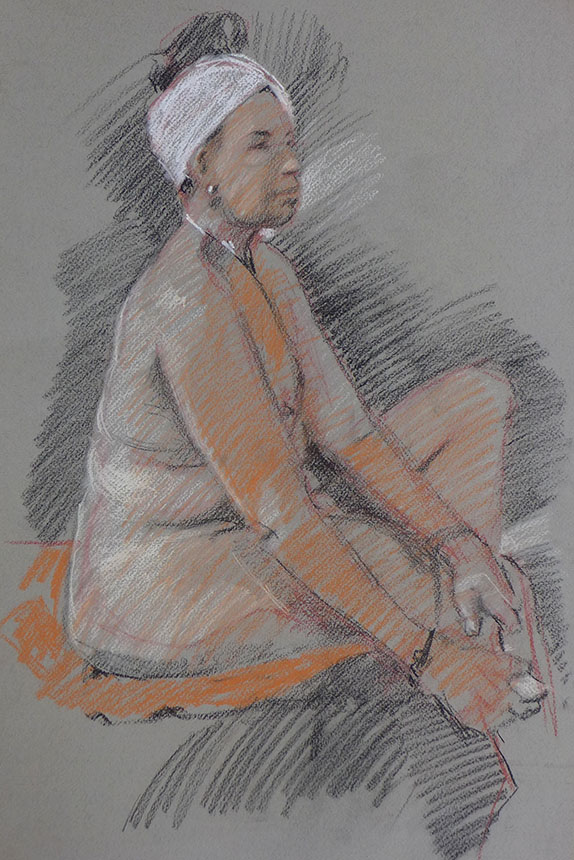
Last from this session. I am pleased to get three decent drawings from a 2hr session. Even one makes it
worthwhile. Some misfires are almost inevitable!
.

A quick 15min but it catches the sunny charm of the model.
.

Last one, largely done with the sides of the pastels, line work was added at the end.