Rob Adams a Painter's Blog painter's progress

October 7, 2012

Originality

Filed under: Art History,Life Drawing,Painting — Tags: , , , , , , , , , , — Rob Adams @ 1:21 pm

I’m spoilt for choice about what to rant about at the moment. Curators and their recent upgrading to “uber-artists” is one, but that will have to wait. Originality is this week’s topic, I’ve touched on this subject before, but it really deserves the full treatment. It is, as I have been told and read repeatedly, the most desirable thing to have, the holy grail for any artist, your own little bit of uniqueness. Oddly  almost a century of chasing this hare bred of diversity has produced a strange uniformity , with the vain attempts to be original becoming themselves the unifying ingredient. You can’t paint a straightforward landscape it has to have some quirk or agenda to differentiate it from any other landscape done in any other time.

I did a search on the Saatchi Online for painted pictures related to place, Link you can amuse yourself by arranging the different kinds of originality into types. The odd thing to my mind is that you don’t really need that many categories. Most can be assigned a historical style. You can easily make selections that could be attributed to the same artist, even though they are painted by different people in different countries. Levels of technical achievement are very very low, but we are not, in this new age, meant to care about that. Most of them printed big on a “gallery wrap” and stuck up in a minimalist flat will fulfil the function of “art on the wall” pretty well. The web site has a handy function that puts the picture up on a wall in a generic flat, that is worth a giggle. I am not knocking the site, it has potential, also it seems to sell my pictures… which is odd as no one appears to look at them.

I digress, originality, I am coming to think it is a somewhat vain thing to seek after. What is it in the first place? Wikipedia is quite interesting, but very brief. Apparently we didn’t value it in the same way in Tudor times when mentioning the close similarity of a new work to an old one was considered a compliment… I’m not sure the Romantics were to blame for the elevation of originality though as Wiki suggests. Certainly originality could be a few things. An entirely new idea done in an old way, or an old idea done in a new way, or for a full house a new thing done in a new way! Any of these permutations would seem to fit the bill. But is it any guide to worthiness? If I cast a sculpture using diverted magma from an active volcano into a sand mould created by interring celebrities, (casting by the lost person method) I would almost certainly be the first to do this. Does that newness add anything to the finished basalt masterpiece? Not as far as I can see, it could be a good basalt sculpture or an inept one despite all its sparkly, bleeding edge, post ironic newness.

Do we perhaps mean “individuality” in that we recognise a Van Gogh or a Rothko by their personal style? It is something we recognise, but not I feel what we mean by originality as it is used today. We occasionally get newness in new means of producing imagery, such as the recent arrival of digital painting, or the arrival of oil painting in the 14th century. Once again it is hard to see that this casts any fairy dust, other than that of a very ephemeral kind, on the work produced.

Art history loves a new idea, impressionism for example. Painters saw photographic images for the first time and were amazed at how the world was really composed. These fleeting frozen glimpses of time did not in any way fit golden means or other classical rules. They saw pictures out of focus, blurred and overexposed. For a while a few French painters had this new thing to themselves, but it soon spread to the far corners and was new no more. If we look at the output of the artists concerned the paintings are pretty patchy, with a few standout pictures and many many so so efforts. This is not to denigrate the artists, it is just a fact of life that if you do a lot of pictures quickly mainly out of doors then your failures and unremarkable efforts will likely out number your outright successes.

Degas stands out in the consistent high quality of his work IMO, but really he mostly reverted to a form of working that was quite well established before the impressionists came along. In the following decades the impressionist discoveries were pretty much absorbed into a mix of old and new as in such painters as Singer Sargent or Sorolla. It had become another tool in the box, not a revolution after all.

Photography was I think the real revolution here. In rapid succession painters cast desperately about for new reasons as to why they should be paid attention to. You could paint in ways the camera couldn’t see, or of places that did not exist or were inaccessible. Examples would be the inside of your mind, like the surrealists, or viewing an object in a multi-veiwpoint way as the cubists briefly attempted to do (a very good example IMO of how an idea that sounds plausible failed to produce anything of very much worth). That fragmentation has continued until today until what can be art is a longer list than what can’t.

The only act an artist need make is the labelling of whatever they choose as art, that is the art act in total. We were told again and again at art college in the 1970’s that it was the choices of the artist that made the art not the skill of presentation. The result of this rather intellectually flawed idea has produced some difficulties. Previously technical or intellectual merit judged on previous artistic achievements was the guide line as to what was desirable Without that means of discrimination, however unreliable, there was no guide to quality other than guessing in a way that has shown itself to be pretty random. It has turned out that those who had financial interest got to choose what was and was not to be included in the canon of art and was therefore of value. Though they may claim to be seeking originality the choices made seem to undermine that claim.

Essentially the choices are as in the Elizabethan day: things that are similar to what has been anointed as good before. However the difference here is that there is a cut off point. You mustn’t look too far back. The cut off point is around 1900 or thereabouts. You may emulate anything from the Bauhaus or Revolutionary Russia, 1950’s America is also fine. If you stick to these periods you will be awarded the title of “contemporary” if you stray beyond these bounds you will be “traditional”. All this is as far as I can see entirely illogical, abstract painting has a tradition, which pretty much all abstract painters adhere to, the other flavours of art in turn have their trail of what you might call traditional influences behind them.

Historically there has been an ongoing process of looking back, the textbook one is I suppose the Renaissance gazing back through rose tinted spectacles at classical times. This produced marvels of human creativity, a similar act of looking back in the 1800’s for the most part I feel did not deliver in the same way. The Pre-Raphaelites did the same but with mixed results, due perhaps to the popular sentimentality of the day. Our current age looks back to the turmoil around the turn of the century in 1900. Originality could I think be just a phantom, no more tangible than Sensibility, the  Romantic yearning to express intuition and emotion, or the exhausting search for the Sublime. Even reality turned out to be strangely ungraspable as the Realists discovered.

All of this hardly matters, if you collect the generally agreed masterworks in a row originality seems to me to be a minor ingredient, but in contrast individual vision and technical mastery appears I think a very large component. It is I feel what you see, not how you see it and how you express it not what you express that matters most. Or to put it more crudely  a simple idea very well done, will mostly I think resonate more for a wider spread of people over a longer period of time than anything more grandiose.

The way in which we imagine originality might occur might in some part prompt our often prurient interest in the tortured journey of the artist, which sometimes can outstrip our interest or care for the quality of the end result. At first glance this would seem fairly reasonable, but a painting is at the end of the day just a made object. We don’t care if a chair was made by a manic depressive with a penchant for self mutilation, so why should a painting require this irrelevant ancestry?

There is nothing wrong or shallow in just appreciating a hand made depiction or abstraction for the atmosphere it encapsulates, or the poetry and elegant means of its execution. Whether it has been done before in a similar way before or not is hardly relevant to that moment of simple, uplifting and very personal pleasure.

Some paintings, I would like to reassure visitors that I cut off no part of my anatomy before, during or after the production of these humble efforts.

.

London, City, Royal Exchange, Oils, Urban

This is a work in progress still. In some ways the pauses needed for drying with oils are a boon because after a few weeks of living with it you come round

to a well reasoned list of improvements and amendments to carry out. On the list here is scumbling pale over the distance whee the main glow is and

some simplification of the tones here and there where the surface is too busy. It is the Royal Exchange in the City of London. 24in by 18in.

.
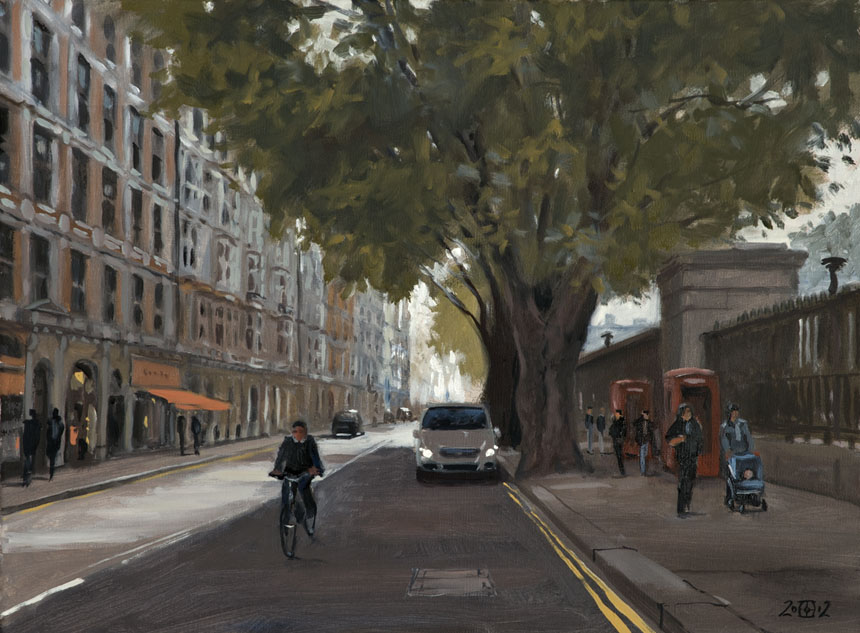
London, street, urban, Gt Russell st, oils

Another studio picture, it’s great to be back painting in oils. If I never do another acrylic I shall not be sorry! I’m happier with this one. The silvery October

light was what struck me when I was out sketching. This captures something of the mood of peaceful activity that seemed to inhabit London that afternoon.

.
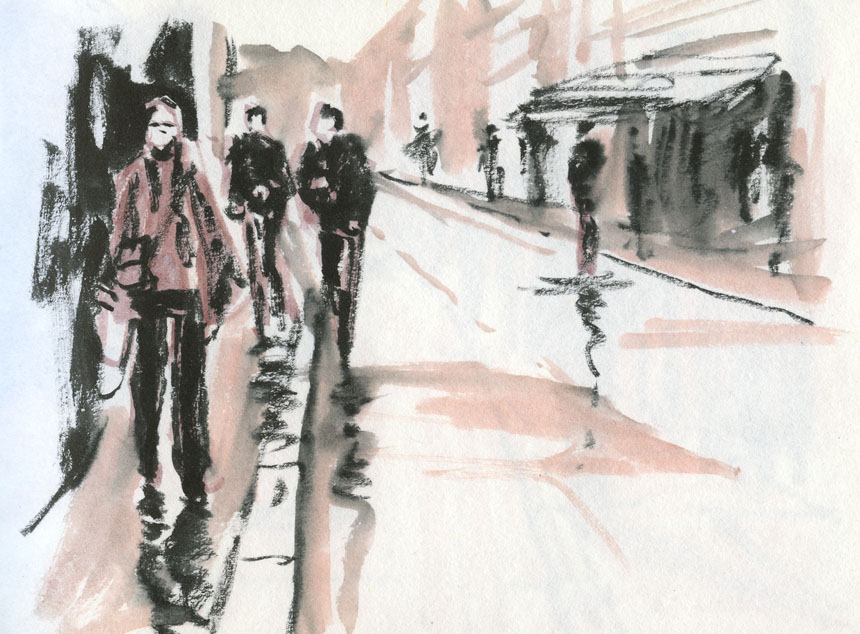
London, sketch

This was what I was sketching with on the day. Waterbrushes were the unfamiliar medium here. I charged them with a warm and a cool colour in ordinary

watercolour and combined them with a black brushpen. A bit rough and ready but very quick for getting down a quick impression. They also allow working

standing in the street with no clutter, just pad and pens. Brewer St in Soho.

.
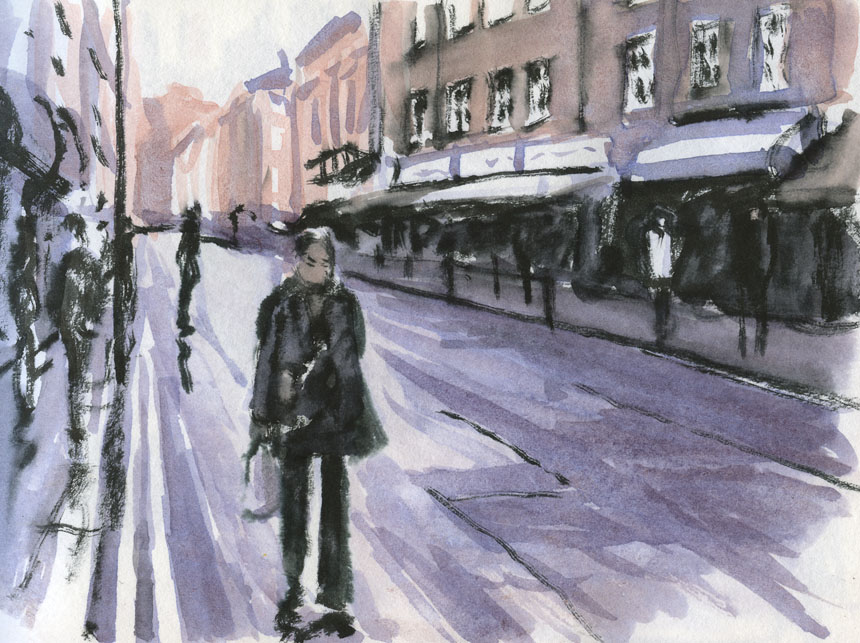
waterbrush, compton st, london, sketch

This is Old Compton St. I was slowly getting the hang of it, very easy to overdo the blacks.

.
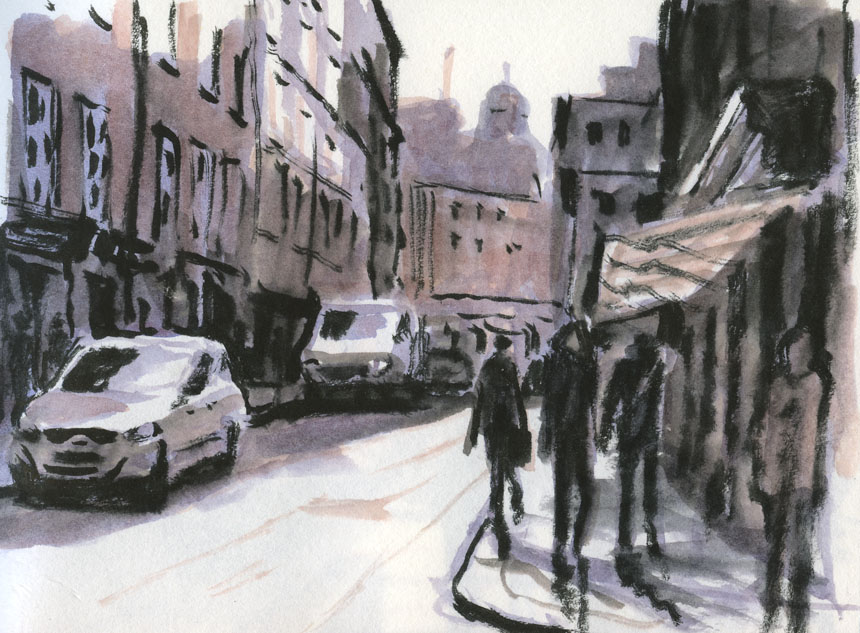
London, soho, sketch

Beak Street. Hard doing this as people were banging into me as they passed by.

.
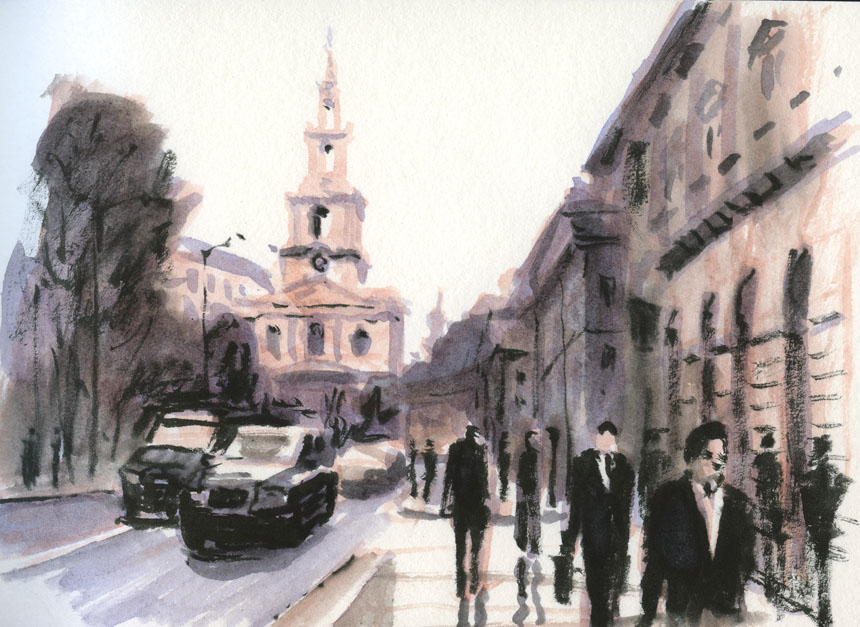
London, the strand, sketch, church

This is Mary le Strand in the Strand. I was a bit more restrained on the blacks here which works much better. Water pens have real potential as a

quick sketch medium, the fact that they are quite hard to control adds to the vivacity of the end result. These are all tiny 5in by 4in and only took 10 to

15 minutes each.

.
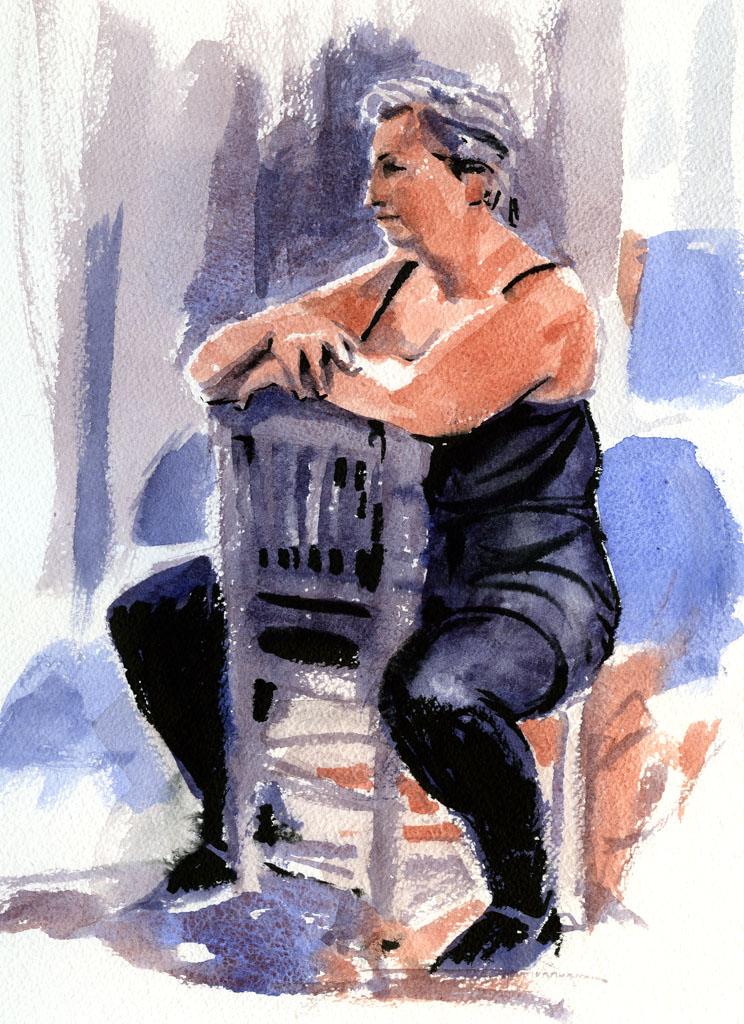
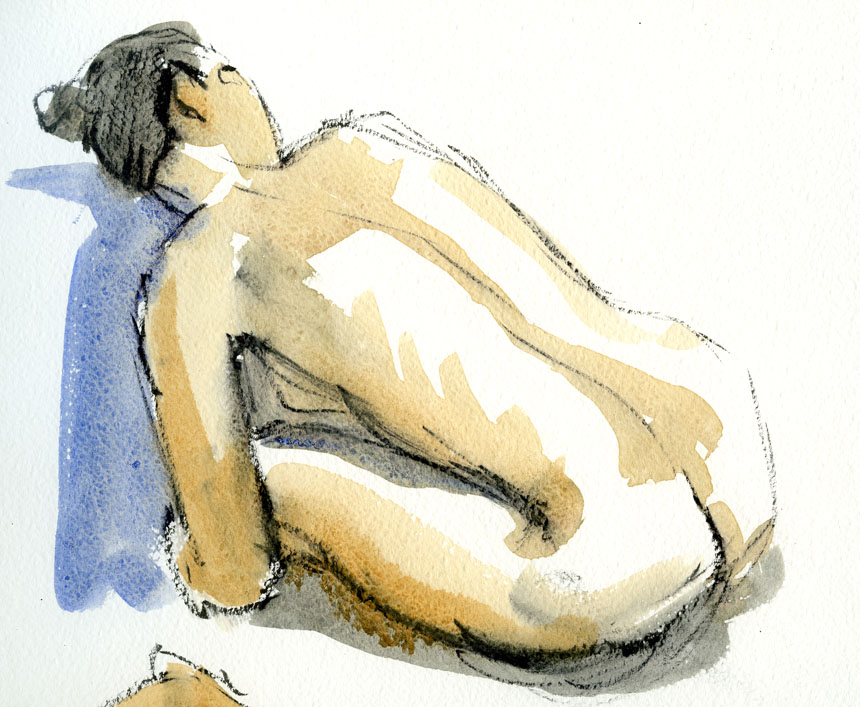
figure drawing

I took the same gear to life drawing that evening much, easier to control in a larger format!

.
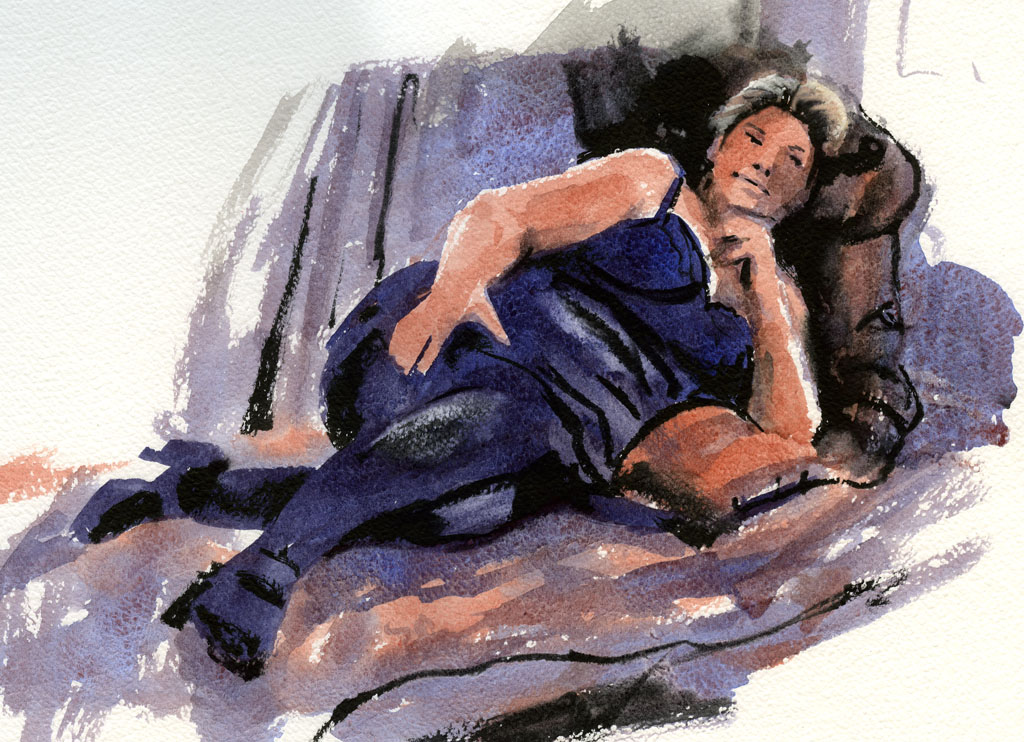
Figure, sketch, drawing

Last one, for big areas I just squeeze a few drops of colour on to the paper and then spread it around. it was fun to draw from a clothed model for a change.
September 21, 2012

London Plein Airs and Some Figure Studies

Here we are again, no one is more astonished than me that I have kept up this journal. When I started I gave it 6 months before I lapsed into long gaps between posts. Other than being able to hold forth to an audience that can’t answer back, one of the reasons I have kept it up is that I found it has considerably increased my output. IE I have been doing paintings in order to have enough to post. Anything that gets my nose out of a book and settled down before my easel is to be welcomed! To my astonishment 5000 people visit a month which is more people seeing my work than I ever would have imagined; even if 2/3 of them click away immediately due it not being their sort of  thing. So a thank you to all my visitors, you are helping me keep my nose to the grindstone!

The other thing that has improved and increased my output has been meeting other like minded painters. When working in the commercial arena I only very occasionally met other artists. When I did it was a different sort of relationship to that of going out to paint for a day with friends. Life drawing sessions as well have broadened my artistic and social horizons. Another thread is interactions with other artists on the Wet Canvas site. There is much encouragement to be gained by positive feedback as well as the occasional negative comment. Though we none of us exactly love critical comment I have found that comments, however inexpert, are very rarely wrong. Where I have not made much progress is getting my work in front of people in the flesh.

I am starting to get work into the open exhibitions in London but these only add up to a very few paintings exhibited in the year. Still with only just over 2 years of setting out on the course of painting for myself full time I am pretty pleased with the progress. Next must be a trawl for galleries that might want to have a few of my pictures for sale on the wall. Also sooner or later I must attempt an exhibition of my London paintings, one of the most enjoyable aspects the pictures I have painted so far are the local pictures from around where I live.

Something I have attempted to do with this part of my output is to catch a few of those moments of beauty in everyday life that would otherwise go unnoticed. This is actually harder to do away from home as you just don’t encounter such brief moments on occasional visits. It is only by being frequently in a place those infrequent charged moments are encountered.

Returning to the online world for a moment, it is indeed a strange new world we inhabit. I have a presence on quite a few places online, from Saatchi Online to the oddly named  deviantArt as well as posting much new work to Wet Canvas. Whether any of these platforms will become dominant in a Facebook kind of way I don’t know. Saatchi produces very few views, but have nonetheless sold one picture. deviantArt requires you to base your online social life around the site in order to gain popularity and hence views. Wetcanvas is the most rewarding as you can both get a response to your work from experienced artists and also encourage others in turn. I wish more professional artists would take part as I think it would lift the standard and supply inspiration to beginners. All of these forums for showing your work suffer from the same issues. There is no selectivity, anyone can post anything no matter what the quality or stage they are at in their journey. This is not a criticism, becoming too elite can put people off, as ConceptArt found to some degree, I heard, when they tried to separate out the wannabes from the pros.

However I do think there is a place in the online world for somewhere where it is very easy to put your work forward but very hard to get your work shown. One problem would be: who would do the winnowing of the chaff from the wheat and why would they put in the time in in the first place? I don’t think that would be insuperable though. Viewing and voting would be relatively easy online. Open voting systems are of no use as they are open to abuse, so in each area of achievement (landscape, abstract, figure etc) you would need separate jurors and each set in turn would need to have the general respect of their peers in that style, that in itself would attract potential selectors, as to be one would bring a certain amount of kudos and exposure. Maybe also the selections could be broken down to three monthly displays of limited number rather like the Summer Exhibition at the Academy. A rolling constantly updated gallery format has no structure and so tends to have no sense of occasion. Specific shows at specific times as you have in a physical gallery would I think attract a more focused interest from both artists and collectors. People who have an interest are more likely I think to check out a display that appears on a particular date, rather than to check back at regular intervals, or bother with constant emails that inform of updates. The main benefit might in my opinion be the ratcheting up of the quality of the work, there is nothing like giving people a goal to work for to make them raise their game. On the subject of putting work up for consideration I feel it would be vital to make a small charge for each submission, that in itself would I suspect help prevent there being an unmanageable  flood of offerings. It would also supply revenue to run the whole thing. Prizes and so forth would be another tried and tested method of attracting interest and support from commercial sponsors.

Saatchi online are trying to drum up interest with curated selections, but the curators are seemingly woefully ignorant and are drawn from the modern art clique exclusively. There was a recent curated selection with the title of “Impressionism” that contains much that it would be hard to shoehorn into that category. The lack of intelligent focus is underlined by the woeful lack of interest in views, sales and comments that these collections receive. At the time of writing the Impressionism collection which was posted on the 13th Sept 2012 has, seven days later, garnered not one single comment despite being on their front page.

It would be easiest, I would imagine, to launch such an exhibition site on the back of an existing player. Even then such things take time, patience and money to establish and may fail to attract enough interest despite all efforts.

That’s the guff over, some scans of tactically dirtied bits of paper are next.


.

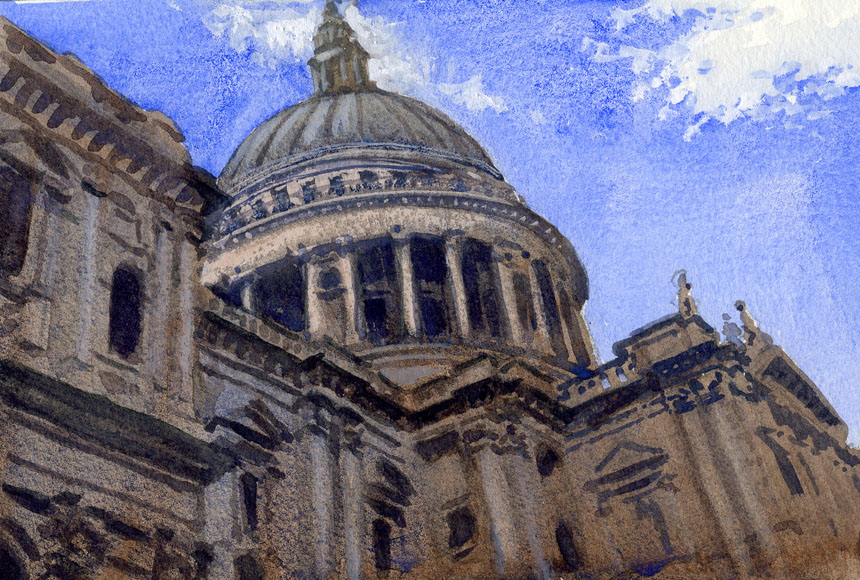
London, st pauls, watercolour, plein air

A visit up to town to explore a particular view with an eye to doing a few studio pictures. Upon my arrival though the light refused to co-operate. I needed

the sun to light up St Pauls when seen from Cannon St, but despite the mostly blue sky the sun determinedly hid behind almost the only cloud in the sky.

Whilst waiting I sat on a wall and did this which was fun, but hard on the neck. I was interested in the tone against the sky which was very dark for an

almost white building. The challenge was to get the feeling of a Portland stone building in the shadow rather than a building just made out of something

darker. Oh and the perspective was a bit of a devil too! 5in by 7in.

.

St Pauls, London, watercolour, plein air, City

Eventually the light played ball and I got this quick sketch done. I didn’t have time to reserve all the lights, so I used some body colour which I hope annoys

the purists. I have given upon my monopod for now and this was done on my tripod set up, no problem as the pavements here are miles wide. 5in by 7in.

.

St Pauls, London, city, watercolour, cannon st, plein air

For this one I retreated even further down Cannon St. I had brought with me a sheet of dark blue toned paper and a few tubes of gouache. The main tone

of the RH building is about the initial colour of the ground. I have to say this is a very fast and easy way of doing one of these contra jour city scenes.

With pure watercolour so much of the work is building up the strong tones required. The downside is a loss of luminosity derived from the white of the

paper. 11inby 7in.

.

child okeford, Dorset, watercolour, mist, fog

A 1/4 sheet studio painting from material gleaned on my Dorset visit. A misty morning in Child Okeford. The gentleman in red was off for his morning

shop. He was a little surprised to be photographed! This looked so dull until the figure and car were put in that I nearly abandoned the whole thing a few

times. Once the key element were in it looked much better thank heaven. All done with my magnificent new size 14 Kolinsky Sable from the excellent

Rosemary & Co who make quite the best brushes I have ever used.

.

Greenwich, London, church plein air, wapping group, watercolour

I was once again invited to paint with the esteemed Wapping Group. I went along despite being somewhat under the weather. I set off early with fellow

painter Graham Davies, this view was an obvious winner so it was our pre breakfast subject. It is from the graveyard of St Alfege in Greenwich. 7in by 5in.

.

A view up a road leading to Blackheath from Greenwich. Absolutely super light. Getting up early is so very worthwhile. The central part with the vans

had to be done later due to a large lorry parked smack in front of us! A bigger painting will be developed from this in due course I hope.

.

The Royal Observatory, greenwich, london, watercolour, plein air

This was done around lunchtime as I was fading fast. After finishing it I sloped off home to sniff and sneeze miserably while sitting  on the sofa watching

telly. It is of course  the Royal Observatory at Greenwich. 7in by 5in.

.

life drawing, nude, figure

Life drawing has got going again. I have started to rather like these Brushpens from Pentel. They are capable of a great variety of marks and soften a little with

the watercolour wash. An odd thing with my drawing, I have entirely given up measuring. Mostly because it breaks the flow of drawing, so what you loose in accuracy

you gain in fluency. Painting is so often marked by this sort of trade off. It wasn’t a conscious decision it just sort of happened.

.

life drawing, nude, figure

Another couple of 5 min ones.

.

Life drawing, nude, figure

A longer 30 min pose. The model Alice is a dream to draw, she is a dancer and is seemingly incapable of taking up an ungraceful pose. She also bravely

holds poses that would put me into intensive care!

.

life drawing, nude, figure

Life painting is an odd thing. I love them when they are a study, but tend not to like finished works. Somehow figure studies are timeless and could

almost come from any age, but as soon as they become a finished statement they become fixed like flies in the amber of the time of their milieu.

.

Rather chuffed with this one. Last of the session and I was really flying.

« Newer PostsOlder Posts »

Powered by WordPress

error: Content is protected !!