Rob Adams a Painter's Blog painter's progress

February 24, 2014

On Beauty

A risky topic I suspect and rather an unfashionable one too. Roger Scruton wrote a book on it recently which I must read. You cannot say what beauty is any more than you can define joy,  love or indeed art. Concepts that are intensely personal are prone to be abused by people in arguments because due to the flexibility and nebulousness of their definitions they can be used to make points that cannot be argued against. The argument will go for example that in a particular circumstance anything can be beautiful. The weakness in these arguments is I think that a cleanly defined beautiful/not-beautiful, art/not-art boundary is assumed. However such phantasms of the human spirit can be brought more into focus even if they are not subject to an outright definition. We can for example say that for the most part we find regular faces more pleasing than ones deformed from the norm. There is a lot of research in that area that shows we like the facial features to be symmetrical and averaged. The images of many faces overlaid and blended are disconcertingly beautiful and show that we are looking for differences from the norm as a way of deciding genetic worthiness/unworthiness.

This does not always follow with real encounters of course. Someone might have a face that is transformed by character and animation. Nonetheless perhaps our underlying assessments of beauty are slanted towards the reassuring. We might admire a verdant and peaceful landscape or a dramatic mountain scene, but we might assign them differing types of beauty. For an arable farmer the verdant land would be attractive as a home whereas the rugged mountain less so. Our farmer might find them both beautiful but in contrasting ways. It is quite plain to me that the early cave painters found beauty in the animals they hunted that went beyond the straight forward desire for a successful hunt.

Thus we are immediately mired in the boggy land of the aesthetic. Hurrying on the heels of aesthetics come those who would tell us what is fitting/fashionable and what is not. Currently beauty and decoration are very much off the menu. We are supposed to like the sparse. Our dream apartments have empty spaces, plain surfaces and white walls. I cannot help but wonder if this is perhaps a choice caused by hoovers rather than aesthetic concerns! When designing exhibitions of decorative items from historical times we place them in sparse minimal cases. To me they always look a little sad in such soulless arrays, like butterflies pinned in drawers. They seem like items in a shop rather than exhibits in a museum intended to fire our imaginations.

In architecture beauty has been completely outlawed it sometimes seems. There is little built that moves beyond the grim utilitarianism of financial objectives and cupidity. When decorative items are used they are plastic panel doors with cartoon graining, the result is depressing rather than uplifting. Architects generally seem to be comfortable with repetition but not rhythm. Being uplifting and enriching our daily lives is, we seem to have forgotten, the whole point of decoration. In furniture we are in the thrall of anally retentive Scandinavians or those who wish to emulate them. I am not totally in disagreement, bad decoration is indeed often worse than none. Alas because we don’t do much training in the area of decoration the few examples that do appear are for the most part weak pastiche cobbled together from found images using photoshop. The decorative arts were once a big thing and lauded, why this is no longer true is a puzzle.

The only real thing I can think of is the advent of mechanical production. We have adjusted our aesthetic to suit the available means of production, maintenance and distribution rather than the other way round. We perhaps associate the hand made with the crudeness of DIY, some hand made objects seem to need to advertise their handmadeness by adding rusticity or similar.

We also tend to confuse beauty in a seen thing such as a mountain or an object made with no visual intent such as a worn wall with the beauty inherent in an object made by a human being who has laboured to gain a skill. If you splash paint randomly or even semi randomly on a canvas it will be nice to look at. If I wet some watercolour paper and pour colour on it I may well get a very attractive and interesting surface. This however is mostly the same sort of beauty as we get from admiring the patterns on a beach. The beauty in an art object is different because of the skill and the fact that a person has sacrificed part of their life in order to achieve the ability. Due to the arguments put forwards in the 20th century we tend to conflate these kinds of beauty. The weathered wall is not of any real cultural significance even if torn from its place and put in a gallery.

Music mostly does not suffer from this confusion. We might get an emotional surge when we listen to the wind in the trees, but we do not confuse that, except in moments of poetic hyperbole, with music. We do not confuse a person noodling on the piano in a random untrained manner with music either… the difference to a concert pianist is obvious and no one would say that the random noodling is art of the same order as the pianist’s bravura performance.

The statement that everyone is an artist is very much not true. To be an artist you must firstly be a fully formed craftsperson, only then should a small proportion of the resultant work be deemed “Art”.

.

henley on Thames, Thames, flood, river, plein air, oil painting


This is the recent floods at Henley. Some fascinating transformations of familiar scenes. We were lucky to get some brilliant light and a mostly dry day.

.

henley upon Thames, Thames, Plein air, oil painting


Another from the same day. The shadows were only momentarily thrown across the road. 8in by 10in oils.

.

Thames Henley, river flood, oil painting


Last one of the day, we found a flooded road that reflected the last light. I had to paint this very rapidly! 12in by 12in oils. The first use of my new 12in by 20 in pochade… I will add pictures of it at the end for the painting gear nerds!

.

interior, oil painting


The next day was very wet and windy so we went to and painted an interior in a friend of Steven Alexander’s wonderfully cluttered cottage. 10in by 12in oils.

.

Jermyn St, Mayfair, London, street, oil painting


This is Jermyn Street in Mayfair painted on an expedition with the Brass Monkeys. Not quite sure what to do with this one, it is a bit like an empty stage waiting for the actors to arrive! 10in by 16in oils.

.

Jermyn St, Mayfair, London, Brass Monkeys, oil painting


Another from Jermyn St. I had to add a figure to reduce the dominance of the car. 8in by 10in oils.

.

Kent, track, Aylesford, oil painting.


A day out painting with friends. This is a track above Aylesford in Kent… we went to paint the dramatic wide view of the Medway valley and ended up painting a muddy track! 10in by 10in oils.

.

East Farleigh, Kent, oil painting


This is East Farleigh, the river was in full flood but I found the light in this very attractive. I was nearly run over a few times but really enjoyed trying to make something of the split composition. Painting up a hill always produces challenges to as you have to make sure that the cues are there to explain your view point. 10in by 16in oils.

.

Trafalgar Square, London


I don’t often do this kind of sketch, but as it was a Brass Monkey day and I also had to attend the Wapping Group private view I needed to wear clothes ungarnished with oil paint! So pen and wash was the order of the day. pen and wash is a great combination and I really should do more of them.

.

St Martins Lane, London, watercolour

Last one before heading to the Mall Galleries. The day was very flat but St Martins Lane always supplies some contrast due to the height of the buildings and the narrowness of the street. 5in by 7in watercolour.

.
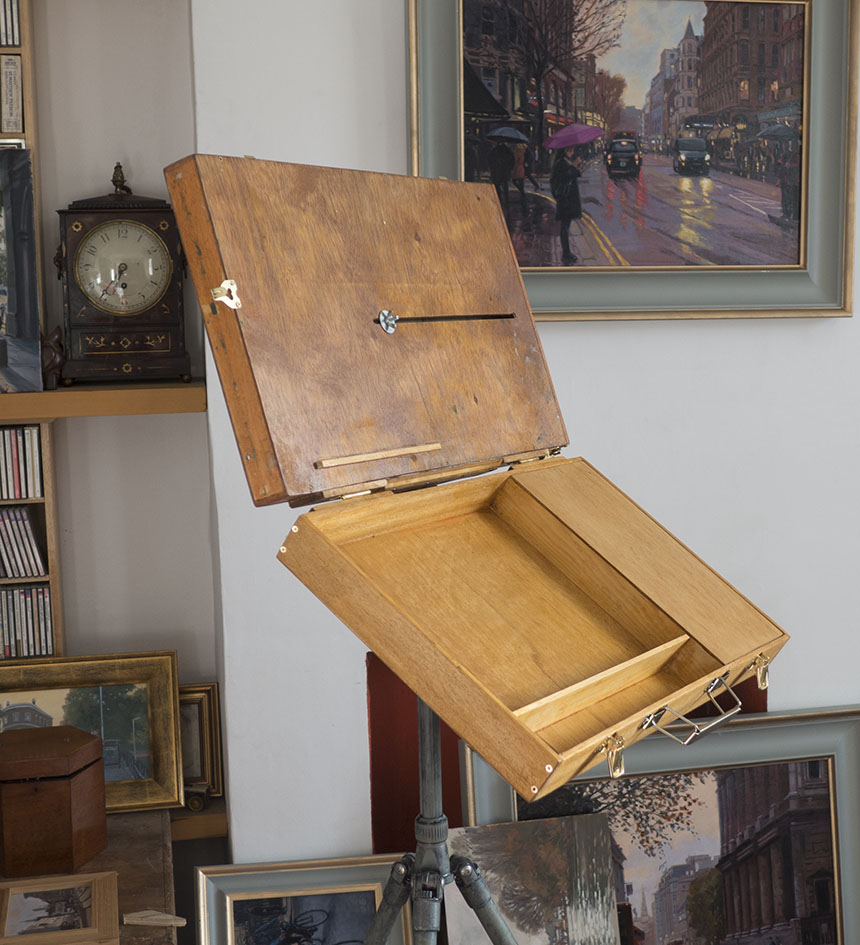
pochade

Here it is… a mighty 12in by 20in. It is still light, but would be a bit of a handful in the wind! Due to the size it has some storage so I should be able just carry this and the tripos which will make quite a light set up for its size. Next I need to work out something for 16in by 20in canvasses…

.
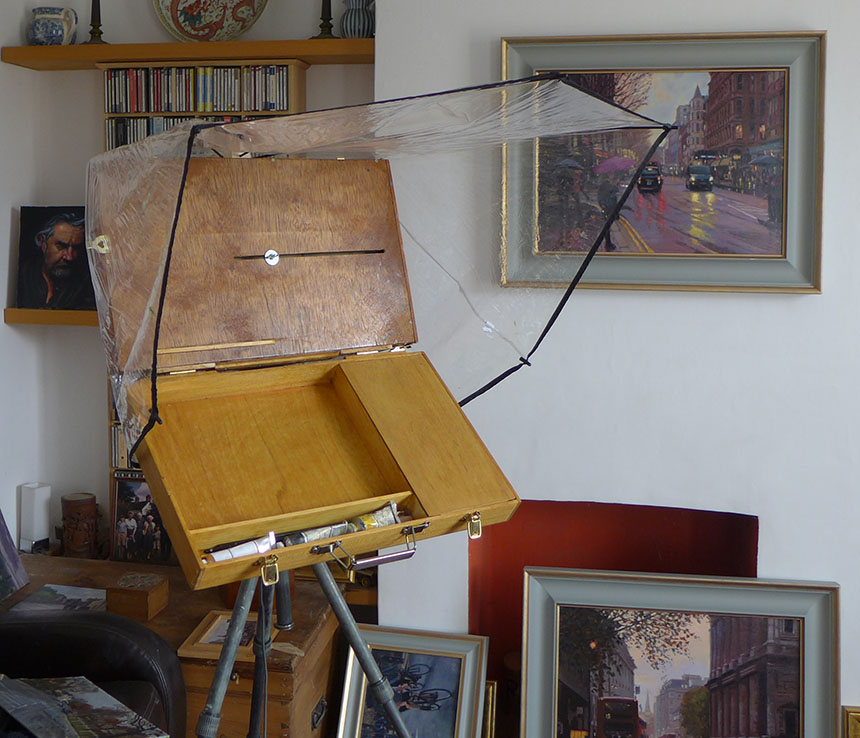
pochade

I also created some rain protection from the brolly that bit the dust in Dulwich a week or so ago.

December 7, 2013

Art Education.

In a conversation recently I took the position that art colleges teach drawing very poorly. I was quite fairly asked how do you know that? To which I had to admit I only had my own experiences from three decades ago and word of mouth from current art students to whom I had talked. So quite casually I started to look at art college’s websites and then looked at the work of the tutors who might be expected to teach the students to draw. The results were truly depressing. Almost no colleges had an even halfway competent draughts person on their staff, some of them had professors of drawing, who spouted guff about how important it was to them. They did not seem however to have found it important enough to spend the time learning the relevant skills.

Everywhere was the opinion that drawing was some kind of metaphysical prayer state where you could commune with the inner self in the purest way. I downloaded staff lists and pictures of the tutor’s work with the intention of posting them in this page, but really I only found one tutor with a reasonable skill level and that was at Falmouth. No where else was there a person who would have had the ability to teach a student drawing skills if they wished to learn. Below is a list of attainments that a student of art will be taught. This one is from the University of Kent:

Subject-specific skills

You develop the following subject-specific skills:

  • effective deployment of terms and concepts relevant to understanding art in a contemporary context 
  • the ability to locate evidence from a wide range of primary and secondary sources, and interpret it in relation to the aims and conceptual framework of fine art practice
  • the ability to present, explain and defend a visual art project, in both its developmental and final states, employing argument and interpretative skills relevant to professional practice
  • the ability to draw upon understanding of the materials and processes central to a variety of fine art media, as well as the technical skills necessary to produce practical work in these contexts
  • the ability to critically evaluate a range of different conceptual and practical methodologies and approaches to both understanding and making art in a contemporary context
  • the ability to competently perform the tasks necessary for contemporary professional artistic practice, including skills of display and dissemination of work, fundraising and gallery negotiation
  • the ability to manage a fine art studio and studio project, including time management, budgetary control, space management and the acquisition and maintenance of equipment
  • the ability to place art works produced by the learner or others into a historical, and conceptual context, employing analysis and critical interpretation to forge connections between practices that elucidate the process of creation.

Transferable skills

You gain transferable skills in the following:

  • communication: articulate ideas and information comprehensibly in visual, oral and written forms; organise information effectively respond to written sources; adapt style for different audiences; use of images as a communication tool
  • information technology: source, navigate, select, retrieve, evaluate, manipulate and manage information from a variety of sources; select and employ communication and information technologies; produce written documents; employ advanced software for module projects and tasks
  • working with others: interact effectively with others, for example through collaboration, collective endeavour and negotiation; accurately define and review the work of others; skills of negotiation and persuasion in relation to the planning and execution of a project or the dissemination of its outcomes
  • improving own learning: study independently, set goals, manage workloads and meet deadlines; explore personal strengths and weaknesses; develop autonomy in learning; ability to listen effectively and so to learn from and participate constructively in discussion; update knowledge and skills, seek and use feedback, critically reflect on and improve performance
  • problem solving: identify and define intellectual and practical problems; explore alternative solutions and discriminate between them; creative experimentation; focus and apply attention to detail; gather, organise and deploy ideas in order to formulate arguments cogently and to express them effectively both orally and in written form; make subtle and discriminating comparisons of texts and visual artefacts; research and evaluate sources in the process of carrying out independent study.

There is a hint that practical skill might be learnt at bullet point no 4, but don’t get your hopes up, I could see no tutor at the college who had any competence at all in the area of drawing.

You might think I am exaggerating, but the evidence due to the internet, is there for all to see. So if you doubt me it won’t take you more than 10 minutes to check. If you do find a good drawer let me know and I’ll post the fact here with pleasure! I might also add that some colleges seem very coy about their tutors and what work they do. With good reason in my opinion, very few would have any chance of making a living at art outside the cushioned oasis of the education system. There is a requirement that art tutors exhibit occasionally, but in most cases this seems to be very perfunctory.

I know that the colleges would respond that I am talking about an outdated skill and what students need is skills in video, self publicity and curation. I don’t disagree, those skills are needed, but drawing is more important and fundamental in my opinion. The evidence online shows they do not appear to have the resources to teach in this area even if a student requested it. If these colleges were private I would have no complaint, but they are not, they are funded by the state.

In the other arts a music student would be expected to have some skill in playing, even if they were going to compose not perform. This is because of the insight and understanding of the subject that learning to play brings. A creative writing student would be expected to be competent in grammar and sentence construction. Oddly I found that fashion departments taught drawing on the whole quite well. I have said before and will repeat. Drawing is important not necessarily for what it results in on paper, but for the understanding it brings to the person learning it. Drawing gives a vital and unique insight into the nature of looking and seeing, as well as the skill to explain what you might have learnt to others. This in my opinion is of huge value even to video and abstract artists as such knowledge and competence cannot as far as I can see be gained in any other manner. Drawing is not in itself art it is only a practical and intellectual tool, but for the visual arts at least it is a vital one and should be taught to a high level by any self respecting art college.

Here is Leeds College of Art who claim to make drawing a central plank:

FINE ART DRAWING STRAND

Working in the drawing strand allows you to elevate your drawing from being a well understood core discipline in art practice to being the distinct and exciting art form exhibited in museums and galleries across the world. Our artists will introduce you to processes and visual drawing systems whilst also exploring the integral expressive nature of drawing which is primal, elemental and our most immediate form of image making. You will be encouraged to extend your drawing practice widely in two, three and four dimensions in a range of of materials, media and techniques.

They are distinctly coy about who might teach you but I found the information hidden away under “research”. Alas none of the staff as far as I can see have any drawing skills whatsoever…

A tiresome conclusion people seem to jump to when I make these arguments is the, “You want us to go back to drawing from plaster casts.” Nothing could be further from the truth. I find the teaching methods and intellectual stance of the so called modern ateliers absurd and equally as bad as the current state art schools. I do not want to throw out contemporary art thinking I want to enlarge and enhance it.

After that rather depressing round up a few paintings might be in order.

.

Nude, life drawing, watercolour, figure

I took watercolours to life drawing which is always scary. 30 min is a very short time for a study! It does however concentrate the mind wonderfully.

There is only so much that can be said in that time, only so many marks that can be set down. This means that your choice of what to explain and what

to let go of are very important. The first one was a write off but here I got the key things delineated and nothing to much overstated. Accuracy in such drawings

has to be somewhat done on the fly though I do try and get three points in a triangle placed accurately. Here I made a triangle from where the shoulder touches

the cheek to the dark of the pubis then down to where the bangle on the rt arm touches the red throw. I’ll sketch that in below.

.

Nude, life drawing

I hold up my brush to determine the angle of the first almost horizontal line and then get that placed. I then decide how long I wish it to be and mark the

two ends. Next I get the alignment of the long side down from cheek to wrist and gently mark the rt hand end. Finally I take the angle of the lin from pubis

 to wrist which fixes that point. The advantage of a triangle is that it is fixed in shape so you can be confident of its proportions. Once this imaginary triangle

is in place it is far easier to estimate positions and angles of the rest of the body. You could of course proceed to mark more points but in the sort of time scale

these paintings have to be done that is not an option! A final tip, make your initial triangle cover as much of the body’s area as possible.

.

Nude, life drawing, watercolour

The next one, another half hour. I ended up with some rather over sharp edges in the back. As always overstating is worse than understating for the

most part.

.

Nude, life drawing, watercolour

Last one that is fit to post! I often find that the last drawing of a session is the best. You get into the zone and start to make decisions

more efficiently and with greater confidence.

.

Deptford, Church, graveyard, pen drawing

I took my pen and ink out to draw plein air which was an experience. I think I will use technical pens to sketch out doors as dip pens are better in the

studio. They can be very finicky and have this ambition to dump a large blob of ink at any gust of wind! This is St Paul’s Deptford designed by Thomas

Archer.

.

Battersea Bridge, Thames, london, watercolour

On a Brass Monkeys outing as I was heading home the view from Battersea Bridge was fantastic. I did a very quick sketch which is below and then this

studio painting. Very simple with only two colours Quinacridone Burnt Orange and Ultramarine. 10in by 10in. Watercolour.

.

Battersea, Bridge, Thames, London, plein air

Here’s the sketch done in less than 15 min. I pretty much stuck to this only refining the drawing from the photo. The photo was quite dark and very

vibrant, which isn’t what the eye saw at all.

.

Maldon, Essex, watercolour

Famous scene of Maldon in Essex. Really just a colour test I only used Ultramarine, Cadmium Red and Quinacridone Yellow, all Daniel Smith.
1/2 sheet, 140lb Arches Rough. Not sure I like this, it could be from any era! I softened the line of the water later which here is too dominant.

.

Deptford, Station, watercolour

I am trying to get some London watercolours done for the up coming shows. This is Deptford Station 9in by 9in. Super sun this time of year it beams

down this road like a search light!

.

Mary le Strand, London, oil painting, plein air

A favourite scene, this is St Mary le Strand. The day was very flat so I could take my time. The best one I have done of this, it is a deceptively difficult subject.

I’ve done it zoomed in but this time I wanted to get in the big block of quieter stuff to the right. 10in by 16in oils.

.

The shard, thames, London, plein air, oil painting

This and the previous one were on a Brass Monkey day, we were all surprised to find ourselves faced with a glorious sunset! I decided to revel in the colour

and not hold back. I only had 20min at the most to get this down. 8in by 10in oils.

.

painters, thames

Here are Mike Richardson and Terry Preen finishing off, it is so pleasant to go painting in a group!

« Newer PostsOlder Posts »

Powered by WordPress

error: Content is protected !!