Rob Adams a Painter's Blog painter's progress

November 20, 2012

Estuary Days

Filed under: Drawing,Kent,Life Drawing,London,Painting,Thames,Uncategorized,Watercolour — Rob Adams @ 7:52 pm

Another period of commercial work. It’s odd I nowadays get offered jobs that I would have died for in earlier decades. Having been a freelancer all my life it is second nature to say yes to jobs when they come up. To say no so I can concentrate on my own painting is surprisingly traumatic! I am outrageously fortunate to have never run out of interesting and challenging work over nearly 35 years. Despite that there is always that nagging feeling that the work will run dry. I can quite understand why it wouldn’t suit many to not know if you have work or not in a months time. If I had had a family to bring up I suspect I would have had to take secure employment rather than living the risky existence I have done.

This period of work has underlined the fact that I haven’t missed work at all. Some of the people, but not the projects or the deadlines and certainly not the meetings. The worst things were “creative” meetings or, “brainstorms”. It is an odd idea that if you stick a bunch of people in a room and get them to spew out random ideas it will generate startling artistic ideas. In my experience it never does. Art just is not democratic in that way. The film industry recognises this with its strict hierarchy, even with that I suspect many films fail because of too many opinions rather than too few.

Imagine doing a painting by committee. First a discussion as to subject. Well that is likely as far as it would get. Even if there are just two painters out for a day that can double the time taken to settle on a subject! Then assuming we have our subject then the composition would have to be voted on, with no doubt plenty of thumbnails and even the odd feasibility study. The marketing manager would state the requirements for saleability and perhaps do a word picture and an image board to be put before a randomly chosen selection of the public. Then the whole thing would have to wait while a risk assessment of injury, rain or other acts of man and God would have to be carried out and a report made. Once done a scope of works could be developed. Health and safety would have to be considered, the easel checked and half the colours and the turps removed as hazards to health. Their work done the committee members could then retire to a safe distance while the picture was laid in by the painter. The painter as a manual worker would of course be the junior partner in the enterprise. The pecking order would be marketing manager, finance head, creative director, art director, producer, personal assistants to all of the above, tea maker, the framer, and finally the painter.

Once the picture is blocked in a progress meeting would be held. The subject, composition, format and medium would be changed and the painter rebuked for not following the brief properly. After a quick brainstorming session the title is decided to be “Morning Symphony”. The second attempt is judged to have fallen at the same hurdles, but with the deadline looming and despair setting in the painter is told to carry on. But for God’s sake try and make it more cutting edge and contemporary! Is the Creative director’s parting plea. At last the painter is allowed to paint in peace while the committee have a late lunch during which they come up with the idea of a nocturne. Hours pass and the committee is reconvened to stand around the (hopefully) finished work. They are not pleased. Why has the artist painted a morning scene when plainly what is required is a nocturne? The marketing man rings the lawyers to check if the painter can be sued for the costs that the failure to deliver will have incurred.

As fortune would have it a member of the public arrives and buys the painting off the easel, paying the accounts director in fifty pound notes. Hurrah a success is declared! The committee congratulates itself for a project well conceived, managed and executed. With a flourish the Creative director signs the painting and hands it over. They then retire to the pub for a well earned drink. The painter cleans his brushes and packs up his easel and hauls the whole lot back to the car. In a week or so he will send an invoice that will be ignored until the next painting is needed…

Painting is I’m afraid irrevocably elitist and undemocratic. You are after all supposed to be looking for exceptional achievement. You wouldn’t choose runners for your team on the Olympics on any other basis than high levels of ability. Oddly the current art establishment believes art should be democratic and skill or ability should play little of no part in the assessing of artistic worthiness.

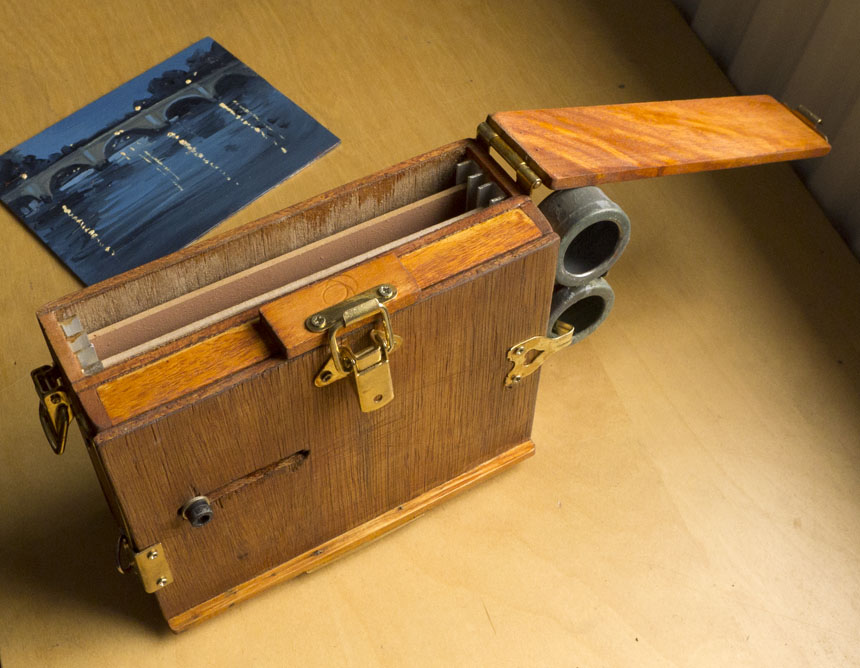
I have been woodworking again in the quest for the ideal pochade for hand holding. The results below. I have just had to accept that 7in by 5in is the most practical size. In the places I wish to paint from you often cannot stay for very long in any case. There is also the consideration of discreteness, I quite like painting in cafes and pubs, so at this size a quick sketch is more than possible. In the end I got the weight down to 1lb or 800g including panels. Pictures below for the plein air nerds!

.

pochade, plein air

.

pochade, plein air

I plan to load the palette before and only carry a few key colours in a plastic pencil case.

.

Medway, Thames, river, plein air, oil painting

This was a visit to the Saxon shore near Gillingham with the Brass Monkeys. Wonderful day with rapidly moving clouds that changed the light from moment to moment. 16in by 10in.

.

medway, thames, river, marshes, plein air

The same hulks from a different side. I really had to race to catch the light. When it is changing so quickly you need to fix in your memory how you wish to do the light. If the far shore is dark as it is here I find it best not to change it if a moment later it becomes brightly lit, chasing the light rarely works. 16in by10in.

.

medway, thames, estuary, plein air

Last one of the day, the light was going fast so I had to radically simplify to get it all in. 8in by 10in

.

Life drawing, watercolour, figure

I am persisting with watercolour in life drawing. Maybe back to pastels next week, it does you good I feel to swap media every now and again.

.

life drawing, watercolour, figure

I would quite like to occasionally introduce line but I think I will have to make the tones lighter for it to work well.

.

figure drawing, nude, watercolour

Here I tried to build it all up in single strokes.

.

life drawing, nude, watercolour

.

August 19, 2012

Being Yourself

Filed under: France,Kent,London,Painting,Thames,Watercolour — Rob Adams @ 3:51 pm

A subject I have been struggling to think how to deal with without causing unintentional offence… to my fellow painters I often see the influence of other artists in many a painter’s work. It is often not to hard to guess which painters an artist admires just by looking at their work. There is a point however when inspiration turns to emulation which I have come to think is maybe not such a good thing for the artists concerned. Often I like the work done but it somehow never quite stands up when you see it side by side with the “master” they are following. Why do some artists inspire followers? Two watercolour supremos Alvaro Castagnet and Joseph Zbukvic, both of whom are very fine painters in a similar idiom, are a case in point. There is a spread of artists emulating the style of these two. I assume perhaps wrongly that there is a connection between them as they both lived in Melbourne. Both artists make videos and take many courses, but so do others. Another artist that inspires droves of followers is Edward Wesson another interesting and poetic painter. I don’t think he made any books himself but his follower Steve Hill has published a fair few books and videos, such as “Watercolour The Wesson Way”. A very good painter and friend refers to the many artists who aspire as “The Wesson Clones”!

Artists who inspire such followings are nothing new we can track them throughout art history. But with the advent of teaching and demonstration videos has focused the result away from being inspired by, towards emulation. Being inspired by assumes to my mind the ambition to surpass your master. Whereas to emulate seems to mean follow in the footsteps without perhaps the ambition to out do. The difference between “I want to be better than” and “I want to be as good as” maybe. One thing that strikes me about the styles that inspire a following is that they are demonstrable, by which I mean an artist can produce a painting while the cameras are rolling or the students are watching. Also the painting methods have a degree of what I call conjuring. I remember being entranced as a child by Rolf Harris doing big broad brush paintings and asking “Can you see what it is yet?”.

I have had many influences myself, some good some not so, from Frank Frazetta,  Edmud Dulac, Rackham, Alex Raymond, Chris Foss, Alan Lee, many Marvel comic strip artists, and book Sci Fi jacket illustrators and onward to Singer Sargent and Sorolla by way of Trevor Chamberlain. In each case however they have all gone into the mix, and been mostly assimilated. I might have done a few “in the style of” at the height of my interest, but once the lessons that seemed relevant to me had been learnt, I tended to move on. Some of the influences were perhaps negative. I was over fond of dragons, castles and languid maidens. Which in my hands became rather kitsch. I could very likely make a better job of such subjects now but the desire to do so has somewhat faded.

I bring this subject up as I am trying to decide how much I wish to take from other watercolourists. I do I feel need to refine some of my techniques so looking at how others do it is a sensible first port of call. On Joseph Zbukvic’s site there is a great video and interview of him doing a painting which demonstrates the reasons for some of my ambivalence. Both he and Castagnet are in some respects technique driven artists. That is to say the method of carrying out the work is determining what kind of work is done in the first place. They both paint in very wet, large washes with a quite limited and mostly unvarying palette and therefore tend to mostly tackle subjects where this technique will work well. Despite the limitations this is an interesting method that I can see many uses for. I have actually gone through a previous period of experimentation in this area but I didn’t find it suited the sort of architectural studies I was painting at the time. If you are painting a picture where the ambiance, light and activity of the whole scene are preeminent then this broad brush approach works well as it reduces any architecture to stage props. But if you are painting the facade of a gothic cathedral where the architecture is the focus then having all the windows blurry blobs is not such a good idea. Although I quite admire the painters I have mentioned and they paint some gorgeous pictures; I find their repeated insistence on passion and looseness a little confusing. As far as I can see they are selling technique and their style requires technical excellence more than almost any other. This is not necessarily a bad thing to my mind, but it is their stress on expressiveness and confidence I find a concern. Such confidence comes from technical expertise and experience, so it must be built up by many hours or more likely decades of practice. This facility is unlikely I feel be be developed by watching a couple of DVDs or going on a painting holiday!

There are plenty of videos on uTube of people splashing the paint around in this mode, the accent is mostly on simplification another over stressed area of desire in my opinion. Simplification or reducing to the essence , it is true, is a hard thing to learn, but complication is a tool also and a powerful one in the hands of such as JMW Turner or Alan Lee. The trick is to use both simplicity and complexity in ways that help the whole picture. I tend to think of this now as “telling” detail.

So my advice to any aspiring watercolourist or any other medium, is to be inspired by another artist and steal what ever you wish. But don’t try to paint pictures that ape another’s style too closely, always try to absorb what you need into your own style. To that end it is maybe good to take from many varied artists rather than proponents of single narrow styles.

That’s the chat over with… a few pictures.

.

france, waterclour,ships, boats

This is a studio painting from my Brittany trip. This is called a marine railway and is used to get the fishing boats out of the water for repair. I’m working

on stretched Arches not 140lb, which I rather like for this kind of subject.

.

dog, rain, watercolour

Stretched paper allows very wet working which I have exploited here. I am as I said above trying to absorb the very wet process into my work but without

letting the technique turn into a collection of slick tricks.

.

thames, river, watercolour

Another from my afternoon in Richmond. This is Isleworth seen from across the river Thames. Painted with the paper stretched on my Keba Artmate.

The device stretched the paper tight as a drum, as there is nothing behind the paper it has a pleasant bounce to paint on. Arches not again.

.

city, london, waterclour

Here is a cityscape using a deliberately loose style. The method does suit this sort of scene and is good at expressing bustle and the transitory moment.

I drew out quite accurately then painted the whole thing with my enormous 14 squirrel mop. Done on stretched Arches rough 140lb.

.

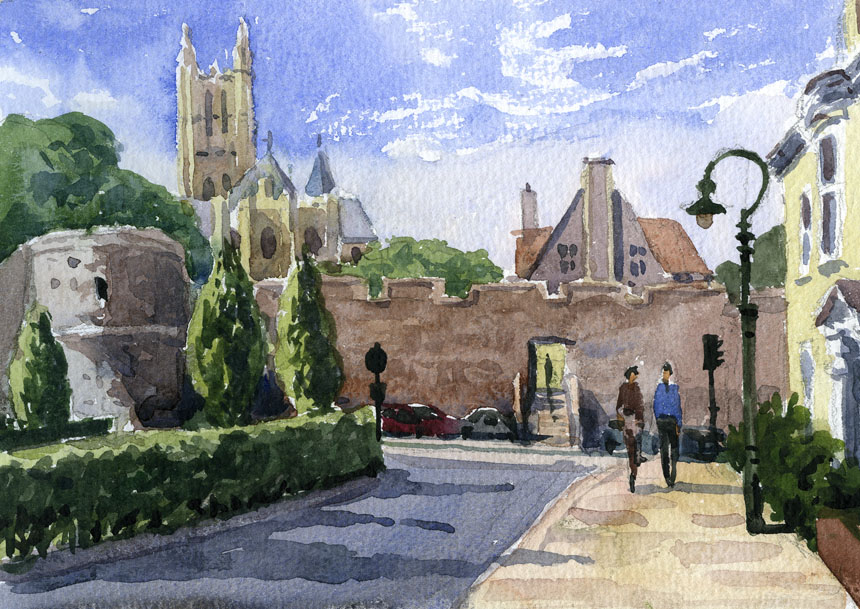
cathedral, canterbury

As it was a lovely day I decided to visit Canterbury. A lovely town destroyed by tourism alas. I rather disconsolately wandered around and was in the end

forced to paint away from the centre as it was impossible to paint amongst the throngs of visitors and the hucksters that prey upon them.

The cathedral is surrounded by a high wall and ten quid to get in… I rather rushed this as it was blowing an absolute gale which made it very tricky.

9in by 6in.

.

bicycle, canterbury, watercolour

A back street in Canterbury. I was a bit cross with myself for rushing the last one so I took my time here I drew out the cyclist in my little sketchbook before

drawing her in I really must force myself to do that more often as it makes a big difference. 9in by 6in.

.

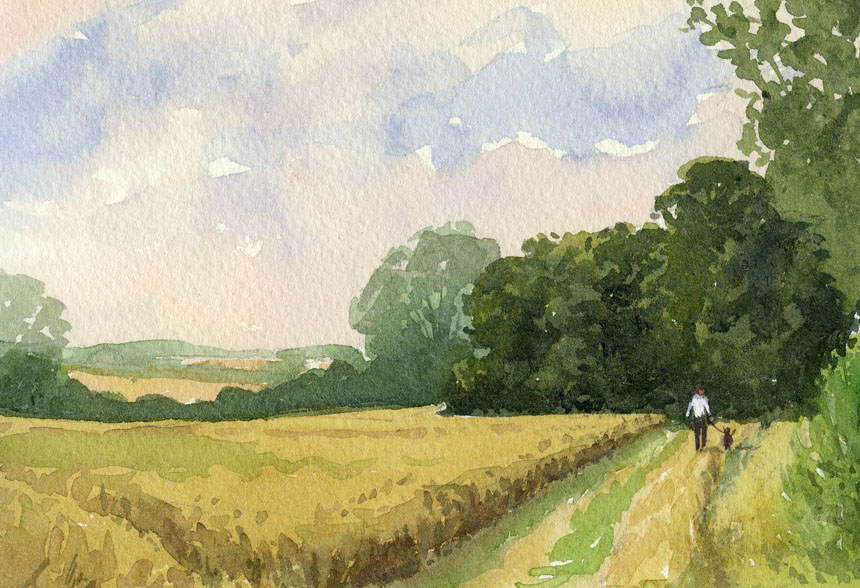
dog walker, north downs

I escaped Canterbury as it was just too busy and drove along the North Downs, did this in my little sketchbook 7in by 5in.

.

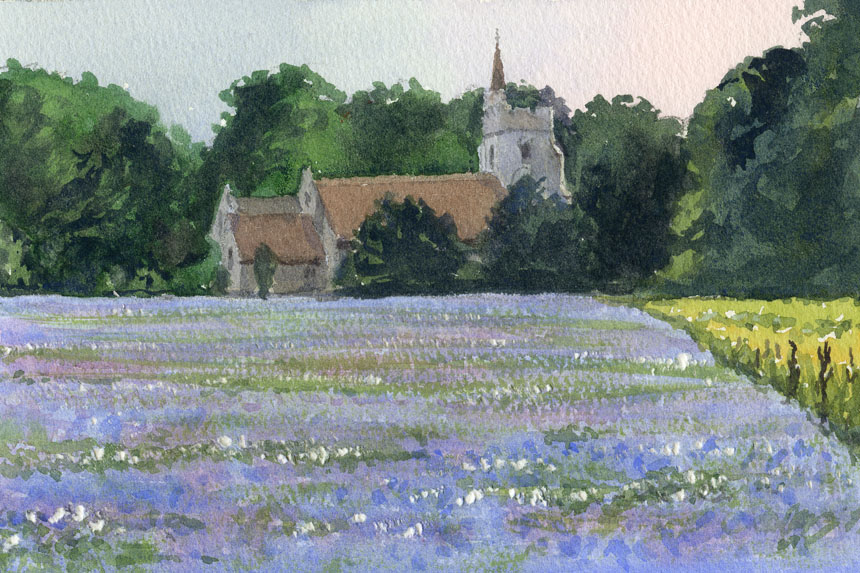
Kent, Sheldwich, flowers, field

I drove through the lanes to get home and couldn’t resist this scene of St James’ at Sheldwich, the meadow was a riot of blue mauve and white flowers.

7in by 5in.

.

car, girl waterclour chilham, kent

This is Chilham done next day an almost too perfect English village scene saved by having a flash car in it!
1/4 Sheet Arches Not.

.

london, charing cross, street, watercolour

Another big brush effort. This is Charing Cross Road basking in the afternoon heat. One of the advantages of the style is that this only took about

40 minutes. 6 a day I could be rich! More seriously becoming more adept at this style will allow larger plein airs to be done. At present unless the subject is

quite simple I struggle to get a 1/4 sheet done before the light has moved on. Arches rough 1/4 sheet.

« Newer PostsOlder Posts »

Powered by WordPress

error: Content is protected !!