I have always been ambivalent about how to paint or draw books. Even more so about DVD’s. I have over the years bought a few of them and I inherited more when my mother died. They often have to have a theme and a snappy title, “Wild Splashy Watercolour Made Easy” or “Painting Trees with Gusto” There are many drawing and painting books done by people who are, to put it kindly, somewhat short on the skills they seek to pass on. Some are admirable though Victor Ambrus’ ones are very good, but more for the beautiful drawings than as a teaching aid. In truth all the ones I have ever bought were for the paintings inside rather than the words of wisdom. My mother had one by Alwyn and June Crawshaw full of unremittingly average paintings though Alwyn has quite a pleasant pencil sketching style.
So does anyone ever learn from these things? I somehow doubt it. I have learnt a great deal from specialised books, such as anatomy for figure drawing. I didn’t really learn drawing though just the information about what goes where etc… I never did manage to learn all those names! You can get a book to draw almost anything “How to Draw Marmosets by Candlelight” animals are very popular generally. Also ones about the state of mind, “Drawing From the Bottom Left Of the Brain”. Expressing yourself is very big with everything from portraits to egg timers covered, “Expressing Your Navel in Acrylics Made Easy” etc.
One unifying thing is that it always seems to be easy. There are no “Watercolour Disasters” or Oils Are a Bitch to Get Right” or “Repeated Failure Made Harder” titles. Often it is quick too “Quick Easy Effortless Watercolour in Seconds”. The complete reverse of the reality which is it takes years and years of sustained effort to learn how to paint a watercolour that looks as if it was easy! I might write a book “How to Spend a Lifetime to Learn Painting and Still Not Ever be Satisfied”. Why do I get the feeling that if published it wouldn’t fly off the shelves?
Much turns around the question: How do you teach art? There can be no one way obviously. I have difficulty believing though that either the art school madness of the last 60 years or the teach yourself manuals are really up to the task. The first of these was The École des Beaux-Arts in Paris Founded by the urbane Cardinal Mazerin. It was created to address the shortage of craftsmen needed to work on Louis XIV’s vast decorative and architectural projects. Though it gained real artistic muscle under Napoleon. We wouldn’t perhaps like the structure today based as it was on fierce competition to gain the Prix de Rome which was the chance to study in Rome itself. There is an impressive list of alumni in Wikipedia but for more than 350 years of history it is actually rather short on stars and the ones that are there mostly rejected its values later. It also fostered I feel one of the truly awful periods of painting in human history with the academic style of History Painting with its bogus classicism and tedious Orientalism. It still raises its ugly head today with revival movements such as Classical Realism today. Ateliers are reappearing as well teaching a stilted formalised method which is not entirely without merit, but far to narrowly based in my opinion.
On the other hand we have the all conquering art school movement started with the Bauhaus which had the admirable aim of combining Fine Art and Crafts, except the traffic was alas all mostly one way with the fine art being introduced to the crafts rather than the crafts to the fine art. It was in many ways a bold bid by so called “fine” artists to hold sway over the whole spectrum of creative activity. They also, along with the Vkhutemas in Moscow, were at the cusp of the arrival of factory produced products which needed a new approach to design to make the mass production process possible. The old craft/artisan approach plainly being impractical to adapt. In order for the factory production to work deskilling was required with each of the steps to produce a finished thing broken down so that a worker could be taught the bare minimum needed to produce their particular part of the whole.
The sad fact is that this process passed over into the fine arts too. The old idea of mastery and laboriously built up skill was for the most part progressively abandoned. I am not wholly averse to this as overly restrictive reliance on method can be debilitating too. However I would feel the process has gone way to far. Visual artists as taught in art schools are of little use in supplying the artistic needs of either industry or society in general. The original idea of supplying the visually erudite to add style and beauty to the products of the factory has failed. Colleges that teach design are now separate and produce specialists narrowly focused on specific areas. The wide pollination of ideas disseminated through society and industry has as far as I can see been more or less been abandoned. Rather there has been an increasingly ghettoised artistic landscape with fine art producing people to teach art to those who in turn will teach art. While the areas of human endeavour that need visual expertise mostly draw their talent from elsewhere.
It is only uncritical state funding that could have produced such a conundrum. It is not that we don’t need the high intellectual works of the conceptual and the abstract or the artists that produce them. It is just that we don’t need so many and such work cannot speak to any other than a very small elite. The current system where we attempt to teach the unteachable to droves of students for whom the vast majority will in turn be fated attempt the same quixotic, sisyphean task and so on ad infinitum seems to me an insanity.
There is I think a simple truth: that you can teach the how but not the why. Practical skills and methods can be taught and historical context, but not the reason for things, for that is something none of us truly know and so cannot be passed on or in any way taught. Part of this idiocy has come about from the tendency to think that skill and craft are short on intellectual content. Scholastically challenged students are regularly put on to variously named courses that teach “handicrafts”. Anyone who has mastered any artistic medium or truly mastered any craft will tell you how far that is from reality. All such mastery requires a degree of understanding and curiosity about the self, it is part and parcel to being skilled.
Mostly small sketches this time I have been off on my travels visiting Dorset and Worcestershire. I only had opportunity for quick watercolours as I try not to be rude and make friends hang about as I paint. I have also been elected as a Candidate by the Wapping Group so will be joining them by the Thames every Wednesday for the rest of the year, which should produce plenty of paintings and also hone my plein air skills.

The last expedition of the year for the brass monkeys. Mansion House and the Bank of England on the right. Yet another wet day so only subjects that could be painted from the dry!
.

This is St Steven Walbrook. People with red brollies really did walk by… who could resist! I hated this on site but once home I saw I had got two very simple things wrong. The tone of the road and the tone of the office block. These needed to relate because the colour structure is made up of these cool areas contrasting with the warm buildings. I did a bit more to the left hand building so in the final one it is not quite so heavy. It’s odd how just being away from the subject can help you to see a painting more clearly. All that reality can be rather overwhelming.
.
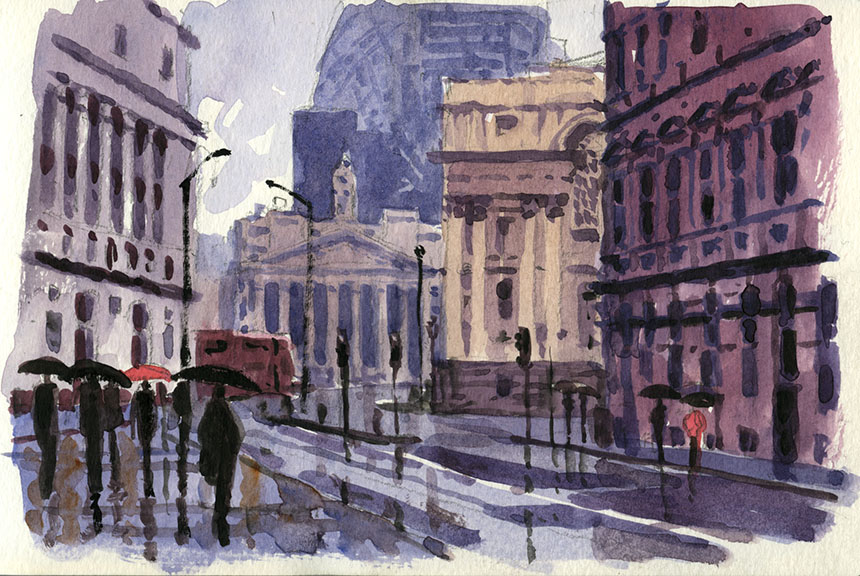
Same area a few days later… and still raining! I saw this view as we were leaving on the previous visit. You can’t really do a finished watercolour in these conditions, though it had actually stopped raining long enough for me to get this down. For this sort of sketch I try to break every area down to two washes a base wash and one dark. Then in the final pass I add the final darks across the whole sketch.
.

I was kindly invited to Dorset by my good friends Richard and Kate. Not much chance for painting as it is nice to put aside painting and just enjoy being social! I did make a few quick sketches just to fix the places in my memory. This is Wells cathedral in Somerset. 7in by 5in.
.

I saw this as we were walking along a high down in Dorset. A farmer had parked his Landrover making this very simple composition. Possibly one for a larger painting. 7in by 5in.
.

I do like my Moleskin sketchbook, it has lousy paper that is in an odd way just right! No real chance of wet into wet as the paper is too thin, but it dries very quickly which is just what you want for small sketches such as this. Dorset again near Pimperne. 7in by 5in.
.

A rather fun scene. I shall definitely do a studio one of this. Still in Dorset. 7in by 5in.
.
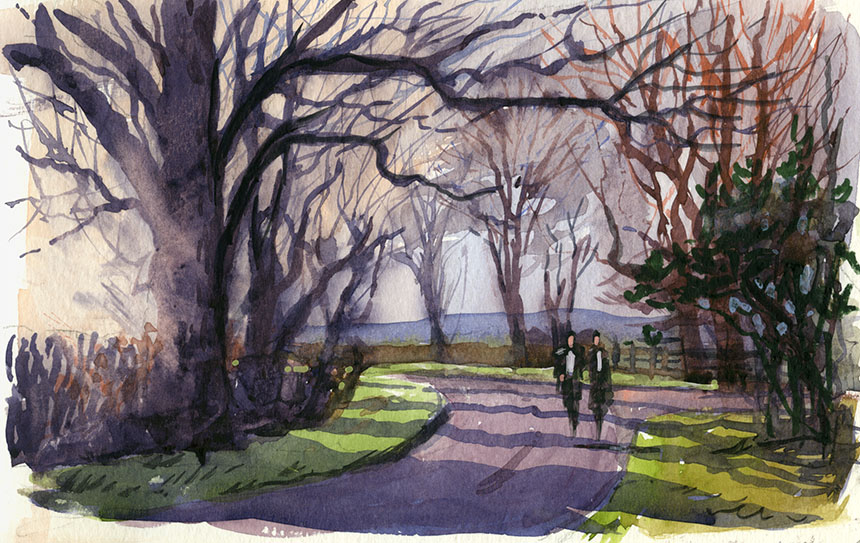
I painted this standing with my paints on a blanket on my car bonnet, the blanket being to stop them sliding off! It is a lane near my brother’s house near Hanbury in Worcestershire. 7in by 5in.
.

This is the first studio watercolour I have done in a while, based on the sketch. There is always much about the sketch I prefer but they are different beasts really. On a computer screen they are given even billing but framed on a wall the studio work tends to have more presence than a quick plein air.
.

Hanbury church which sits very dramatically on a hill. The wind was pretty dramatic too and also very cold! As with many churches you can’t get a mid distance view you are either too close or two far. I tried to exploit the closeness here and get the feeling of it being high on a hill. Actually the only real thing making you feel that is the lack of middle distance. 7in by 5in.
.
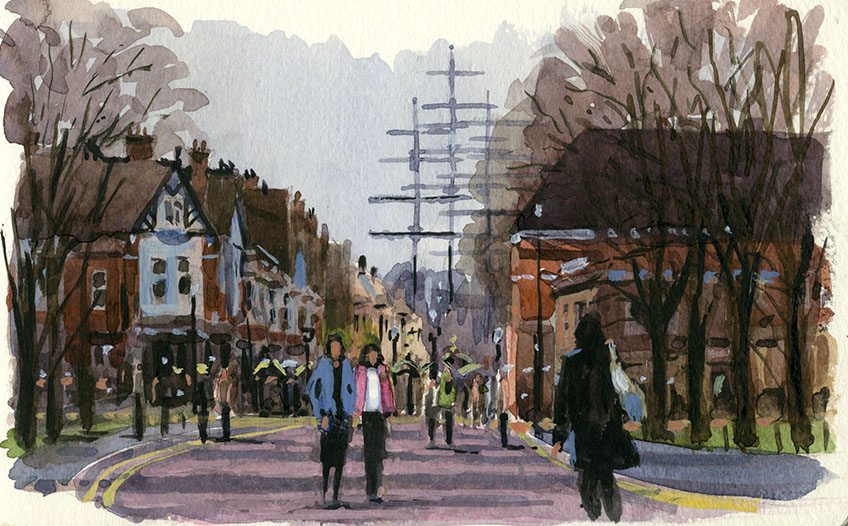
Back in town again, this is Greenwich park looking towards the masts of the Cutty Sark. Odd diffuse sunlight gave a strange feeling I ended up using black to try and catch the effect and also some body colour. I have started using white acrylic premixed in a pot instead of the traditional chinese white it has the great advantage that it can be washed over and seems to sit better with the watercolour.