Rob Adams a Painter's Blog painter's progress

July 11, 2013

Working from Photos, Working from Life

It is a subject many artists are sensitive about. I am a bit myself, if I am to be honest. There is nothing more disheartening than the supposed compliment: “It’s just like a photo!”. Just as with tracing there is a hint of the cheating about it. Just as with tracing there are pitfalls that come with using photographic source material, but that does not mean you should not use them, only that you need tactics to avoid the difficulties that they can cause. There is I feel a problem with working only from photographs and never from life. Though I am sure there are artists that overcome the hurdle. My main issue would be with those who can work from photos but cannot paint easily when sitting in front of a real subject. I would encourage all such painters to give it a go and paint from a first hand view rather than the processed flat image that a camera produces.

Once again it is not so much about what it does to the canvas but what it does to the artist. Painting from life gives you a set of tools and a perspective that will in my opinion lift your studio work even if it is mostly derived from the photographic image. You may not produce anything but scrap in your work from life, but the experience will enlarge your perspective and make you look at other work with a more educated eye.

For many years when working as an illustrator I was dependent on trawling newspapers, books and magazines for reference photos of whatever it was that I was commissioned to paint. Then there was the laborious process of merging this various information into a coherent image. My working sketches were done on tracing paper and often had many layers as I juggled with different elements. I had a vast Grant Enlarger the size of a fridge that enabled me to blow up and reduce images. All in all a cumbersome process that I grew to dislike. On my days off I would go out and sketch in watercolour and enjoy the blissful simplicity of just painting what was before me. It is only now when I am trying to establish myself as a picture painter that I find myself using photographs to do paintings to please myself. Before this period I had only painted ten or so “Studio” landscapes from photos all my other work was plein air.

Oddly this means I come fairly fresh to the act of painting framable pictures from photos. There is not the problem of disparate elements, I am working from images of scenes I have captured myself. It makes me very aware of the gulf between a photograph and a painting,  also how rare a thing a photo that will make a good picture is. When I was first out and about I snapped anything that took my fancy; but doing a lot of plein air in the last few years have made me much more selective. The other thing is that my “painting antennae” have become much more sensitive. I habitually squint and assess the tonal balance of possible subjects. I now only take a photo if it passes the simple squint test, IE does it simplify into a pleasing pattern. Bit by bit I have become better at selecting bits of the real world that have that certain something.

Once I have my photographs home I find that 90% can be ditched. Once they are away from the subject they have lost their resonance. Just a few then are “possibles.” Every now and again I get a very likely candidate and that will go on to the next stage. I am not that interested in doing paintings that I could easily do directly. What I am looking for is some ephemeral moment that was there just for a few seconds, a trick of the light an arrangement of figures and occasionally a figure that can hold a whole picture together as a focus. These also are rare things. Indeed very few pictures of people look “right”, to be useful they need a certain balance and above all a good silhouette. I trawl through photos looking for them and put them in a separate file. I might stay in one place once I have found a scene I am interested in and photograph passers by for 20 min or so. I just watch the LCD on the camera as the people pass and capture likely moments. Then when I come to make the painting I have plenty of likely subjects to populate the picture!

The main thing I need to decide is what the painting is to be about and hone that focus, it is easy to get distracted during painting and stress areas that need to be quiet and unassuming. For me also mood is very important and I often shift the palette from the original to bring a colour harmony to the picture that the photograph didn’t have. Tone also needs to be adjusted to support the composition. As you can see by this list it is much more straightforward to paint a scene from life! It is in my opinion pretty worthless to just to copy from a photograph. All the photo-realists, hyper-realists and droves of amateurs doing photographic pencil renderings leave me completely cold. To copy a photo takes far less skill than interpreting one. The former is mostly time and patience the latter is skill and experience.

A bit of everything in this post. Studio, plein air and life drawing. Alas most of my time has been taken up doing commercial work so less pictures than usual.

.

Soho, London, bicycle, sun, oil painting

A sketch for a bigger painting, somewhere in Soho I think. This is 14in by 10 in but the final one will be 36in across. I am trying to do preparatory paintings

like this for all future studio works as it should make painting the final one that much easier.

.
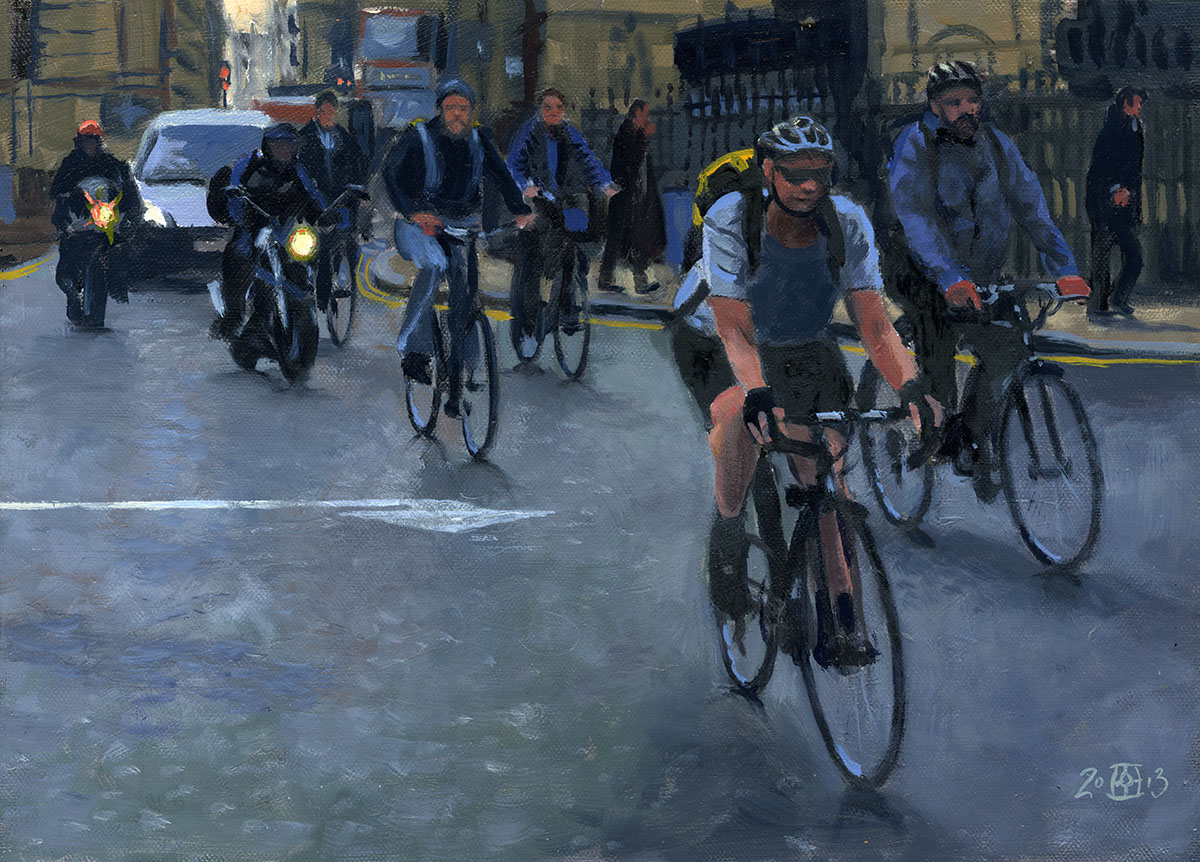
Cyclists, bicycle, Royal Exchange, London, City, oil painting

Another 14in by 10 in sketch. I stood for quite a while photographing the morning rush at the Royal Exchange in the heart of the City. When the lights

changed it was like the beginning of the Tour de France with the cyclists and motorcycles away first! I have a couple of others of these planned. I rather

like the odd mood because it is very early and the people all quiet and self absorbed despite pedalling fiercely. Below the snap that I took it from.

.

Royal Exchange

I have shown the whole frame here so you can see what I have done. The little group of commuters was perfect so I left them alone, just playing with the

tones to enhance the mood.

.

London Memorial Gardens, Embankment, plein air, oil painting

Back to the plein air. A wonderful day out with the Wapping Group. This is London Memorial Gardens near Charing Cross. I got there early so this is

7.30 am. A constant stream of people on their way to work, no tourists at this hour. About 10in by 10in. I have since muted the green on the left a little.

.

Whitehall Gardens, Big Ben, London, Park, Plein air, oil painting

After a coffee I moved straight on as the light was super. This is Whitehall Gardens , and unusual view of Big Ben. 14in by 10in.

.

Victoria Tower Gardens, Houses of Parliament, plein air, oil painting

Took on a monster here! Something not quite right but good practice. This is Victoria Tower gardens. 14in by 10in.

.
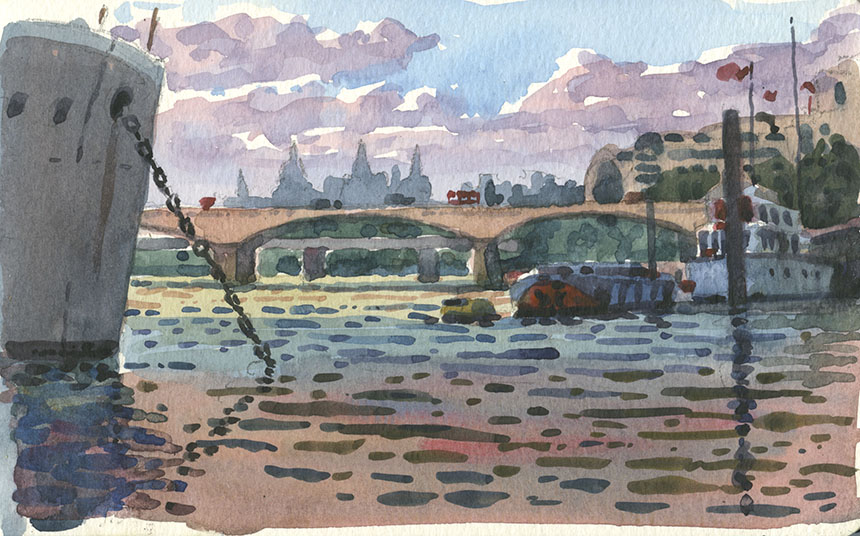
Thames, watercolour, plein air

I couldn’t resist a quick watercolour sketch, even though I am meant to be practicing the oils.  I was chased up the steps by the tide as I did this. 7in by 5in.

.

Nude, Life drawing, figure, charcoal

Only one session of life drawing left after this. This is done in brown charcoal.

.

Nude, life drawing, charcoal

More experimenting, I am starting to get the hang of this charcoal stuff a little more.

.

Life drawing, nude, charcoal

I am getting the balance of broad fill and detail better, which makes the drawing hang together more. 20min.

.

Life drawing, nude, charcoal

Another one I am pleased with, using the side of the sticks more works well on the rough newsprint. 30min.

.

That’s it I’m off doing the Pintar Rapido….. so wish me luck!

May 22, 2013

Optimism

Why am I always so up beat about the probable end result when I start a painting? I seem to start every picture with a full tank of misplaced optimism. Experience should tell me that the chances are about 1 in 50 for a cracker, 4 in 50 for a corker, 10 in 50 for a passable job, 20 in 50 for a so so and 15 in 50 for a complete minger! Looking at it that way there seems to be some similarity in being a painter to being a compulsive gambler. I doesn’t take many wins to make hope spring eternal and the nags that failed to finish soon fade from memory. The odd thing is that painting a good picture doesn’t give you a high that lasts for long, the feeling is soon overwhelmed by the anticipation of the next one. As I get older this process becomes more and more compressed, if I do a picture I am pleased with then I am delighted of course, but next morning last nights triumph is consigned to the drawer, both literally and metaphorically.

I think this process is necessary for the making of a painting. The risk of failure is part of the attraction. Overcoming the odds would hardly be attractive if the probability of bringing home the dry cured bacon was pretty much a certainty. Which brings on the thought that before setting out on a painting I must unconsciously assess the risks of failure or success. It is always very difficult to observe your own inner workings, but thinking back this is probably true for me. Before starting a picture I run through in my head how I will tackle each stage. Some times a subject will present no new challenges. This does not mean the picture is not worth painting, only that I have dealt previously with similar problems and am pretty sure how to solve them. If I fail on such a painting, mind you, it throws me into a deep pit of despondent gloom garnished with self pity!

Sometimes however the picture you are contemplating is far from certain to succeed. There are some hurdles either technically or conceptually that are hard to assess until the process of painting the picture is well underway. Also when you start a picture then all that gung ho confidence drains away as the first few marks you have made stare back at you from the paper. There is an immediate mismatch between the glowing vision of your imagined masterpiece and the reality these very prosaic initial marks. At this point your careful plan for scaling the north face of Mt Parnassus becomes more like a wobbly tightrope walk over a vertiginous chasm.

Managing these expectations is I feel a large part of being an artist especially in the commercial arena. You need the optimism and confidence to get started. You need the risk and possibility of failure to progress. If you cannot manage the disparity between how you imagine a work will be and how it seems to be turning out then you will shortly have a cupboard full of half finished paintings! It is not a problem if you can’t summon up the optimism as you would likely never start a picture in the first place… We all suffer is some degree from this it can be quite hard to set to and start.

My method of dealing with this initial stage is what I call the “Head in the sand” method. For the initial stages I don’t assess progress I just try to carry out the actions without forming an opinion of their success. At the end of a key stage such as drawing out or blocking in. I re-engage the critical faculties and re-plan the rest of the work as necessary. It is hard to describe but what I think I do is mentally let go my glowing imaginings that prompted me to start in the first place and using what I have on the paper before me re-imagine the final result. I then use this as a guide to the next stages. As a picture progresses I might do this several times, each time the imagining of the final finished work becomes easier as it is based on more and more concrete evidence of progress so far. It is often in these last stages the magic happens, you once again have a mis-match between the imagination and reality but this time the reality is an improvement!

My this is hard to explain! I will try metaphor. I am at the foot of a mountain, I see before me the peak in the distance and imagine the wonderful view from it. From where I am standing in the valley I can see the first part of the path that will carry me to the summit. However once I have climbed some way my vantage point has changed. The summit looks different and further away, also the path towards it takes me along a ridge that I could not see from the valley. Still I can see my way forward and set out on my new path. As I reach the top of the ridge it all looks quite different. What had I thought was the peak was merely obscuring the actual top. Once again I must redraw my plans in order to climb the next stage. You could imagine all sorts of hardships and set backs here that might delay your progress, the way forward obscured by clouds etc. Eventually you reach the peak and look around. The view is very different from the one you imagined while still far below. To extend the metaphor (already creaking under the strain) even more, sometimes you find your progress blocked by an unexpected crevasse and must retrace your steps! Or you get to the top only to find the view is rotten…

There are a few steps you can take to make falling off a cliff less likely. Firstly take the time to break the painting down mentally into stages, a sort of route map. You might abandon this later but you need one to make a start. Next, draw the damn thing out properly! If you have a photo ref there is no excuse for not to getting the drawing right. Use a grid, print it out and trace, project, whatever it really does not matter. Better still draw it out in a preparatory sketch and rearrange it until you are happy. Then grid and transfer that. You may see artists, I am occasionally one of them, who just leap in with the paint, but that is the result of decades of doing it the long way. After a while with much practice you develop a sort of mental grid so that part of the job is not really skipped over. Don’t jump to conclusions part way. Just because your original aim is not possible anymore do not give up. Reassess, re-plan, build a new dream from the ruins of the old. Many, many times I have painted quite a different painting than the one I initially intended, many times probably a better one. The last and hardest one is to stop when it is finished, if something does not add to the whole don’t put it in, however much fun it might be to paint.

There are also things to help you advance. Don’t just paint “safe” pictures, take risks both measured and the occasional “long shot”. The list of artists who sank into repeating safe formulas for success is long and to my mind terribly sad. If you are painting a landscape don’t paint a stock tree in a manner you have done a hundred times before but paint that particular tree in that moment. If you always paint in a the same methodical way, experiment, throw the dice, you never know it might come up a six. Be aware though it will probably bounce off the table and end up under the side board!

Hey ho, I only intended to write a few words on the subject, but I find I have gone on at length once more, here are some pictures where you can spot me not taking my own advice!

.

Mousehole, cornwall, watercolour, painting, boats, harbour

I am trying to get some studio paintings done based on my recent visit to Cornwall. This is Mousehole. I assembled the view out of a few photos which

required a fair few adjustments. It is very rare that a photographic image is directly suitable for painting either in colour or composition. Taking advantage

of todays technology I roughly put the bits I want in place and then sketch over the top in photoshop. This way I can try different arrangements until I am happy.

Cameras especially on a wide angle setting distort badly at the edges of the field of view so I usually take a series of snaps with a 50mm setting. This gives a more

natural feel in my opinion, though it is quite a lot more trouble. Tonally I had to rearrange things so that the eye ran around the foreshore to the focus, also I wanted

a diagonal band of interest with quiet areas top left and bottom right. As you can imagine this means a slight redesign of Mousehole but I hope each adjustment is

subtle enough to keep the scene completely plausible! 1/2 Sheet Arches Rough.

.

Sennen Cove, Cornwall, fishing boats, sea, fishermen, watercolour

This is Sennen Cove on a beautiful evening. The light was cross the beach in this way for only about 2 min, so no chance of a sketch! I am still exploring

the balance I want between loosely painted areas and detail. It is interesting how the different finishes can be made to sit together. Small ares of detailed

interest trick the eye into believing the whole thing must be detailed. The intention in doing this is not to save work but to avoid the stiffness that too much

overall specific detail causes. It is very much the fashion to paint everything in a frenzy of wet into wet and though I often like this style it is quite limiting

in the moods and qualities it can express. Bold bravura brushstrokes etc are superficially exciting but have difficulty in expressing quiet subtle moments unless

they are completely amorphous. Also I ask myself does the world require yet another Zbukvic, Wesson or Castagnet? I add this aside because I get weary of

people telling me I must be more loose, be more free etc. I am perfectly capable of painting in that style, I did so in my twenties for a while, but don’t choose to

nowadays unless the subject is appropriate. This one put me through the mill rather. I drew the whole thing out only to have the sky wash reveal a sizing flaw

that made a bit of paper very absorbent… after a certain amount of cursing I had to redraw on a new sheet! 1/2 sheet Arches Rough

.

Cattle, cornwall, watercolour

An old one, it is always interesting how your style changes, there is much I would do differently if I repainted this. I may indeed revisit old paintings to

see what I make of them now. It’s Cornwall from a previous visit, I was painting the church when ambushed by bullocks! 1/2 sheet, Saunders rough.

.

Nude, life painting, figure, woman, watercolour

A few life paintings from the last session. I was experimenting with pre-toned paper here using acrylic white along with watercolour.

Interesting but a little gloomy, so after half an hour I tried the same thing in pure watercolour.

.

nude, figure, life painting, woman, watercolour

Here is the result of another half hour on the same subject, much better though it is a struggle to get enough described in that time

due to drying. Wonderful fun to do though.

.

Nude, figure, life painting, woman, watercolour

A sucker for punishment I tried the toned paper again but this time was more liberal with the acrylic white. Once mixed with watercolour it is very similar

to gouache but easier to overlay. I took about 45 minutes to get this far, but much better.

.

Nude, figure, life painting, watercolour, woman

Last one of the session. A lovely pose so I reverted to pure watercolour again. I used a few bits of white to clarify. I find it is important

not to try and conceal this sort of edit it works much better if done obviously as it integrates with the drawing. Life drawings are a sort of

history of observation and the signs of that exploring add to the qualities of the end result I feel. Off to France next so there may be a delay

before next posting!

« Newer PostsOlder Posts »

Powered by WordPress

error: Content is protected !!