Rob Adams a Painter's Blog painter's progress

February 4, 2012

Too Much Work in January But a Few Pictures Nonetheless

Filed under: Drawing,Life Drawing,Painting,Philosophy,Watercolour — Rob Adams @ 5:44 pm

The title says it all, I have been doing far too much work for others and not enough for me. Even as I type that I feel ungrateful. I have great clients, who give interesting jobs and are willing to put up with my reluctance to work. Still I more and more resent anything that takes me away from painting. However I must be realistic in the present financial uncertainty. I know my hard earned savings could be gone in a flash… or at least considerably less time than it took to earn them. Our leaders are removing money from those that saved and giving it to those that splurged. You can see the government’s dilemma though, they can only take money from them that has it and that by default is the savers. I should I know just go “what the hell” and concentrate on my own work but I was brought up cautious and it sticks. Still we live in a world of unreality where you can consume yourself out of a financial hole, and everything has to grow for ever. Neither proposition merits more than a moments thought to see that they are nonsense, but still you hear them propounded by supposedly wise heads. You only make your way in the world by doing one thing and that is by being useful to others. Identify a need others have and fulfil it for some of what they have that you need, it should be simple. It has been for me, I can draw, others who need things drawn but can’t, give me money to do that for them. The focus today is for activity for its own sake as if just running around a lot and making stuff nobody need will somehow bring prosperity and civilisation. Well we do all run around like no people have ever done before in history, but a lot of the doing would be better off not done as it is merely waste.

In truth not all the world’s billions need to be working to keep us all fed and clothed. With mechanisation we can produce what we require for life with the labour of relatively few people. However lots of people with time on their hands are a government’s worst fear, the devil makes work etc. We are rapidly reaching an age where computer controlled fabrication plants will be able make most what we require without needing more than a very few souls to oversee the process. It is plain though that if that is the case then there will be nobody with a wage that allows them to buy anything. We get round this of course by inventing imaginary needs that must be serviced, service industries can, they thought, be expanded forever. We are living through a period in history that shows this to be untrue.

Take a step back. Let’s look again at those jobs that industries have automated. Not only grindingly tedious jobs have been given over to the machine, but activities that brought pride in achievement and skill. Furniture made by craftsmen has retreated to a tiny niche market  of the rich. The rest is CNC’d into being in vast fabrication factories. Yet most of us, I suspect if given a choice, would go for a hand made item if we could afford to choose. The advertisers certainly believe this with, “Homemade” “Handwoven” “Hand finished” I always wonder if that last one is the packing of whatever into a box. So if we have people spare from needful work why shouldn’t we have the luxury of crafts made things, the user benefits and the maker benefits in a useful activity that has the potential to be personally rewarding? We could make our buildings beautiful instead of merely throwing up boxes that merely please accountants. We could eat good bread instead of that sweet pap sold to us by Allied Bakery. Have paintings on our walls instead of prints. There is no particular practical reason I can see why this should not be so, but the political problems would be immense, so great as to make such utopian dreaming a fantasy.

Back to my main subject. I have been taking my water colours to life drawing of late. There has been some sea changes in my method that seems to have wrought an improvement. As with most improvements they seem focussed on leaving stuff out. It is no wonder that contemporary art has leapt to the conclusion that if less is more then nothing must be most. However like most simplemindedness a little thought shows why this is not so. As you walk to the edge of  a high cliff the view may improve but at a certain point you fall off. With art it is similar, but you can’t see the edge, so the challenge is to get as close to the brink as you can without plunging into the gulf! I have reduced my palette to just Quinacridone Burnt Orange and Ultramarine. It only takes the tiniest bit of orange to grey the blue and also oddly only a very small amount of blue to dull the orange. The result is quite a wide colour range. Enough talk, some paintings, some can be clicked for a larger view.


.

life drawing, figure, nude, watercolour, painting, Rob Adams

First one of a session, I penciled in just the major contours. With only half an hour there is not time to be over fussy about accuracy so I just have to trust my eye and not measure. One thing I try and do is just see it as a flat pattern, I even sometimes run the tip of my pencil around the shape before me to get a preview of what drawing the form would feel like.

.

Life drawing, figure, watercolour, nude, Rob Adams, painting

You always get mixings you would prefer not when working at such speed. The paper just does not dry enough in time. I could remove the patchiness beneath her stomach but this doesn’t I feel distract enough to worry.

.

Life, Drawing, figure, watercolour, painting, nude, Rob Adams

With this one I was getting into the flow and I got my timing right. There is a certain point where a wash will gently merge but not overwhelm a previous wash. I try and judge this by holding the paper up to a light to see the slight sheen that dampness gives. the best one of the session.

.

Nude, life drawing, figure, watercolour, Rob Adams, painting

The last and least successful of the session, but I feel it only fair to post the misses, there s always plenty to be learnt from your own and others mistakes. Here I lost the woods for the trees, too many hard edges and not enough areas left for the imagination, to make it worse the areas I chose to leave a bit undefined were badly chosen.

.

life drawing, nude, water colour, painting, figure, Rob Adams

The next week just warming up here, I didn’t really like the pose I should have zoomed in and just painted a section. I don’t really like poses where the model seems uncomfortable. Not in discomfort, but not in a position it is in their nature to take up.

.

Nude, life drawing, figure, watercolour, painting, Rob Adams

Much better here I felt almost in control! The key is to get the order of the washes right, something I am slowly getting the hang of.

.

Nude, life drawing, watercolour, figure, Rob Adams, painting

Arnie our host decided an hours pose would be a good idea. So I planned ahead a wee bit more. While I waited for areas to dry I did a couple of other quick studies. Though I am happy enough here the quickies turned out better than this!

.

nude, life drawing, painting, watercolour, Rob Adams, painting

First one of the quickies about 4 mins, no time to draw just straight in, great fun!

.

Nude, life drawing, watercolour, figure, Rob Adams

Last watercolour only 2 min.

.

Nude, life drawing, pastel, figure, Rob Adams

5min sketch.

.

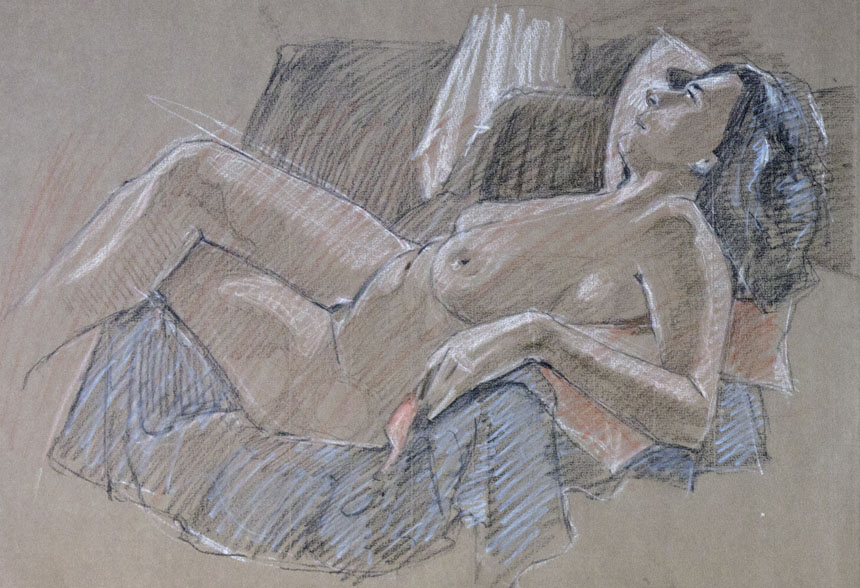
Nude, life drawing, figure, pastel, Rob adams

Half hour I enjoyed the ease of control with the pastels, but I found I had brought some lessons in leaving edges from the paintings.

.

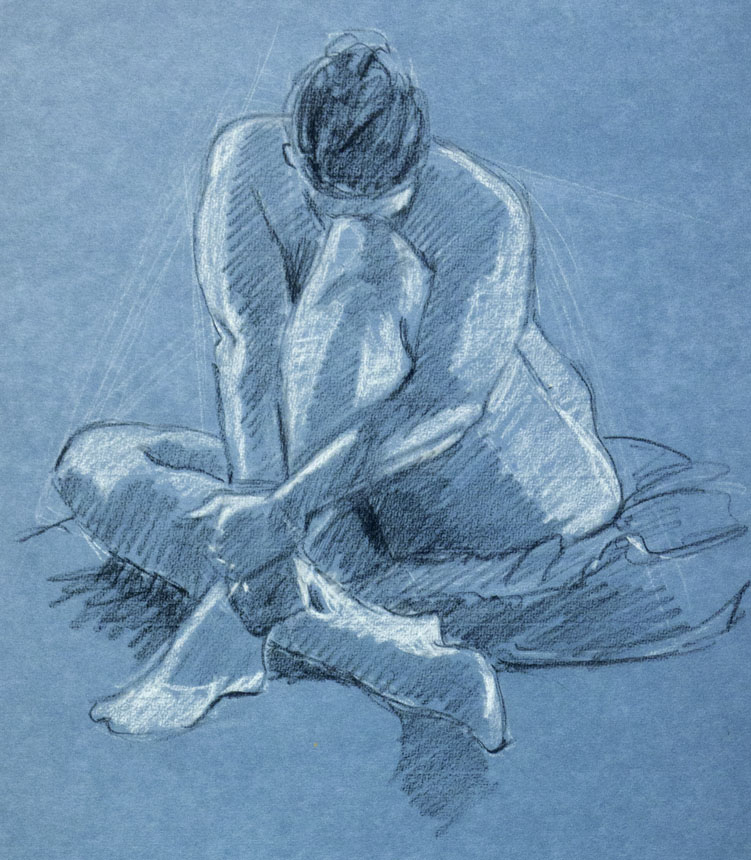
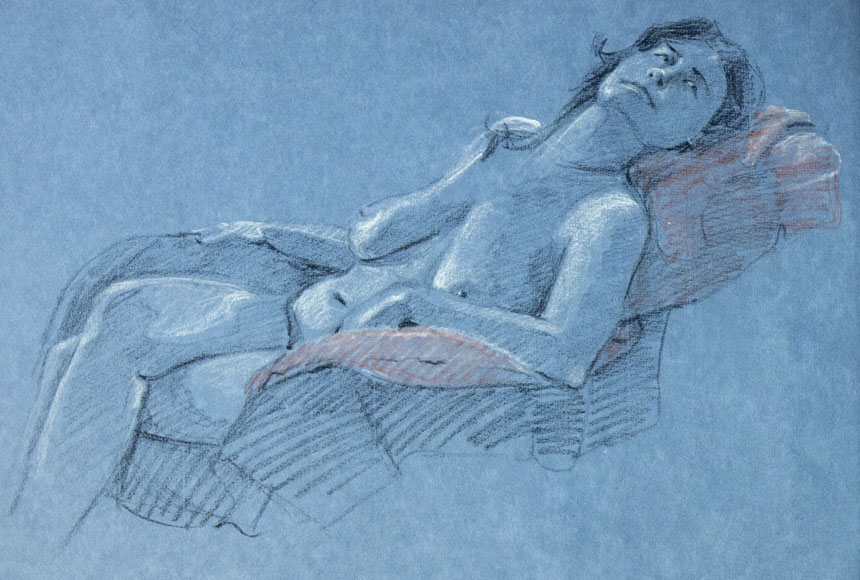
Nude, figure drawing, life, pastel. Rob Adams

Last drawing beautiful light so I just stuck to two tones and the paper.

January 14, 2012

Oils from Ireland and Abstract Musings.

Filed under: Art History,Drawing,Ireland,Life Drawing,Painting,Wales,Watercolour — Rob Adams @ 11:21 pm

I have been thinking of late about the nature of representation and abstraction which, you might say, have shared components of symbolism, illusion, pattern, language and appreciation of substance and quality. To try and gain some idea of how such elements might have been combined I have looked at how they appeared in the earliest times. First may have been appreciation of surface quality, useful you would think in identifying things that might aid survival. Which may spill over into a more abstract appreciation for a coloured or shiny stone, shells and feathers etc. Next might come the association of symbolism with these items, certainly it seems some of the first human non practical objects fall into the personal adornment category. It would be not too unreasonable to suspect a sexual attractiveness/status element here I suppose. Patterning is an early element too with chevrons, diamonds and herringbone arrangements of incised lines appearing. To some extent these are examples of ordering. Beads upon a string in alternate colours, lines or shapes made in different sequences. Weaving of natural materials could have caused development of patterns from a practical antecedent. You might weave a mat out of grass but if you have out different grass types then all sorts of possibilities arise out of the order of combination, leading in turn to generating patterns.

About 35 ,000 years ago, according to our discoveries thus far, we started to make images underground in caves. It is here we see the first evidence of illusory markings. The drawings of animals, are representational in a way we recognise immediately despite the vast gulf of time and social development that separates us from their creators. Oddly humans are mostly dealt with in a more symbolic manner with little of the anatomical observation we see in the images of bison and such. Whatever the totemic uses of such images the actual process of observing and delineation would I suspect be pretty much familiar. I dare say even that studies done “in the field” might have been brought down into the caves to aid execution rather than just relying on memory. Looking at paintings from different ages and locations we seem to have the full spread from entirely symbolic with almost no direct observation to finely observed drawings and everything in between. It is the actual production of these different types that intrigues me, the makers had to do a different sort of observing to attempt a replication of the predominantly “seeing” experience of an animal. Presumably the viewers of such creations appreciated these images in much the same way as gazing at the actual thing. There would not be maybe be the need for an added layer of deciphering and interpretation required for a symbolic image. Different cultures seemed to have various balances, with Australian aboriginal peoples being more slanted towards the pattern and symbolic, compared with the European examples which lean more towards the illusory. It is tempting to compare the relative degrees of change over the millennia of the different cultures. Certainly the Australian peoples remained unchanged until recent times, whereas other cultures display a more mercurial nature, due I suspect to environmental pressures. Whether this is connected is moot, but possible I suppose. I does seem to be true that certain key ideas such as wheels or agriculture are not at all things that are at all certain to be developed by a culture however complex and sophisticated otherwise.

Representing the direct visual experience does have an advantage that symbolic images of the world do not. To decipher a symbolic image a shared inherited culture is needed, with an illusory image that is not so much the case. We today understand the simple aspects of Egyptian imagery without needing to be aware of the underlying symbolic meaning. Interestingly many cultures assemble imagery of a predominantly illusory/observational nature into sequences that have a narrative or symbolic purpose. Chinese painting, for example, combines observed elements arranged and used much in the way we would compose a poem individual of words. It also allows a key development when you begin to combine parts of illusory images that would not usually occur together. So you might attach the head of a jackal to a man bringing in to being an imaginary creation. It is harder to do this with purely symbolic imagery, which maybe such chimera don’t appear as much in Aboriginal creations. So rather counter to reason realistic observation can become an engine of imaginative “unreal” creativity.

It seems to be quite late on that observational imagery of place appears. In Chinese painting there are arrangements of mountains and waterfalls and fruit trees but these are observed parts not a coherent observed whole. Egyptian imagery has foreground detail of plants but no distant hills. In most cultures imagery concentrates mainly on the protagonists and their prized possessions. It is not really until the representation of saints in Christian art that coherent depictions of place occur. Then we must wait a few more centuries until the first landscapes that are concerned only with place make their appearance. Further centuries will pass before people and place will be brought together in compositions that combine the two equally. These works also are also the end result of a slow draining of symbolism from painted images in particular. Impressionism is the extreme version of this.

The revolution we term “modern art” is to some degree a return to symbolic content and pattern by arrangement. A good abstract painting might be only calling on the appreciation of surface quality, or pattern in arranging colour. Surrealists go back to combining observed content with symbolic. In both cases they represent a step back into the deep past (I am making no judgement of worth here) When looking to the future I do wonder if, as in other reconsiderations of earlier times, if a rapprochement will take place between proponents of illusionistic representation and those of abstraction and if so what it would look like. Certainly the production of work that uses the power of illusory image-making to create unreal or impossible visual experiences proceeds apace in the commercial arena. Sadly for the most part neither group will deign to consider the other with any respect. A situation I find a little odd. People engaged in the the production of imaginary illustrative content scorn the often admittedly weak technical skills of the fine art world and in response the fine art world rather hypocritically dismisses illustration, which tends to suffer from weak intellectual underpinnings, as mere commerce and of no cultural significance. Both positions are in my view misguided. Rather sidelined and marooned are those who work away at some historical style such as impressionism or classicism. Again each seem to revert to the Orwellian two legs good four legs bad position. The former scorning any narrative content the latter nailing their colours to the restrictive mast of the atelier system of development. Most by ways and backwaters of art history have their proponents in our content rich world, and that is perhaps in the end the defining characteristic of our time. Never before has so much visual eye candy from so many ages been there to appreciate and absorb. It is hardly surprising that the result is fragmentation. I would put in a plea for artists and critics of all persuasions to celebrate this diversity and not spent fruitless energy in attempting the worthless task of promoting their particular corner of creation to prominence over others. Alas due to human nature this is unlikely I suppose, current top dogs and recipients of state largesse will no doubt hang on like grim death, stamping down and decrying any possible competition.

Now for some light relief a few paintings and drawings. My Christmas expedition wasn’t terribly productive oil painting wise, but a few got started and almost done despite the elements. I have also managed a couple of studio efforts. These and a few life drawings added on for garnish are all I have to offer this post. The oils can be clicked for a larger image the drawings not.

.

Ireland, Eire, Oils, Plein air, Painting, Clare, Rob Adams

The weather was against me here, it was windy and drizzling as well which combined to turn the paint into mayonnaise! So a fair amount of tidying up needed, but the painting didn’t change in essence so by my very unpurist judgement this is a plein air.

.

Burren, Clare, Ireland, eire, plein air, oils, painting, Rob Adams

The only oil I completed plein air this Christmas. The chances of the weather and light being agreeable at the same time were slim so this was done very close to base… The upside is that such changeable weather does produce wonderful moments of light. At sunset or any other time of day a certain subject will produce a scene that is more or less the same, I have many photos from different years that show this is so. But inclement weather will consistently throw up unique lighting combinations that can make the humblest of subjects look glorious.

.

Ballyvaughn, Clare, Eire Ireland, Plein air, oil painting, Rob Adams

I got the drawing done and the sky and reflections in the water, then had to run for dear life for the car as the heavens opened. Still once these elements were established the cottages and foreground rocks were straightforward to finish. There is something that desperate haste adds to a painting that is hard to quantify but often a good thing… except when the whole thing gets scraped later of course.

.

Famine Rd, Oil, painting, Clare, Ireland, Eire, Rob Adams

This one I had only drawn in when a large tractor and trailer forced me to move on. I wasn’t terribly taken with the subject so I moved on. Once home however I thought it worth finishing. Not sure about this one but it did prompt me to experiment on the next one in a way that I found very interesting. On this I worked scrubbing in as dry as I could and then working over.

.

Famine Road, east Clare, Ireland, Eire, oil painting, Rob Adams

This is looking along a “famine road” built during the Irish potato famine to provide labour for the destitute. Oddly one of the requirements was that they had to go nowhere. Here I tried an experiment I laid the areas down almost as I would a watercolour painting putting in one tone and leaving clean primed board where the next tone was to go. So almost no brushstroke was laid on top of another but only side by side. I allowed the ragged edge of the bristle brush to define the edges between strokes. Once the prime was all covered I did the least I could to pull it all together, in the simplest terms I looked for bits that didn’t quite work and replaced them with stuff that did, until nothing caught my eye as being out of place. The I stood back and looked at it as a whole and accentuated some areas and suppressed others. Overall I am pleased at the result, this sort of subject is always on the verge of turning to mud but in this case the mixed greens and browns retained their individual character and stayed fresh.h

.

Life drawing, nude, rob adams

A few life drawings to finish off.

.

Life drawing, Rob adams

.

Life drawing, Rob adams

.

Life drawing, Rob Adams

.

Life drawing, Rob Adams

.

Life drawing, Rob Adams

That’s it… new life drawing starts on Monday, a great if frustrating pleasure!

« Newer PostsOlder Posts »

Powered by WordPress

error: Content is protected !!