Rob Adams a Painter's Blog painter's progress

April 17, 2011

Spherical Perspective

Filed under: Drawing,How to do,Perspective — Tags: , — Rob Adams @ 11:30 am

This is the first instalment of a few posts on perspective and how we can use it in making images. This post is quite advanced but I do intend to do a “rule of thumb” perspective guide for those not of a mathematical bent. For now we are in the world of curved perspective which can be scary but explains a little about why even when we follow the construction rules of perspective things can look “wrong”. This is especially true when we use what in photographic terms is called a “wide angle”.


.

Spherical, Perspective, drawing

So here we go… We might assume from what we are taught about perspective that this is the way we actually see. But it’s not. In the outside world there are straight lines, so we put them that way into our pictures. We have developed complicated schemes of geometrical rules to guide us. We take photos with cameras that have lenses that carefully distort the world to make it fit with the expectation that straight line should be straight. But visually they are not. Have you ever tried to draw that really large checker board floor? Somehow at the far right and left it goes all stretched. Do the same thing with circles on the floor and it gets really wild. Just look at those ellipses on the far left they get really funky! Have you ever tried to stitch together that big panorama? They never quite fit do they. But if you take lots of pictures say every 5 degrees and just use the middle strip of each, it’s sort of easier. And when they’re all stuck together, well… those straight lines look distinctly curved. In camera terms we call this a Fish  Eye lens effect.

.

Spherical, Perspective, drawing

Spherical, Perspective, drawing

Let’s find out why this happens. Take the set up above. Simple enough, a railway track, a station and you. Now perspective and our eyes tell us that things get smaller as they move further away. I’ve no problem with that. So here goes. If we look straight ahead Say “B” then the track is quite close. If you drew it it would go straight across the page left to right. If we look to our right say “C” then the track in the center of our vision is a lot further away. On the right the track vanishes at a point on the horizon. These pictures are both fine but you wouldn’t want to try and join them together! But wait a second, the track really is joined together. And we haven’t moved. We just looked to our right…If we looked to out left then we’d see the track go to a point at the horizon again. So what have we got? one set of parallel lines and two that meet at points. This isn’t looking much like a railway track!

.

Spherical, perspective, drawing

Let’s see what’s really happening. Imagine if we do a whole set of tall narrow drawings turning our heads a little for each one and then stitch them together. This gives us the result above. If we were a chicken – or even a fish- this is actually how we might see it. We are not quite so different from them as you might think. You don’t, after all, keep your eyes still when you look at a scene. Indeed your eyes only do detailed looking with a small patch of our retina called the fovea. The brain then stitches all the bits together rather like you do in a photographic panorama. On top of all this we turn our heads. In real life we can soak up a huge vista of visual information and glue it all together seamlessly. Our problem as artists is to get some of this down on a piece of flat paper. So let’s try find out what’s really going on and how we might use it.

.

spherical perspective, drawing

So if we take our camera and take tall thin pictures of an endless gridded floor and see what we get. I’m using a virtual one as endless gridded floors are a bit thin on the ground around here. The image above is the result  in which everything joins up neatly. It looks pretty fisheye when it gets very close to us, but every paving stone joins every other where it should and is the right size for its distance from us. It’s also plain that It will repeat all the way round 360 degrees. That’s good too because it’s a well known fact that endless gridded floors do just that!

.

spherical, perspective, drawing

Here is the same method applied to our polkadot floor which looked so weird in the first example. This is a 180 degree view so very wide, but none of the ellipses are tilted and everything joins up in a logical manner. The problem of ellipses in perspective is a very old one which renaissance artists puzzled over a fair bit. This was due to their often needing to draw long rows of receding cylindrical columns which using linear perspective would look distinctly wonky on the far left and right. They devised a simple cheat which modern artists seem to have forgotten, but I will deal with that in the next instalment.

.

cylindrical, perspective, spherical, drawing

Here is our grid joined up so you can see how verticals work, you could easily imagine laying out a cityscape on this grid. You can repeat it endlessly if you mirror it left or right. This is the most useful curved perspective and is called Cylindrical perspective it is the equivalent of two point perspective, I will deal with the horrors of full Spherical perspective next! But first below an example of Cylindrical perspective by the wonderful M C Esher.

.

Escher, perspective, cylindrical

This is called House of Stairs and is made using the same grid I drew above, but swivelled through 90 degrees.

.

Spherical, perspective, drawing

Now we are entering the strange world of Spherical perspective. The above grid can as before be duplicated endlessly, I know it looks like an impossible spiders web but it is the same as the cylindrical one except the verticals curve too. This is the equivalent of 3 point perspective as when you look up at a tall building and the top diminishes. The image above can be clicked for a larger version.

.
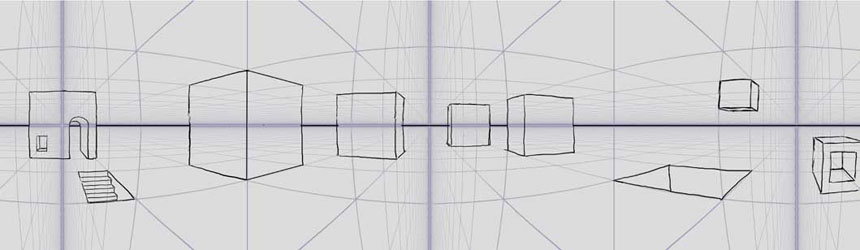
spherical, perspective, drawing

Here is the same grid used to place a few very simple forms. I takes a little while to get your head around it but if you print out the grid and scribble on top of it you will soon get the idea. For the mathematically minded the geometry of the Spherical grid is Hyperbolic whereas the traditional straight line perspective is termed Euclidian.

.

spherical, perspective, drawing

Here it is used in anger. You can click for a larger view. As with all spherical perspective the nearer you get to looking down at your toes the odder it looks!

.
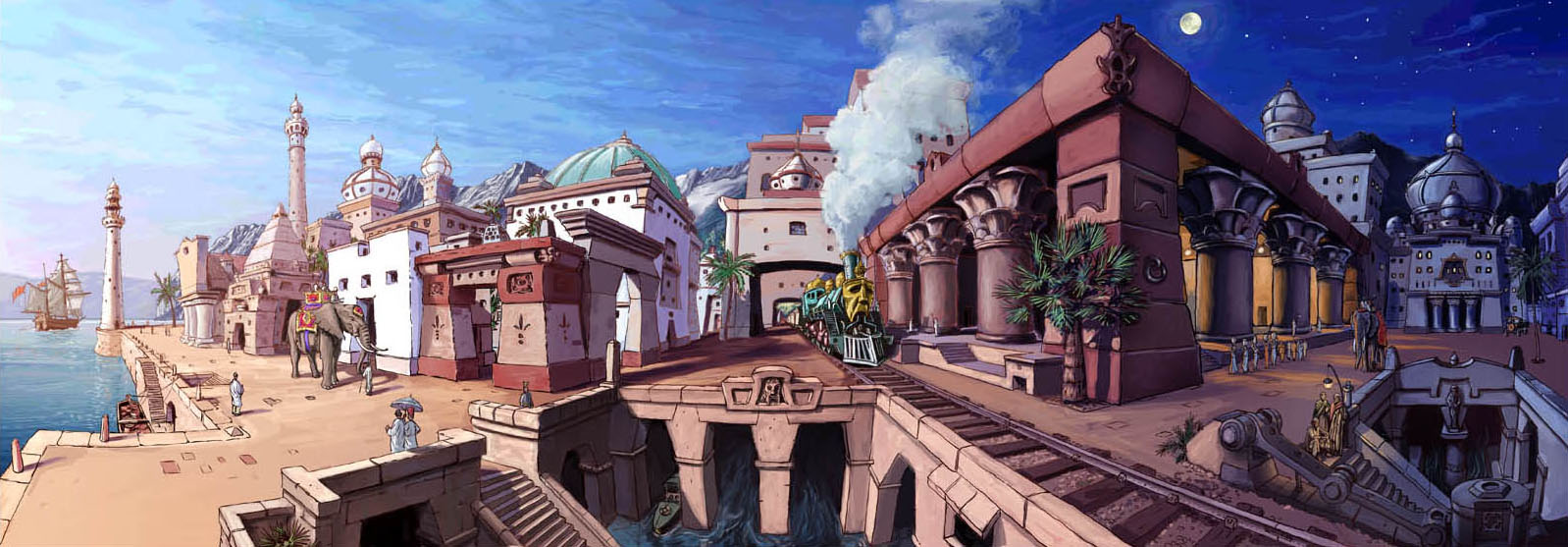
spherical, perspective, drawing, panorama

Here it is finished. You can click for a larger view. The examples I have given are extreme ones in order to show the principles involved. We don’t often draw or paint 180 degree panoramas. But the same principles can be applied to good effect in more ordinary views where to the casual viewer the underlying curves would be to subtle to notice but they will unconsciously find the painting just that little bit more believable especially in townscapes and other subjects with a lot of man made rectilinear content.

April 16, 2011

A Few Days in Cumbria

Filed under: Cumberland,Drawing,Painting,Watercolour — Tags: , , , , , , , , — Rob Adams @ 2:08 pm

Having found myself with an empty diary for couple of weeks I made a quick decision and packed up my paints and headed off to Cumbria via the Midlands. There is nothing like being alone in a lovely place to concentrate on the painting. I know this sounds a little antisocial but there is no getting away from the fact that everybody wants to sit down to eat in the evening just as the light is at its best! It was great to paint countryside again as I have been very focused on urban subjects for a while. So much so that I struggled at first with the change of scene. Despite the beauties on offer I found it difficult to “settle” on on a scene, there is always the feeling that there will be a better subject around the corner. This visit I was more organised than usual in marking potential subjects on the map and using a compass to determine what time of day the light might be good.  Good in theory but I only got back to paint a couple of them so I will plainly have to make another visit. I did almost equal amounts of oils and watercolours which really drove home to me that I have a fair way to go before I am as comfortable with the oils as I am with the watercolours.

The only route to getting better at anything music or painting is to practice and practice, with music at least the failures vanish into the aether, but unfortunately paintings hang around to remind us of the time we didn’t quite nail it! It is the sad case that to do any good paintings you have to paint a lot of bad ones and I find it best to just accept that as the case rather than dwelling on it too much and undermining self confidence. As with sport or music a lot of it is “in the head” and I find it is worth using a few simple strategies to get “in the mood” to carry a painting through to completion. With nearly all paintings the pattern of emotional ups and downs is fairly similar. First I sketch out with boundless optimism eager to get to the painting stage… I have learnt to rein this in a bit as it is easy to rush in too fast to the rest of the process. So I try to just pause and reconsider the scene, sometimes this leads to a complete redraw but more usually a slight rethinking of what is important. It is during the blocking out stage my confidence tends to drain away as the many things that need to be balanced and the different ways areas might be treated compete for attention and can overwhelm. I get through this by muttering “Big to little” under my breath, what I mean by this is getting clear in your head what the main tonal areas are and dealing with the required relationships one by one from the lightest to darkest or vica versa. The other thing to is to get decided upon what the order of compositional importance is, IE which part or aspect is the star of the show and which ones are the supporting roles. The next hurdle is stopping myself rushing to get to the “fun” bits. As you proceed you start to see the touches that will bring the whole thing to life, the wood from the trees as it were. The temptation is to skip past less important areas that need to underlie but will come back to haunt you if not done carefully. I try and avoid making judgements as to the worth or not of the painting as I actually do it. It is easy to convince yourself that the thing is a failure when it may not be. Even when I have finished on site I try not to make any final critical assessment as immediately on completion you just don’t have the emotional distance to gauge the merits or not. I often change my opinion about something I have done once a few days have passed sometimes demoting a picture I thought successful or seeing something in one that I thought just “so so” that I had missed when just completed. Despite all this 4 or 5 paintings got wiped off at a late stage, for some daubs there really is no hope! Most pictures can be clicked for a larger view.


.

Oil painting, plein air, cotswolds

When crossing the Cotswolds heading North I was much taken with the raw newly ploughed fields so I stopped and painted this 14in by 10in. The wind was very strong and bitterly cold and the light rapidly changing. I might do a studio painting based on this despite its flaws as the subject has some interesting abstract possibilities that could be brought to the fore.

.

Watercolour, painting, plein air, art

This was a very picture book scene but very typical of the area. I enjoyed painting it as it gave me the feeling of having “got started” on my expedition.

.

Watercolour, road, cotswolds, plein air

I came across this scene as I drove towards Snowshill on the edge of the Cotswolds. I was taken by the bleak simplicity. I didn’t quite get the tree to my satisfaction but I think this will make a good picture if I redo it with a slightly looser treatment. Not possible on site alas as the wind was actually blowing the paint across the paper!

.

Alcester, Droitwich, salt, roman road, oil painting, plein air, road

A peaceful road… not if you were painting it, the backdraught from the passing lorries nearly lifted me off my feet on a couple of occasions. I had a lot to get down in a short time and the light was very flat. A great subject though and I shall return and do it again. The road is a Roman one used to carry salt from Droitwich in Worcestershire, this stretch is just in Warwickshire approaching the old town of Alcester.

.

Patterdale, Cumbria, lake district, watercolour, plein air, painting

The Lakes at last! Over Kirkdale pass and looking down to Brothers Water and Deepdale. Cloud shadows over the hills, who could ask for more. I cheated the view point to the right to give the feeling of being in the road. This is something I quite often do as it gives a feeling of being “in” the scene.

.

Martindale, cumbria, lake district, Ullswater, plein air, painting, oils

My first full day and a wet and windy one to boot. I had to weigh down my easel with big rocks. I need to refine my treatment of winter trees, I’m getting better at them but not quite getting the balance of detail and brevity of brushstrokes I would like.

.

Ullswater, cumbria, lake district, plein air, watercolour

More trouble with winter trees! Although I often like the result when watercolourists reduce a tree to a quick wash and a few sticks I feel it doesn’t really do them justice sometimes and it is easy to fall into the habit of populating your scenes with”stock” trees rather than taking on that particular tree. Here I made the error of going in too dark too soon which reduced my options later.

.

Aira Force, waterfall, cumbria, lake district, oil painting, plein air

This is Aira Force waterfall near Ullswater. Great fun to paint though the mist from the fall made me and my palette quite wet. I was very tempted to take this further but decided to stop at this level. I can always do another from this and reference. The first things I scrubbed in were the sky and the falls in white on my red ochre ground, once that was established this was very straightforward to paint.

.

Aira Force, Ullswater, Cumbria, Lake district, plein air, oil painting

This is the path to the waterfall, I loved the mossy tree choked gorge with the sound of the water rushing below. I painted this over a couple of evenings as it was close by, so I took a slightly more measured approach to building up the tones which gives the picture a softer look.

.

Tarn Hows, Tom Gill, plein air, oil painting, cumberland

More waterfalls! This another of those magical Lake District valleys called for some reason Tom Gill running down from Tarn Hows. A delicious spot to sit and paint especially as the weather had changed entirely and become warm and sunny. It’s very tempting to over do water so it is of the utmost importance to keep it loose and expressive and not get hooked on the detail however beguiling it might be.

.

Windermere, Cumbria, lake district, oils, plein air

Lake Windermere at the end of the day. Started a little late and it was almost dark when I put the last details of the boats.

.

Ullswater, cumbria, lake district, plein air, oil painting

Late in the day on Ullswater, a much painted view I suspect, it was done by Turner I know. He had cattle in the lake in the foreground… but they would have drowned I reckon! I had to paint this very briskly as the light was going fast so all dine in forty minutes or so. I did it on a dirty raw sienna ground which I rather liked against the blues.

.

Small Tarn, Haweswater, Watercolour, plein air, painting

This was a wonderful day. I walked up from Haweswater to Small Tarn, a stiff climb with all my gear. At the top I was rewarded by this view the shapes and the way the light simplified the shadow was a delight. The only technical challenge was the water, getting the feeling of the stony bottom running under both the reflected sky and mountain areas. This sort of scene you have to be very careful in getting your tones right and I did several tests on the back of another sheet before committing to the paper.

.

After doing the lake I back tracked a little to do this. I know another waterfall, I can only apologise. This was quite hard to paint, getting the relative tones was very tricky. To some degree you can “choose” what colours to see in a scene.In the previous one I saw the purples which took the pasture towards yellow. Here I chose to pick up on the Ultramarines which moved the grasses towards the green. But all the tones in this were aimed at one thing which was to give enough tonal leeway to express the sunlit waterfall and make it really sparkle. In the end I spent more time mixing tones and hues than I did in actually applying the paint to the board!

.

Small Tarn, Cumbria, High Street, Mountains, watercolour, plein air, painting

I dumped my oil painting gear down a crack as it was just too much to haul any further. There was nobody about and I had the hills pretty much to so I though it safe enough, though I carefully took a photo of the place I hid it so I could pick it upon my descent! This is Small Tarn seen from high up it was fun deciding the relative tones and hues of the shadows as they grew distant.

.

Haweswater, Cumberland, lake district, watercolour, painting, plein air

A last one for the day, I was dog tired by now but couldn’t resist this view of Haweswater as was nearly back to where I started.

.

Martindale, Ullswater, Cumberland, lake district, plein air, watercolour

A walk on my last day up Martindale. I didn’t settle to paint anything until on my way back as the light was too brash. It was only when walking back to the car that the sun had dropped enough to throw a shadow over the valley floor. This was done from the bridge with the ever present danger of death by passing 4×4 or tractor. Looking at it now I wished I had painted it a little more thickly and a wee bit looser.

.

Ullswater, Cumbria, watercolour, plein air, painting

A last painting for the trip. A perfect scene, the water easily simplified by the differing reflections.

.

Drawing, pastel, sheep, ewes

Some sheep to finish off, I intended to do a picture with sheep so I sketched the woolly blighters in anticipation of finding the right scene. Alas it never happened so they will have to wait for another day and will probably end up in a field in wales!

« Newer Posts

Powered by WordPress

error: Content is protected !!