Rob Adams a Painter's Blog painter's progress

September 20, 2017

Seeing

Augmented reality, the media tells us, is the next big thing. They don’t seem to realise that the basic human being has it built in already. The light that bounces off and passes through our exterior world and the photons bouncing around inside our eyeballs have no idea what they might represent. There is no tree photon, or sky photon. They just have amplitudes and wavelengths which we call brightness and colour.

When we do what we call seeing everything obvious comes ready labelled by our image processing system. Houses are houses, trees trees and even things that are obscure are given tentative labels such as scrubland or hedge. We have all had the experience where our heads up display has got it wrong and we realise that there is a building in that clump of trees, or when walking home in the dark when the brain frantically relabels that dark blob as a parked car we are about to collide with rather than a hedge.

The image processing does not stop there. The shadows are lightened the brights are darkened so we can perceive details within those areas. You have all I expect noticed that your sky in a photograph will come out almost white and over exposed if you set the exposure to show detail in the shadows. 80% of the colour you see isn’t there, only a tiny part of the eye, the fovea, sees in colour. Our image processing software paints the rest in. If in tests a red light is put in the peripheral vision, with the subject fixing their attention straight ahead, when the light is changed to green the subject will continue to see it as red.

When looking at our fellow humans the process goes even further, our heads up is supplying age, sex and status information on the fly. It even supplies narrative guesses such as: that group is a family, or those two are a couple. We astonishingly can even work out the mood and emotional state of passers by from their general demeanour.

For the observational painter all this post processing this causes major problems. We see trees labelled as green when they are often a grey brown, we see the sky as blue when it is really a steely grey. As I have mentioned we see the darks as lighter and the brights as darker. The problem is that if you paint the post process version of your perception then when someone else looks at your picture they reprocess the whole thing again. So your darks which you painted too light appear even lighter and the light areas such as the sky duller and not as you had hoped luminous. Your brown trees, which you eyes have made you paint in phthalo green, get a further boost into luridness when viewed by another.

Paint manufacturers don’t help by selling us lots of very bright pigments which we put out on our palettes. Odd really as 95% of our picture is probably going to be brown or grey even if we are painting that day in a funfair. Digital camera manufacturers and before them film manufacturers did and do much the same thing. Most of our cameras process the images we snap so that the greens are a brighter green and the blues of our skies the expected pure bright blue. They also process contrast so that our images are punchy with dark darks and clean whites. What is called properly exposed… the real world is however often not properly exposed and it is that version we need to try to paint.

So if we are to observe the world for purpose of painting it we need to strip away the processing. We do not need to know that the tree is a tree or the house a house. They are just shapes that have a tone and a hue. This is not easy to learn how to do. Even harder is to strip out the tonal adjustments our perception systems make. The best way  I have found is to squint. If you progressively close your eyes down to the thinnest slit possible you will find that the image starts to break down into simple tonal areas. The shadows will coalesce into single areas without interior detail. If you make a small hole in a but of black card and squint through that it makes the process a little easier. Or you can take a snap on your phone with the image effect set to sepia or similar.

The other method I use is to make a small ring with my fingers to look through and flick it quickly between areas. This way you can quickly determine that the darkest colour in that threatening sky is still way brighter than the road that your eyes perceive as quite light. I advise going and getting bits of the world and plonking them on your palette next to the colour that you have mixed for it. This is especially disconcerting with greens. Go and get a leaf from that bright green tree you are painting, you may be surprised!

The aim of all this is to be able to paint the world so that the viewer of the painting does their usual post processing of the visual stimulus supplied by your picture without the overlay of the painter’s own visual system doubling everything up. This will produce a much more nuanced, lifelike and subtle perceptual experience when you picture is looked at.

Detail is another issue. We don’t actually see all that detail. The brain just puts in off the shelf wall paper to fill in the gaps. So that detailed city is not bespoke it is generic. Only if you concentrate on it as you do when painting do all the buildings take on individual character. Many people never actually see the world as it is only as they expect it to be. So when painting if you put in all that detail it looks unreal like a photograph rather than something seen by a living eye. What you need to do is find a generic language of marks that says buildings without being specific. You will be amazed when people compliment you on all that detail which isn’t actually there. So like in the real world their brains filled it in because that is what they expected from the clues you gave them.

The purpose of all this is to give your paintings the immediacy and mystery that looking at the real world through human eyes gives. Nobody after all stops in front of a real scene and says, “Ooh it’s just like a photograph!”

Wellington Clock, Swanage, Dorset, plein air, watercolour, painting

This is the Wellington Clocktower which once graced the end of London Bridge. It was found to be in the way of the traffic and got demolished and rebuilt by the shore in Swanage. We have had wonderful skies lately and this day was no exception. I took a fair few photos as it changed with the idea of doing a studio oil. 12in by 8in watercolour.

Swanage, wellington clocktower, Dorset, oil painting

Here it is. Watercolour is so good a luminosity, but oils are great for solidity and form. I tried to keep the touch light but not to ape a plein air work. One of those paintings that I felt “ho hum” about until it was in its frame where it sprang to life. I think it is paintings with very open edges such as this where a frame allows the feeling of more beyond. 20in by 12in Oils.

Swanage, Dorset, Plein air, oil painting, beach

I’m starting to get a taste for beach paintings, this is Swanage again. The mood has changed now that Autumn is looming and the schools have swept the children and families from the shore. I stretched the view a little left and right perspective wise as a camera would to accentuate the sense of space. I spent about 20min on the town and mid-ground and then battled for 40min doing the beach! Areas that have very little going on can be some of the hardest things to paint. 14in by 10in Oils.

Melbury Hill, Dorset, plein air, oil painting

This was a real quickie as the light faded. It is Melbury Hill from Shaftesbury. Dusk when the sun is below the horizon and there is a cloud cover as well is a very tricky mood to catch. I didn’t really manage it this time but it made me want to go back for another stab at it! 12in by 8in Oils.
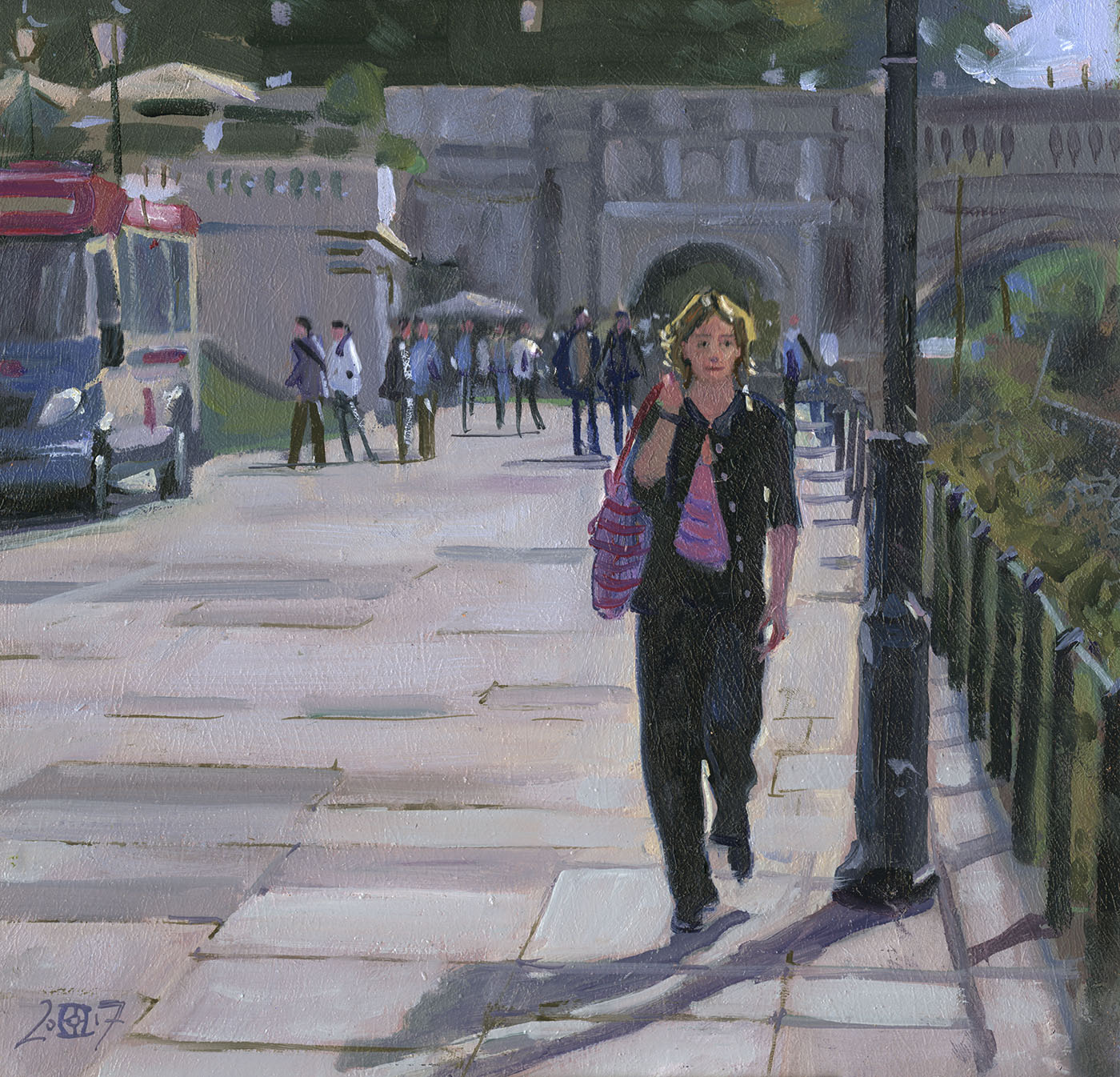
Richmond, Thames, oil painting

This was started a couple of years ago when painting with the Wapping Group by the Thames in Richmond. I dug it out of a box and thought it had potential. I remember getting the young lady in and feeling pleased she worked so well even though her legs belonged to another! I then added a couple with a dog going the other way and it all fell apart. Luck has a big part in painting and the couple was obviously pushing mine too far. As soon as I saw it afresh I had the idea to simply remove the doggy couple and just have empty paving. A bit of tidying up and I was quite pleased with the result. 10in by 10in oils.
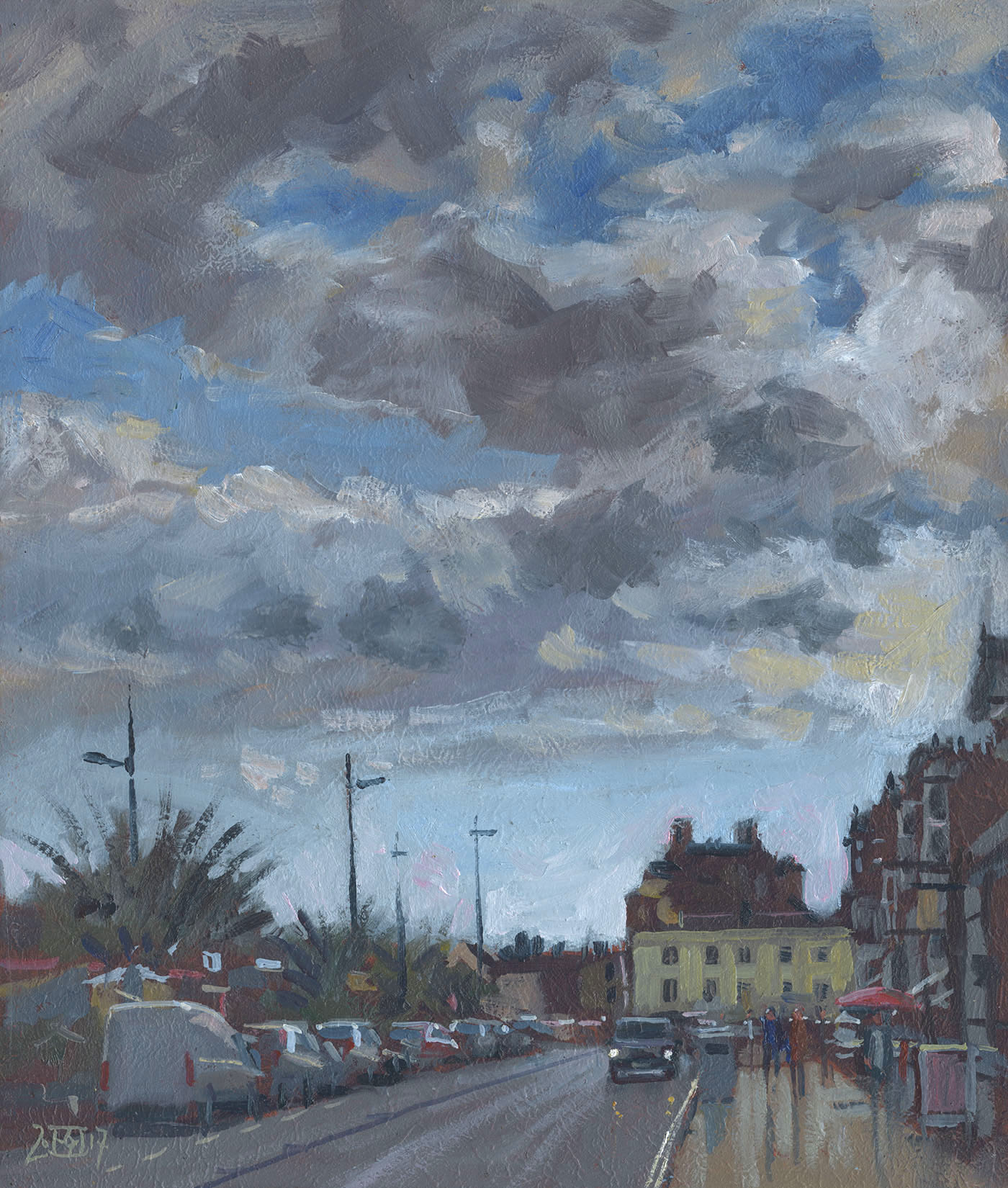
Weymouth, Dorset, esplanade, plein air, oil painting

To the seaside again! This is Weymouth on a wonderfully dramatic and showery day. A real struggle with the elements so the picture is a bit rough around the edges. On getting home I considered tidying it but decided best not. 10in by 12in Oils.

Weymouth bay, sea, storm, oil painting

Another one from the unfinished pile I am working through. The storm was painted looking across Weymouth Bay about a year ago, but I had tried to paint beach in the foreground and had given up halfway. However on this last visit I had taken a snap of the sea and a not too dissimilar sky which I whacked in across the bottom. Much better with this sea as it adds a touch of colour, the painted out one was rather grey . 14in by 8in Oils.


July 16, 2017

Natural

Filed under: Dorset,Painting,Uncategorized — Tags: , , , , , , , — Rob Adams @ 9:30 am

Natural, if ever there was a word or idea that has been more misused I can’t think of one. It’s inverse too, “unnatural” is often brought to bear on anything we vaguely disapprove of when we can’t think of a rational reason reason for the dislike. “She/he is a natural.” Purports to explain talent, or more likely as a comforting explanation of our own lack of achievement. We use it to explain bogus logical sequences: “They over thought the whole thing, so naturally it all went wrong.” Natural has been put in front of so many things that I hardly know where to start. Natural Philosophy. Natural Science. Natural Law. Natural Wastage. Natural Birth. There are forces of Nature. Naturism. We explain our own misdeeds as going against our better nature. Behaviourists and others agonise over nature versus nature. Nature is at the same time the nurturing mother and red in tooth and claw.

In general we mean natural as made or carried out by intellect as opposed by stuff that just happens. The division of the universe into things effected by the workings of conscious thought and those that are not. A problem is of course that intellectual processes are also just stuff that happens, so any neat division starts to look a little fuzzy. People seem to love to divide things into Natural/good Unnatural/bad in an Orwellian Animal Farm manner. Natural ingredients are plainly better than unnatural ingredients even though almost every single possible ingredient has, due to breeding or processing, had something done to it. Part of the blame is of course the dippy Rousseau idea that humanity in its natural state is especially noble. An idea that we are quite fond of which is as far as I can see not supported by any evidence or logic. At the same time if we do act naturally we are accused of being “beastly” or “feral” … dammit you just can’t win can you?

I play music as well as painting so often find parallels between the activities. With music as you progress you soon run into the problem that at first you have to “make” it happen until you are practiced and skilled enough to “let” it happen. Musicians talk of muscle memory, but as all memory takes place in the brain “motor” memory is a better description. The brain stores frequently used routines (playing scales) in a different way to lesser used ones. When enough of these actions are automated then playing a tune is often a matter of turning off the conscious control and just letting it happen… naturally. Musicians also know that any conscious intervention to the action stream can cause you immediately to crash and burn. There you have to draw a line under the parallels as music is a linear sequence of actions to a strict timetable whereas painting is a more languid temporally flexible affair. However the learnt sequences of actions are important to both.

Here is where the popular  view of the art of painting seems to have taken a strange turn. If you talk to most painters they don’t practice, that is we tend not to try and establish routines in any systematic way. When I was learning to draw with a pen I spent many hours practicing parallel hatching and controlling the weight of a line. Not to make a finished drawing but just to learn fine control. To learn the airbrush it was even more necessary as the motor actions had to be so precise. So why are musicians more likely to practice the nuts and bolts of their art separate from performance and painters mostly scorn to? How many of you have practiced making brush marks or watercolour washes in isolation away from making a painting? Or accuracy for its own sake rather than in the making of a bit of potential art? With painting we tend to go down the road of learning on the job rather than honing our skills. Part of this is that we tend to believe that such systematic practice is an unnatural activity whereas creating a bit of art should spring into being naturally.

There is of course nothing wrong in learning on the job. You don’t need to gain skill by organised practice in either painting or music. It does however give greater freedom if you do. Mind you I would be the first to acknowledge that being over systematic can also be a problem leading to inflexibility. As in most things a degree of balance seems to me the most likely strategy to produce consistent improvement in ability. I see many potentially capable artists hamstrung by this belief that art is naturally present in all of us and we merely need to remove obstacles of thought, self consciousness and introspection to allow it to naturally flow. Hence all the slightly comical attempts to “let go” and be “free” to which my question is, let go of/be free of what?

This is a topic I return again and again to as it seems to cause a great deal of frustration in people who would love to be able to paint or draw better than they currently do. Alas much of the “wisdom” that is on offer from approved published and teaching sources is frequently misleading due to their proponents just parroting guff about being “free”, “loose” or instinctual and never really questioning the underlying ideas. We would love to believe in magic as the advertising world well knows with products being magic this or that, but neither painting or anything else happens by magic. It happens by practice and study. Just as with learning walking as a toddler, we try, fail, get up and try again until we learn how to walk to whatever destination we might choose. The magic, if you must have some, might be in in choosing the destination as against the means of travel. So you see it is the natural way of learning things, so why not apply it to art?

There is a backlog of stuff I haven’t published so the following bits of artiness are a little random!

Corfe Castle, Oil painting, Dorset, nocturne

This was done in a rush when passing through Corfe one evening. The plein air it is built on was done in just 3 colours Raw and Burnt Umber and Burnt Sienna and of course White. The intention was to drift colour in at the end but I ran out of light. The result was a little uninspiring so the board got put to one side. A few weeks later I was short of something to paint and thought I would have a fiddle. I put colour in the sky first  intending to work my way across with glazes after that. As soon as the sky was in it had a very dramatic effect and the picture looked somehow almost finished. I dropped bits of sky hue into the foreground and a few hints of ochres and orange in the landscape and then broke for lunch. On my return I suddenly thought it looked more like a nocturne than an evening painting so I added an impossible moon and the picture was done! 16in by 8in Oils.

Hanford House, Oil painting, Plein air.

More nocturnal wanderings. This is the school Hanford House, I was retuning late from a very unsuccessful attempt to paint Hod hill when I passed Hanford and saw how the evening light was giving a great mood. The drawing is mostly from memory of the watercolour I painted a week or so before as I couldn’t get into a good compositional position without risk of being taken as a dodgy prowler! I blocked it in very quickly in about 20min as the light faded thinking to rework it later but next morning it looked just fine if a bit spooky. 10in by 8in Oils.

Salisbury, Wiltshire, Oil painting, Plein air

A visit to Salisbury on business. I have painted this view from the top of the car park before so couldn’t resist quickly having another go. I must get up the in the early morning or evening as it would be fantastic subject in dramatic light. 10in by 8in Oils.

Corfe castle, Dorset, plein air, oil painting

Corfe on a mostly overcast day. A great position to view the castle but it needs a better day. I might try to do a studio one though as there were some flashes of good light as I painted which I have photo ref of. 10in by 7in Oils.

Corfe Castle, Dorset, Plein air, Oil painting

Same day same problem. It is always a toss up at this time of year between getting your greens too murky or too… well… green! 10in by 7in Oils.

Corfe Castle, plein air, oil painting

An embarrassing one. Sometimes I regret my decision to post the ones that went wrong! The Landrover was a desperate attempt to jolly it up. I will return to this view though. I might even set to and try to rescue this one… 14in by 10in oils.

Gold Hill, Shaftesbury, oil painting, Dorset

I have been neglecting to do much studio painting again so here is a version of the ever chocolate boxy Gold Hill. I went to a private view in the gallery nearby as the light was going over. Private views are odd events where you drink execrable wine and talk while ignoring the pictures on the wall. So having lost the will to live I snuck outside to take a few snaps on my phone. The scene is so well known that it is tempting to try to kick against the perfection of the subject, but here I just went with the flow. 14in by 10in oils.

Corfe Castle, Dorset, Plein air, oil painting

At last Corfe in good light! I had been dropping pictures off at the excellent Gallery at 41 in the town. I had intended to explore the different possibilities and views as it is a subject that fascinates. It is so much easier painting when the light is interesting, I brushed this in pretty briskly and was pleased to get the balance of detail in the castle about right. It is a subject that is very easy to over do. 14in by 10in Oils.

Landscape, Dorset, Oil painting, plein air

A day out painting with a painting friend Sue Fawthrop. As she was driving I only vaguely know where this is… near Dewlish I think. Those summer greens in full sail… the sky was full of puffy clouds that I had to mostly take out as the whole picture looked too busy once I had it home. 16in by 10in Oils.

Dorset, landscape, oil painting, plein air

Another nearby. I painted one from across the other side of the road which was ghastly. It is underneath this one so the evidence is destroyed! Sometimes a painting just doesn’t fly so there is nothing for it but to wipe it off and give it another go. I very rarely turn a flawed picture around by struggling on with it. This one was a pleasure to paint and who knows maybe doing the previous stinker helped this one work better. 10in by 7.5in oils.

Fontmell Down, Dorset, landscape, oil painting, plein air.

The light looked interesting so I zoomed up to the nearby Fontmell down to have a quick paint. I threw an old painting of the down that was dull and uninteresting and done in poor light into the car and painted this directly on top of it. Even though the light was quite different it made painting this so quick and straightforward that it is something I will try again. 14in by 8in oils.

That’s it caught up on the oil paintings at least!

« Newer PostsOlder Posts »

Powered by WordPress

error: Content is protected !!