Rob Adams a Painter's Blog painter's progress

April 29, 2014

Taking on a Challenge

Often I think people shy away from a challenge. I know I sometimes do myself. I see a possible picture and think, “Too much to take on…” and paint something less difficult but probably not as good. I have several pictures that have been in my “to do” folder for quite  while just because they are a lot of work with quite a high risk of failure as well. I am writing this post as a sort of kick up the backside for myself to prevent me shying away from ambitious pictures. I tend to imagine people saying, “He bit off more than he could chew here…”. Some of them of course you think , ” How the hell would I paint that?” When you just think the painting requires more expertise than you have.

All the usual homilies spring to mind, “Aim high and even if you miss you will attain more than you would have than if you hadn’t tried.” True, true, but a miss is a miss and an almost but not quite painting is a bit of a neck albatross… they hang around and haunt you! In the final calculation though it is best to try and fail  think. I see many painters who essentially paint and repaint pictures they have done before with slight variations. I hear my own advice about life drawing echoing in my ears, “If it starts to feel comfortable then shift the goalposts.”

Oil painting is my biggest challenge at present. There is something wrong with the way I am laying the paint and the balance of hard and soft. There is nothing for it but to start again and rethink my method. Prepare yourself for some pretty grim paintings as I try to change direction! The first move is to reintroduce more drawing. It is very seductive to try to paint in general areas and then pick out details with deft strokes. The trouble is the result is all surface and not enough substance. I want, I suppose,  to catch more than just the moment. At the moment I have areas of tone that tell you about atmosphere and hue etc but not enough about texture and structure. In part I think my problem is that I don’t have enough variety of marks.

When doing pen drawings I use a wide variety of strokes to add colour and description. In oils my repertoire is considerably more narrow, so first I need to consider adding knife work and more rubbing back to establish unifying textures. It is the sheer breadth of possibilities with oil painting that causes me trouble, I need to narrow it down. I have decided to alter the method initially to softly blocking in and then doing a layer of tightly observed drawing in a very reduced palette. I shall have to try hard not to backslide as it is easy to start with good intentions and then find your feet leading you down the same old paths.

I am enjoying my re-engagement with pen drawing tremendously, such a lovely medium.

I am delighted to say I was elected as a full member of the Wapping Group of Artists at their agm. So will be painting most Wednesdays with them which should keep me on my mettle!

hare and billet, Blackheath, London, plein air, watercolour, watercolor

A few watercolours to start. This is the Hare and Billet on Blackheath. We got up early to get the low light. I really struggled with this. It looked hopeful  at first, then looked dreadful and finally settled down to being just about adequate! 10in by 20in watercolour.


Telegraph Hill, London, Watercolour, plein air

This one went much better. We painted later to catch the evening light. This is Telegraph Hill in Sth London, where in Napoleonic times stood the Semaphore tower that brought news of triumph or disaster to the Admiralty. 9in by 14in watercolour.


Barridale, allotment, watercolour

Before painting from the hill as the light was not right we marked time by sketching on my allotment. 5in by 7in, watercolour.


Isleworth, wapping group, pen and ink, drawing

This is Isleworth. I was somewhat distracted by knowing that the Wappers were in the pub deciding whether to make me a member so painted two pretty grim watercolours. But the steady progressive nature of pen drawing was just the thing!


Romsey abbey, Hampshire, pen and ink, sketch, drawing

This is Romsey Abbey in Hampshire. Slightly scary perspective as I could not get as far away as I would have liked.
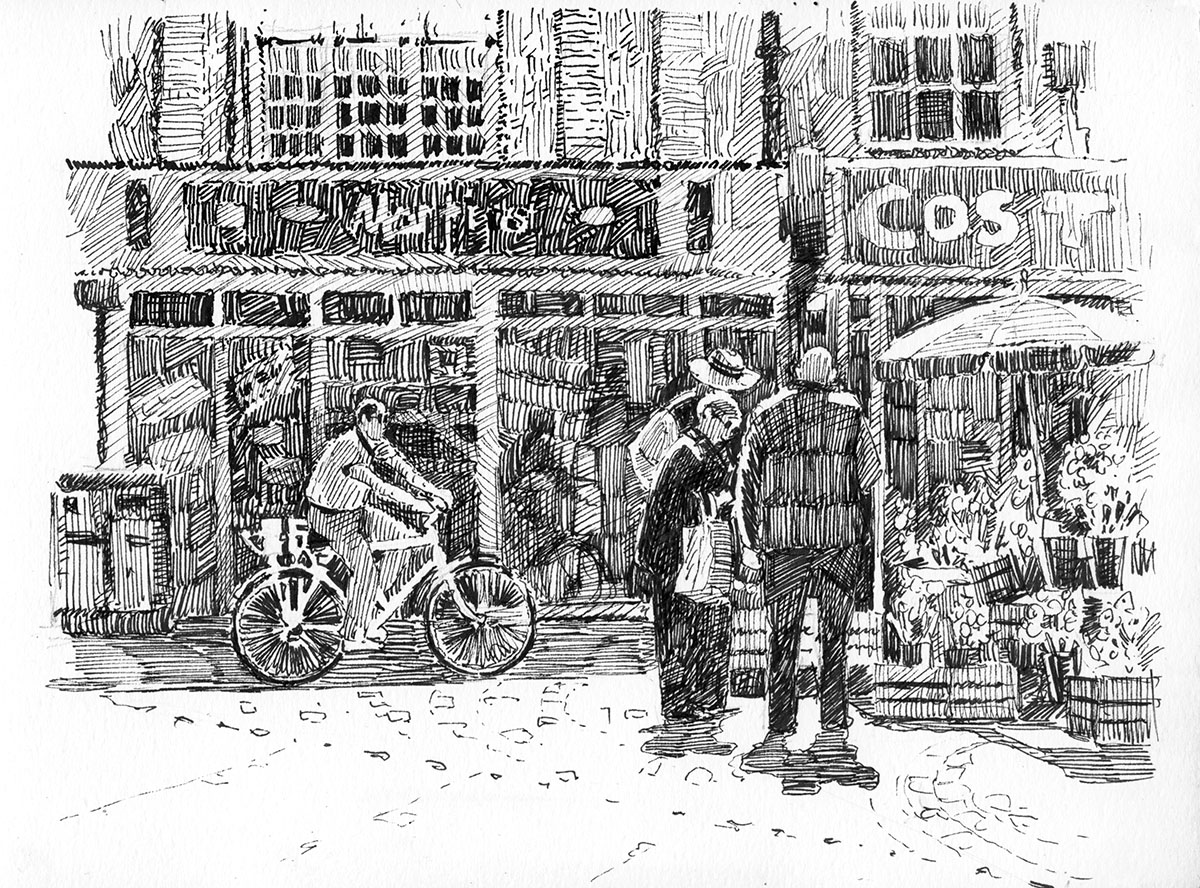
 

Romsey, market, pen and ink, sketch, drawing, Hampshire

Romsey again. As a complete contrast I next did a drawing of a flower stall. I must do more of the incidental views as they are great fun. The hatching on the shop fronts was a bit of hard labour though! The trick with pen drawing I find is not to put too many lines around edges but just let the hatching finish to define the edge. Also if you do add lines dont make them unbroken a line that skips and jumps is much more expressive.


South Kensington, London, pen and ink, sketch, drawing, street

This is South Kensington. I’m going to pencil the figures a bit more carefully in future they can become a little bit too generic and architecty… a fate worse than death!


Gillingham, Dorset, Church, sketch, drawing, pen and ink

Last of the current crop of pen drawings. This is Gillingham church in Dorset. A classic subject that suits the media very well.


Battersea, oil painting, river, church

This is Battersea, and the first of three rather underwhelming oils. There are good bits as well as less good but the whole thing doesn’t quite gel into a whole. Mind you a difficult day to paint. 12in by 12in.


Battersea, thames, river, boat, church, brass monkey, plein air

Battersea again. Slightly better maybe but just not the surface quality I am after. 12in by 20 in oils.


South Kensington, painting, oils, plein air

This is South Kensington. I nearly didn’t post this but as I try to make this a “warts and all” blog I felt I should. I managed to simultaneously get too much and not enough in which is quite a feat. That is of course too much of the wrong scrappy stuff and not enough, or indeed any, of the loose but elegant. 12in by 16in. Oils


March 25, 2014

Getting Better

If you think I am going to tell you a sure fire way then disappointment awaits! There are a few things I do try and do however to make the trajectory up rather than flat or even worse down. Firstly just do it enough, if you don’t use it you don’t completely loose it but you really do loose some ground. Learning anything reinforces pathways in the brain. Research tells us that there are real physical changes with pathways that are frequently used gaining more connections and better blood supply. If you don’t keep those pathways busy the body for economy’s sake will reassign resources and doing what had become easy will become harder once more. This is hardly any different from any exercise so it should be no surprise.

One major area that can cause frustration is learning mistakes. Anyone who plays a musical instrument will tell you that practicing mistakes is all to easy. We can accidentally reinforce errors my making them frequently. I often see this with painters too, where a way of doing things has become set in their method and even though they intellectually know there is something wrong, when they come to paint they are forced by habit down the same less than ideal turnings. I have not only seen this in others alas, but also often in my own processes.

The only way to correct and get over such obstacles is to separate out the problem area and just practice that bit in isolation. So if you have difficulty with tone simplify the issue. Drop colour, give yourself only 4 tones to work with and paint until you have worked up some new pathways. A warning here, it takes a lot of effort to “unlearn” something. You will find that you can practice up a new way of working in the studio only to find that the old bad habits reassert themselves when painting out of doors under pressure. So it is a good idea to take your four tones out into the landscape and get the new habit well and truly programmed in!

The same can be done in any area. If you have problems with figures then get photos and draw thumbnails from them. You can even trace over them multiple times. I have myself traced over the standard London taxi until I can draw them from memory at any angle. It takes a surprisingly short time to get to a stage where you can just draw one without reference. The same is true with figures if you can draw believable silhouettes from memory then you can adapt those to catch the figures that are really there on the day.

Those are a few ways of dealing with identifiable weaknesses. Harder is to take what is already working adequately and push it up to the next level. For me the process is more or less the same. Take the thing apart and then reassemble. It helps to change media and method, also to introduce constraints which forces you to do more with less. An example of this is I often see people always painting with the same palette, if you always put out the same colours you are closing doors off that might have interesting rooms behind them. As a guide if you get too comfortable with a particular way of doing things it is probably time for a shake up!

One activity that will always highlight weak areas is life drawing. This is why I always advise people who want to improve to find a session and attend it regularly. I’m afraid I can almost guarantee it will be a slightly depressing experience. You will go dreaming of Michelangelos and return with childlike misshapen gargoyles! It is this cruel contrast that makes life drawing so valuable. You can see clearly that you are falling short and once you can see that you can move to make improvements. The aim of life work for me is not to produce anything of great artistic merit, but to stress the skills I have already attained to breaking point.

One note of caution there are always kind souls at life sessions who will say things like accuracy doesn’t matter and expressing yourself is the most important thing. I am not saying accuracy is the only thing but it is not inimportant. If your accuracy is a weak point then measure like mad until you have dealt with it. It is getting these technical hurdles somewhat tamed that allows expression to flow freely. Before you can be really be free and react to momentary inspiration you have to take the time and effort to strike off the chains that hold you back!

Note of caution no: 2. Fetishising technique is just as bad in my opinion as downplaying it. The Atelier and similar approaches tend to raise technical competence to a be all and end all. The lie to this is given by the uninspiring and dismal output of the students whose life drawings might well have linear and tonal accuracy but are in themselves lifeless. They take living flesh and turn it to perfectly rendered lifeless static stone. If you don’t get the feeling that the model fidgets and might get up and stretch at any moment you have failed just a surely as if you got the head the wrong size!

Now for some examples of how I haven’t managed to practiced what I preach!

.

Fleet Street, St Pauls, London, oil painting


The first of a batch of new London pictures. This is based on the plein air from the last post. I wanted to roll back the day to the moment we arrived so used the photo ref to change the feel of the light. Still a little but to do, the distance is too busy and crisp so I will soften with a glaze or two once dry. 16in by 24in oils.

.

The Strand, London, oil painting


This is the Strand looking West. Still a fair way to go on this but the basics are in and I am happy with the overall mood. The final adjustments have to be made very carefully so as not to overwork. 16in by 20in oils.

.

Strand on the Green, Thames, Plein air, brass monkeys, watercolour


A day out to the Strand on the Green near Chiswick and Kew. This was a Brass Monkeys day and the weather was a little chancy. I did this view twice the previous version was so awful I binned it! Quite difficult to paint with hail bouncing off your paper! 6in by 9in watercolour.

.

Thames, London, Strand on the Green, watercolour, plein air


Last one of the day I got myself positioned behind one of the pylons of the railway bridge which held off the worst of the very chilly breeze. 9in by 14in watercolour.

.

life drawing

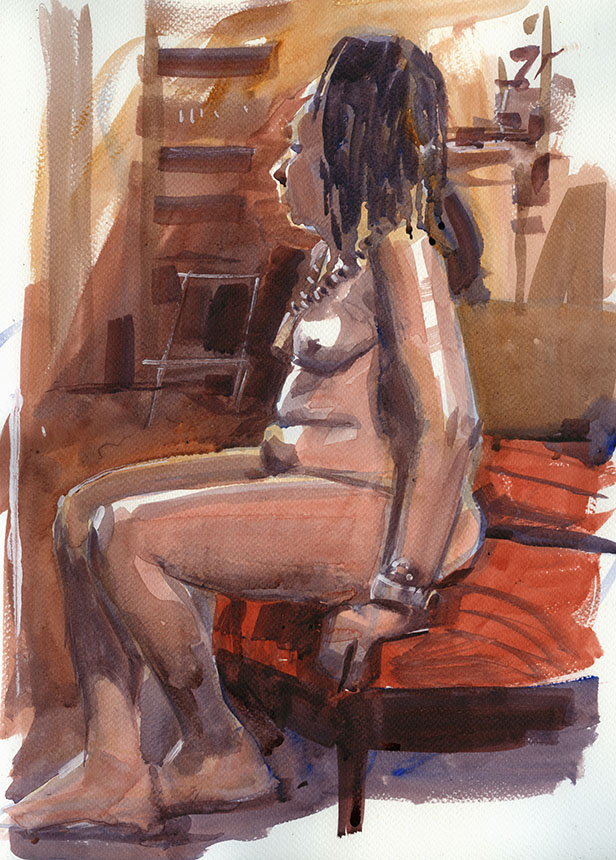
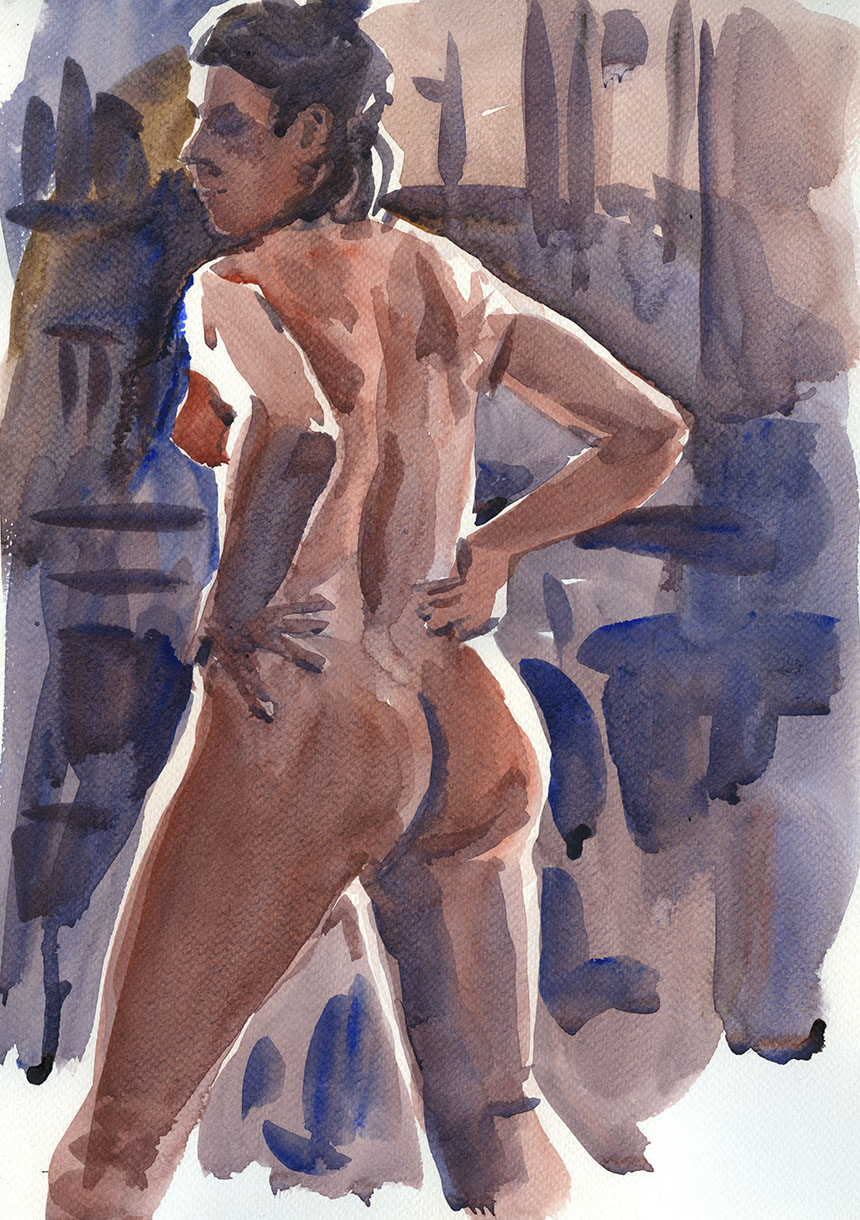
I am watercolouring in the life sessions at present. It is very hard to get a study done in 30min but it is great for teaching you how to make important decisions on the fly!

.

life drawing

Here is an example of ringing the changes I added reed pen and ink to my very limited palette of red ochre and ultramarine.

.

Life drawing

Here we are pared down even more just line with the reed pen and a single wash. 7min.

.

life drawing

Here I have added reed pen but stressed the colour a little more. It is all about getting the most from the available resources.

.

life drawing

I made retaining the whites here my main intent. Very tricky as I am not drawing first. The reason for not drawing is to build confidence in putting brushstrokes down. Confident strokes add a lot to the liveliness of the end result. It is worth practicing taking a brush and practicing swelling and reducing the mark using varying pressure. This helps when you need to lay in a stroke that defined form as well as tone.

.

life drawing

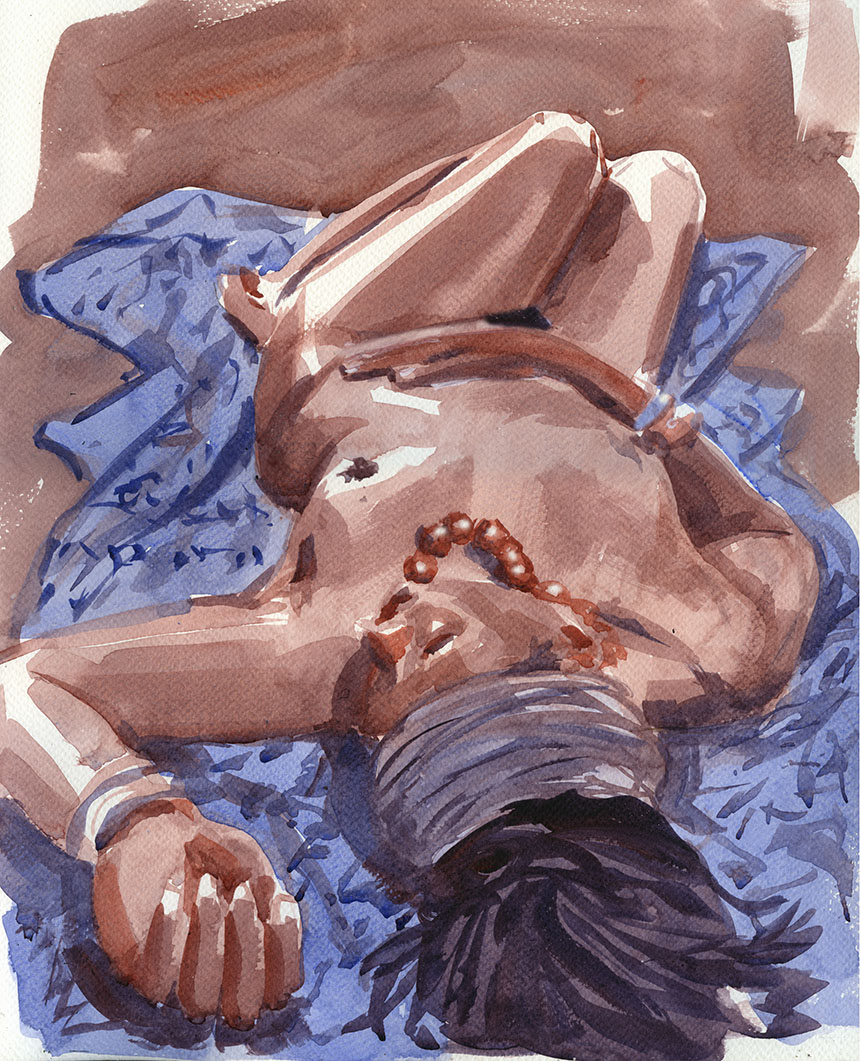
This was as they say “challenging” … getting the extreme perspective in and believable is always very hard.

.

life drawing

This shows how much you can get down in 10min… you just have to accept with life sketches that 90% are fit only for the bin!

« Newer PostsOlder Posts »

Powered by WordPress

error: Content is protected !!