Rob Adams a Painter's Blog painter's progress

July 31, 2015

Landscape Art

In my newspaper today there was a review of Richard Long the land artist. When I was a student he and Andy Goldsworthy were first making their mark. I, as almost everyone else, quite liked what they did, indeed who wouldn’t. The work is engaging pleasant and made of nice stuff often in a beautiful setting, hard indeed to find anything about it all that is not pleasant. They make what is called “interventions” on the landscape. The defining factor seems to be that it should not be a practical intervention such as a useful one like a drystone wall for keeping animals in. Oh and also it shouldn’t be a folly either like the great estate owners were fond of… now I think of it garden design has to be omitted too… whoops, some ancient monuments have to be excluded as well. So really it has to be made by a person who defines themselves as an artist. You could have four identical drystone objects one crafted by an artist one by an architect and one by a landscape designer and one by a drystone waller and it seems that the art cognoscenti say only the artist made one would be art. If they were placed side by side of course it would be impossible to tell one from another. So did the “artiness” come from the object being made or you being told it was by an artist? I seems to me plain that the “art” ingredient was added by you being informed of the fact not the object being made nor you perusing it. So by my way of thinking the art act was the labelling of it. So group of friends hiking might come across an intriguing drystone construction and one of them might pipe up, “Oh that is a Richard Long” all the group would then have an “art” moment. The piper might be wrong, but regardless of that the art experience was had. Was the hiker actually the artist? Well it’s a thought.

long

A few different land art sort of items, can you spot the art?

Now you may think I am going to deny the artiness of the monkish Mr Long and fey Mr Goldsworthy, but no I want to say that they are all made with craft and therefore capable of being looked at as art. My argument would be that they are not a particularly high individual achievement. We ascribe special status to folk like Rembrandt because very very few human beings through history are going to be able to do what he did as well and with as deep long term appeal, depth of expression  and subtle nuances. Perhaps one or two in a generation. However anyone with a bit of patience could make a Richard Long you would not have to wait half a century for another person good enough at arranging rocks! So an object made by man might be lovely to look at, it might be instructive, it might be moving. But it is not that which we celebrate. We celebrate the high points of human achievement. Most of us write, but very few of us write War and Peace. So we value Mr Tolstoy and his works. So the land artists could be safely placed in “pleasant essay” territory rather than “towering achievement”.

With high jumpers we celebrate the person who leaps over the highest bar. We may clap if a portly person makes an impressive attempt at a much lower bar but the record books won’t be adjusted. So to my mind the difficulty of achieving a result and the amount of life that has had to be expended to be able to do that thing is a large factor in the art value of a made thing. With the difficulty of attainment comes rarity and in most cases with rarity comes value. All of the objects both rare and common may well provoke a pleasant and meaningful visual experience. But the rare one is an example of high human achievement and it is that event that we should celebrate.

This edition I am offering a bit of landscape art rather than land art. I am at last getting to grips with painting different subjects now that I am finally full time in pastoral surroundings. Not that it is easy, I am being fairly experimental in my approach so a good few failures will result.


Honfleur, France,  Notre Dame de Grace, pen and ink drawing

A few orphans from France that needed finishing later due to a high shrubbery content! I added a raw sienna wash to my media on the last day just to add another element. Very nice for adding bulk to trees and differentiating areas. This is Notre Dame de Grace high above Honfleur. I would like to have painted but I found it on the last day and didn’t get the chance.


Le Croisic, France, drawing, pen and ink

This is Le Croisic, I added the wash after and am pleased with the result I found a subtle mix of the sienna and the white I use made a lovely warm white which contrasts nicely with the cooler version used in the clouds.


Swanage, Dorset, pen and ink, wellington clock tower

This is the Wellington clock tower in Swanage which rather oddly originally once stood at the southern end of London Bridge in London. It was moved to the seaside in 1854 at a cost of £700 as it did not keep good time and with increasing traffic it had became something of an obstruction. The faulty clock never came. I am told it used to possess a spire but that became unsafe and was removed in 1904. A very quick sketch, I was out on a pier and in the way of fishing folk.


Corfe, Dorset, pen and wash, drawing

On my way back from Swanage I couldn’t resist this view of Corfe castle with the train. It is on a reproduction of paper as used by David Cox in the 18th century which is a pleasant oatmeal colour. Fab view which I shall come back to. Although it looks arcadian you have to imagine lorries belting past a couple of feet behind me!


Hambledon hill, drawing, dorset, pen and ink

A bit of pen and ink madness, I started this last winter on site, but having done Hambledon hill I decided on a wild circular hatch for the sky… slow work so I had to give up when hypothermia set in! I finished it off a few days ago sitting in the sun in my garden. Has a slightly Samuel Palmerish feel, maybe the first signs of madness.


Salisbury, carving, cathedra,l wiltshire, pen and ink, drawing

A visit to diy store Wickes in Salisbury. The store was a bit boring so I went on to the distinctly more drawable cathedral. This is a carving on the facade warning you of what might happen to you if you sin… I got a crick in my neck doing this!


Salisbury Cathedral, wiltshire, pen and ink, drawing

Yes it’s that famous view Constable painted. I decided to have lunch in a pub by the river but got lured into doing this. By the time I got to the pub they had stopped serving which served me right for getting distracted.


Hambledon Hill, water colour, plein air, painting, art

This post is a bit Hambledon Hill heavy I fear! I am determined to get some paintings that catch the character of the place. It is easy enough doing distant views but although it is fantastic visually up on the hill itself, making a painting that catches that is very hard. It is like those wide views that you photograph when on holiday. They look wonderful when you are there but once you are home the photos look ho hum. Photographs taken from the hill have that same quality. So I set out on a blustery hazy afternoon to do my best. This is looking right out over the verdant Blackmore Vale and I am quite pleased with it. I might try some different formats, tall and thin or square the straight landscape proportions don’t quite work for me. 1/4 sheet Watercolour.


Hambledon Hill, watercolour, art, painting, Dorset, hill fort

I started very boldly here with a full and very wet wash. I need maybe to strengthen the fore ground to push the distance back. I might do a studio version to try and get the balance better. It was so windy the painting blew away a couple of times! 1/4 sheet Watercolour.


Hambledon Hill, hill fort, Dorset, watercolour, painting, art

Not the most cheery of watercolours of Hambledon but I am quite pleased with it on the whole. It was quite different day with the wind driving rain showers up the Stour valley unlike the previous dry windy days the washes just wouldn’t dry. Still I must get up there on some wet days with the oils as I love the mood. I struggled down the hill after carrying my painting gingerly at arms length as it was still very wet. 1/4 sheet, Watercolour.


Fontmell Down, watercolour, Dorset, painting, art

I got up at the crack of dawn to do this, even before the dog walkers, but not as you may have noticed, the sheep. Only a little 9in by 6in but it was lovely to do. Not a mood for wild wet into wet washes so I did it in areas which gives it a calm still mood perfect for the scene. People do go on about “wet into wet” and so forth as if it is the only way to paint. I like both the wild and splashy and the carefully laid down and find that the approach can be infinitely varied from the exuberantly expressive to the quietly meditative to suit the feeling of different subjects and moods. The rule is for me that the technique should be at the service of the subject not the other way round. The subject here is the wonderful Fontmell Down.


Eggardon Hill, Watercolour, Dorset, painting, art

This is the view from Eggardon Hill another hill fort in Dorset. A studio painting done on the David Cox paper. Very hard to stretch as it wrenches any gumstrip off. You have to staple all round the edge and even then it pulls free. I must use my Artmate paper stretcher in future. The paper is much thinner than what we use today and is technically quite hard to paint on. Too wet and it turns into an impression of the alps cockling fiercely. On the other hand the beautiful surface with little flecks of brown and yellow gives a lovely quality. You soon understand why the 18th century masters used body colour. To get a bright wash you just have to add some white to the wash. Not enough to remove the transparency but just enough to add brilliance to the colour. I enjoyed doing this tremendously and love the quality it brings to the paint. 14in by 9in, watercolour.

That’s it for this edition. I feel some oil painting is due as I have neglected it in the last week or so, like everything if you don’t keep doing it you loose the edge that comes with regular practice. Painting is very not like riding a bicycle you do forget all too easily!


May 27, 2015

Art and Science

The rise of science roughly mirrors the downfall of the arts in society’s estimation. Art had been very much in the camp of belief as to put it baldly: that was where the work was. Art and artists have always adapted to the needs of whoever was at the top of the heap. This new master of reason and experimentally tested knowledge had no real need of paintings. The futurists, Bauhaus and constuctivists all made hopeful offerings, but neither science, industry nor the general public were much interested. The artists let’s be honest didn’t find much inspiring in it either, there were a few portraits of worthy enquirers next to their instruments and Rembrandt’s autopsy, also that one of the dove dying in a glass sphere by Joseph Wright. Hook’s wonderful drawings of what he saw through the microscope deserve an honourable mention too.

Religion faced much the same problem. The religious establishment at first welcomed scientific enquiry, confident it would inevitably confirm their beliefs. However once the discoveries of science began to squeeze the Deity into a smaller and smaller corner they lost their enthusiasm and started to lock the scientists up and threaten to burn them if they didn’t deny their findings. Painting in a similar way as religion was a lens through which the world might be seen in a new perspective, but science had an ace… it was demonstrably true. Religion might say that miracles occurred and heavy objects might fly through the air, but they couldn’t come up with the goods to order like science could. A jumbo jet would have been given a miraculous cause if seen by our forbears. Indeed that is exactly what happened when isolated tribes saw American planes landing on strips cut into their jungles. Aha, they thought, if we cut a strip of our own then planes carrying treasure will be drawn to land. Poignantly they even carved the radio equipment out of wood. Cargo cults are a fascinating window into religious logic.

Now we might think how foolish those islanders were, but given the state of their inherited knowledge I think it was a pretty good call. What is more uncomfortable is that the current thinking underpinning the worth and purpose of Art is several degrees worse. How this occurs in the first place is worthy of consideration. Roger Scruton has talked interestingly on this and introduces the idea of the “liar” and the “fake”. The liar is aware of his or her own dishonesty, but the fake intentionally chooses for whatever reason to believe in or espouse something untrue. Or as I myself think, think they carefully don’t examine certain underlying concepts as that might bring the whole intellectual house down. Certainly art theorists and critics often seem to elevate weak suppositions into axioms to bolster their view of things.

Is it really possible that our whole current art thinking is just a fantasy? Well, looking back in history you would have to say yes. At some point in history some probably perfectly intelligent persons thought that killing children might improve the crops… or carving huge stone heads secure the future. The idea that an object becomes imbued with an extra iconic quality merely because an artist says so is just as silly. There must have been people who thought and even said that sacrificing children was not the way, but public and establishment opinion was plainly not on their side. So it is today, I might rant and rail, I can attempt to make sure my arguments are coherent and well founded, but almost certainly to no avail.

The art lie is a very profitable lie. It is the same with quackery. Once upon a time you merely said that this or that object was blessed by some saint or other and would heal you. Now they make up sciencey sounding nonsense about energies, realignments, detoxes and infinite dilutions. Art has stepped neatly in the footsteps of quackery, artists now explore, investigate, experiment and question. It grieves me I have to say that my chosen activity in life seems to require hawking the results in a somewhat dishonest manner. I know that my paintings have no special extra quality. There is no spiritual energy in them, they cannot really reach out but only offer the possibility of aesthetic reward if the viewer reaches in. They are what they are: board, paper and paint arranged in a pattern, there is no magic quality. That does not however mean that they cannot be interesting or gauged to attract attention and give pleasure.

Now that is an idea that is out of vogue… visual pleasure, a fair few contemporary painters would recoil in horror at the thought. However if there is one thing that I have found by painting out of doors is that people get pleasure from paintings. Perhaps one in fifty walking by will stop and exclaim that your painting is beautiful and there must be more that are intrigued but too shy to say. Now 2% is a lot of people, so all hope is not lost! The problem is that that 2% have very few places to see current painting, and even if they do we have an art establishment and media assuring them that they are backward looking and irrelevant in any case. As with the child sacrificers and the heretic burners most people will just accept it if the powers that be say it must be so.

The real magic, if it can be so called, is the astonishing luck of being embodied as a conscious thinking being who is capable of appreciating paintings and all the other wonderful things that surround us..

I have been enjoying the oils now that I have my new studio up and running. having a sky light is wonderful and makes it so much easier to judge tones. Clear days give a rather blue cast which has to be taken into consideration, but painting in there is a real pleasure. It is also lovely sitting with the doors wide open and the sound of the birds, bees, tractors, screaming children, lawn mowers and chainsaws drifting in.


Gold Hill, Shaftesbury, Dorset, oil painting

This is the famous “Hovis” view of Gold Hill in Shaftesbury in Dorset. It took a couple of goes as by the time I had finished drawing it out the light had moved on to the fronts of the houses which wasn’t the picture I wanted to paint. Next day the light was better though, softer with a delicious haze into the distance. Chocolate box I know, but it is not the sort of subject that lends itself to a painting with any street cred. Maybe I should add a skip and a burnt out car or two… 10in by 12in Oils.


Gold Hill, Shaftesbury, Dorset, Nocturne, Oil Painting

A week later I washed up in Shaftesbury again, but late in the evening to attend a friend’s private view. After eating a curry, I had a mad urge to paint a nocturne… this is not it really as I don’t think any of the first session is left! The atmosphere and general tones survive though. 12in by 16in Oils.


Battersea, Thames, London, plein air, oil painting, barge

A quick trip up to town to paint with the Brass Monkeys. This is Battersea, I don’t paint many barges but this one took my fancy due to the angle at which it was moored. 8in by 10in Oils.


Blandford Forum, Wet day, street, Dorset, oil painting

This was an experiment in that I did a grisaille to establish the tones. I was working in part from a pen drawing done on the spot and also from a rather blurry phone snap. Here it is in its first stages about half an hour in.


Blandford Forum, Dorset, Oil Painting

The subject is Blandford Forum in Dorset again. As rebuilt in early Georgian times by the Bastard Brothers after the old town was destroyed by a great fire. Doing the monochrome layer underneath gives a great unity of tone which is important in a picture like this where many of the tones are quite close. Dull days are especially interesting to paint for this reason. 12in by 16in Oils.


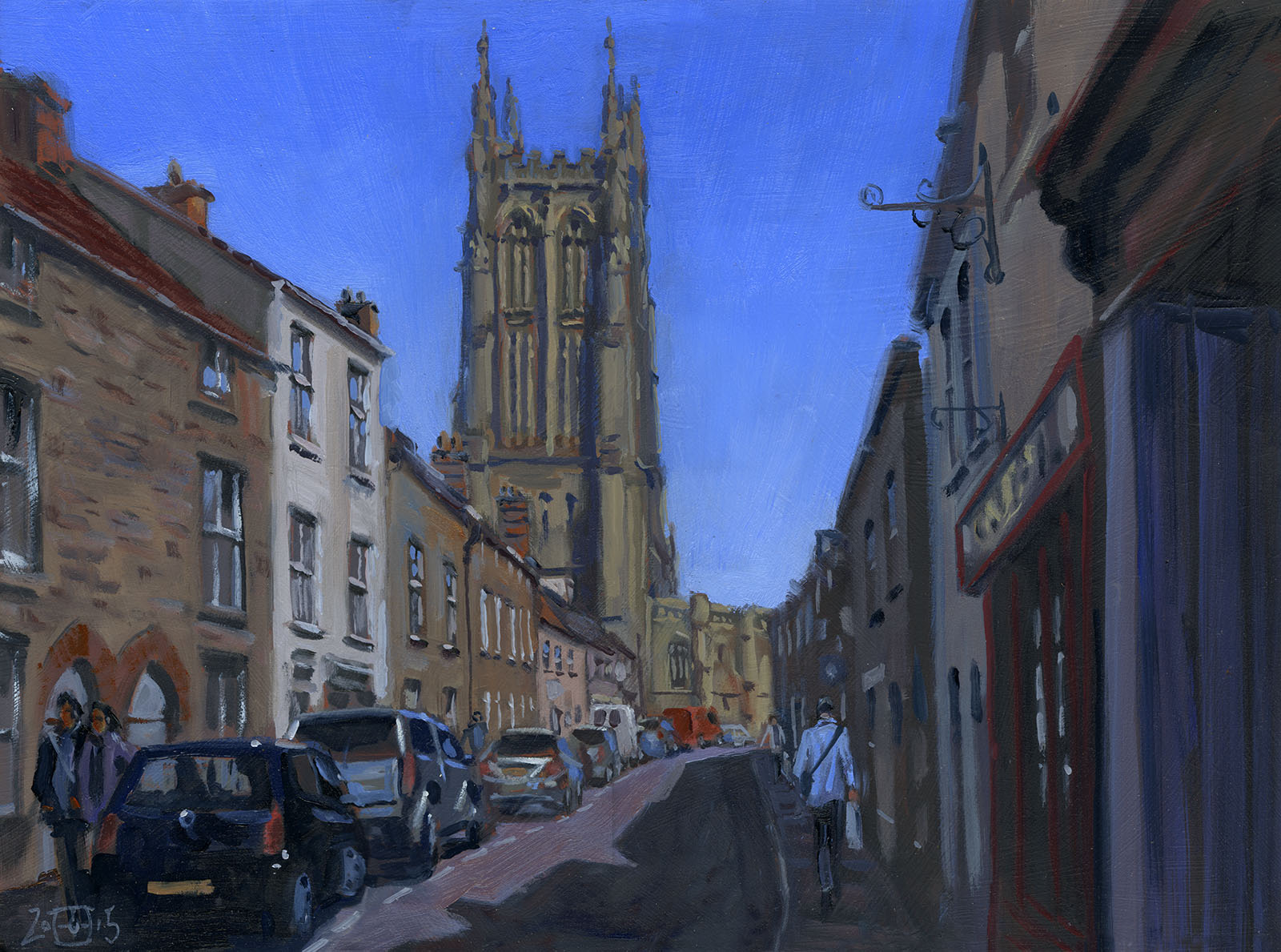
Wells, St Cuthberts, oil painting, Somerset

This is Wells in Somerset. Not the cathedral but St Cuthberts. It was a fantastic day with tremendous light but I didn’t have my oils with me so this is a studio picture. Lots to paint in Wells and it is only 40 min away. I really am spoilt for choice where I am now. 12in by 16in Oils.


Baker Arms, Child Okeford, Dorset, watercolour

I quick dash with the watercolours. this is Child Okeford and my local pub The Baker Arms. Would love to paint this angle en plein air, but a 4 by 4 would run you over, so this is studio. Watercolour. 7in by 12in


Thames, London, Tower Bridge, pen and ink, drawing

To town again to meet with the Wapping Group. I travelled light so stuck to the pen and ink.


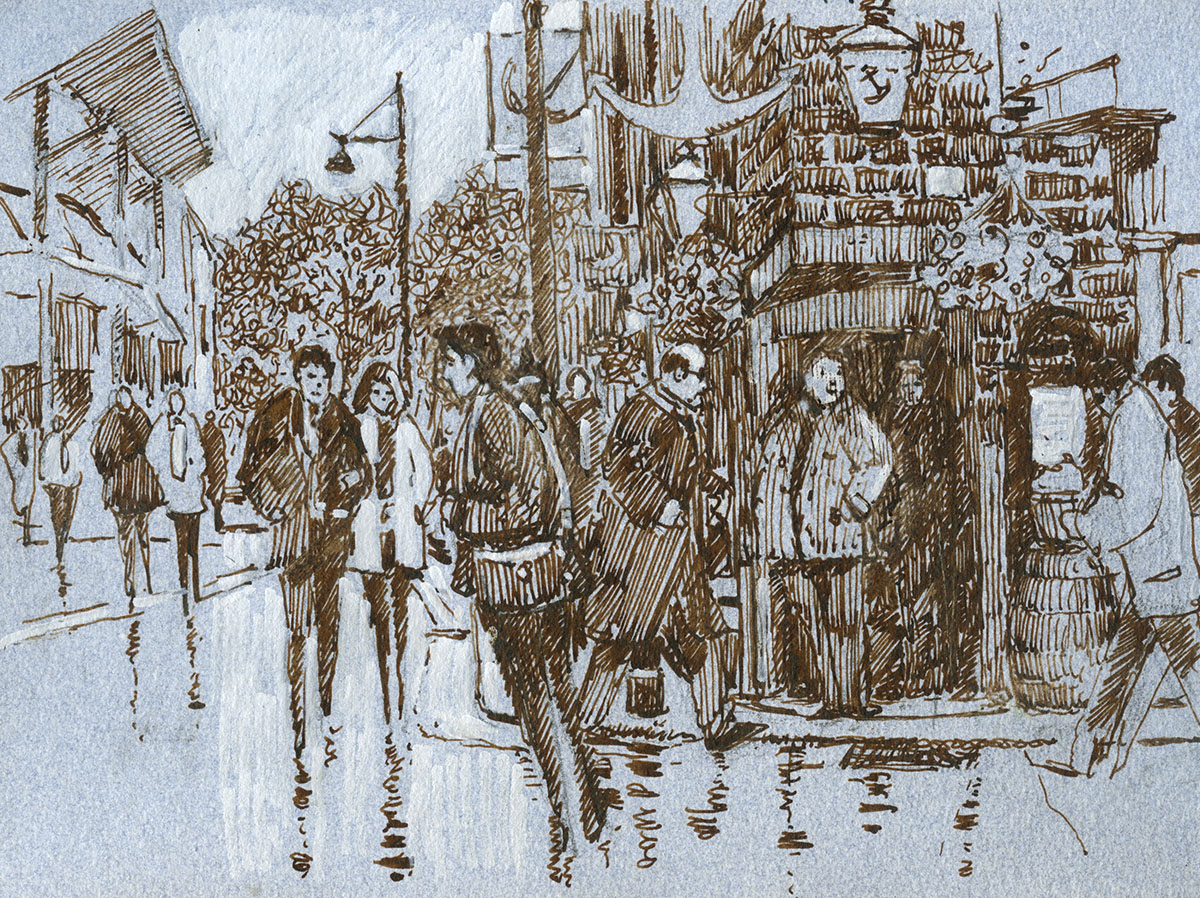
Southwark, London, pen and ink, Drawing

This busy corner took my eye and I crouched under my brolly to do this.


Southwark, London, Pen and Ink, cathedral

Last one of the day. This is Southwark Cathedral.


Child Okeford, St Nicholas, Dorset, pen and Ink

This is St Nicholas in Child Okeford, I was very taken with the splashes of afternoon light across the road. I sometimes get chastised for putting in vans and such… but who could leave out a magnificent example of a 2014 Mercedes Sprinter? I shall ignore them, philistines all…

« Newer PostsOlder Posts »

Powered by WordPress

error: Content is protected !!