Rob Adams a Painter's Blog painter's progress

November 5, 2013

Getting out there!

One of the bonuses of going out painting plein air that is often not mentioned is the increased chance of seeing a decent subject. When painting plein air you are in a place for a considerable while as the day changes around you. Often the most magical of subjects are there only moment. A jogger passes from shadow to light, somehow completing a scene, a street is lit by the sun breaking through leaving the distance dark. It can be any number of things. One thing is certain however if you don’t spend the time out and about keeping an eye out for the possibilities then good subjects will be few and far between.

If I go out for the day and bring back a decent plein air I am very happy with the day, but often the main haul of treasure is in my camera carrying potential for studio paintings. I know many say it is too easy, but you have to take I estimate about a hundred photos before one has a possible painting. I put them all in a folder called “possible paints” usually it is not just one photo but a group with a scene and then further shots of people traffic etc. I don’t think I have ever taken a photo that was “ready to go” if I did it would probably be better just to leave it as a photograph.

Another valuable aspect of a days plein air is that you are in “painting mode” you are constantly assessing and testing things you see in your mind’s eye for picture possibilities. Thsi also happens when you are out and about generally, I always carry a camera even when popping down to the shops for a pint of milk! This often results in 500 or 600 photos a week! I have learnt from experience that the photos need to be looked at very soon after you take them. So on getting home I put them on the computer and pick out anything that has possibilities. I then immediately adjust and scribble over the top my ideas for how it would translate. I drop in potential figures and play with the colours to look for harmonies. The reason for doing this straight away is that the quality of the real day is still in your memory. When I am making the adjustments I am trying to make the photo conform with the memory of the actual day. Often in you mind’s eye the scene was memorable, but the photo when you look at it on screen is a disappointment. I have learnt that you can adjust the image to nearer fit your recollection.

A few things are needed to make that easier. Firstly shoot in RAW format. With jpg most of the information has been thrown away for the sake of the file size. With memory cards so cheap this is daft. A .jpg file is only 8bits per channel whereas a RAW file is 14bits this means that you can adjust the exposure afterwards without the image degrading. A .jpg given the same treatment will decay into a contrasty nightmare and loose all subtlety of tone. I seek also to make the image feel “painterly” hard to describe, but it means that I can see in my minds eye which areas can be combined and simplified and which will carry the story and need more definition. I often quickly paint over areas in photoshop to unify and make them less defined. I do this on a layer so I can always refer to the original should I want to.

The end result is often a world away from the original camera image, but is nicer to paint from. I always paint from a screen image as a printed image has all the tone decisions made for you. Because you cannot paint the actual tones from the screen you are forced to make compromises which gives the painting I feel more immediacy. Painting from a printed image feels lifeless compared. In the same way if I bring a plein air back that needs attention, I first adjust the photo to look as much like the plein air as possible. This makes it far easier to just do the changes needed and no more, which retains the feeling of the original sketch and conditions on the day.

I am increasingly interested in various mixtures of studio and plein air. In several pictures recently I have done a plein air painting, then worked on it in the studio and finally taken it back on site to refine from life. I have this week also done a picture from a photoref and then taken the resulting picture back to the location. It was very interesting to work directly on top of the almost finished image adding direct observation where it improved and leaving where it was fine. The result was a definite improvement. The main changes were to the shadow areas, it is hard to see the light “bounced” into the darker areas in a photo ref. The eye sees more variety of tone.

.
Blackheath, London, Plein air, Painting

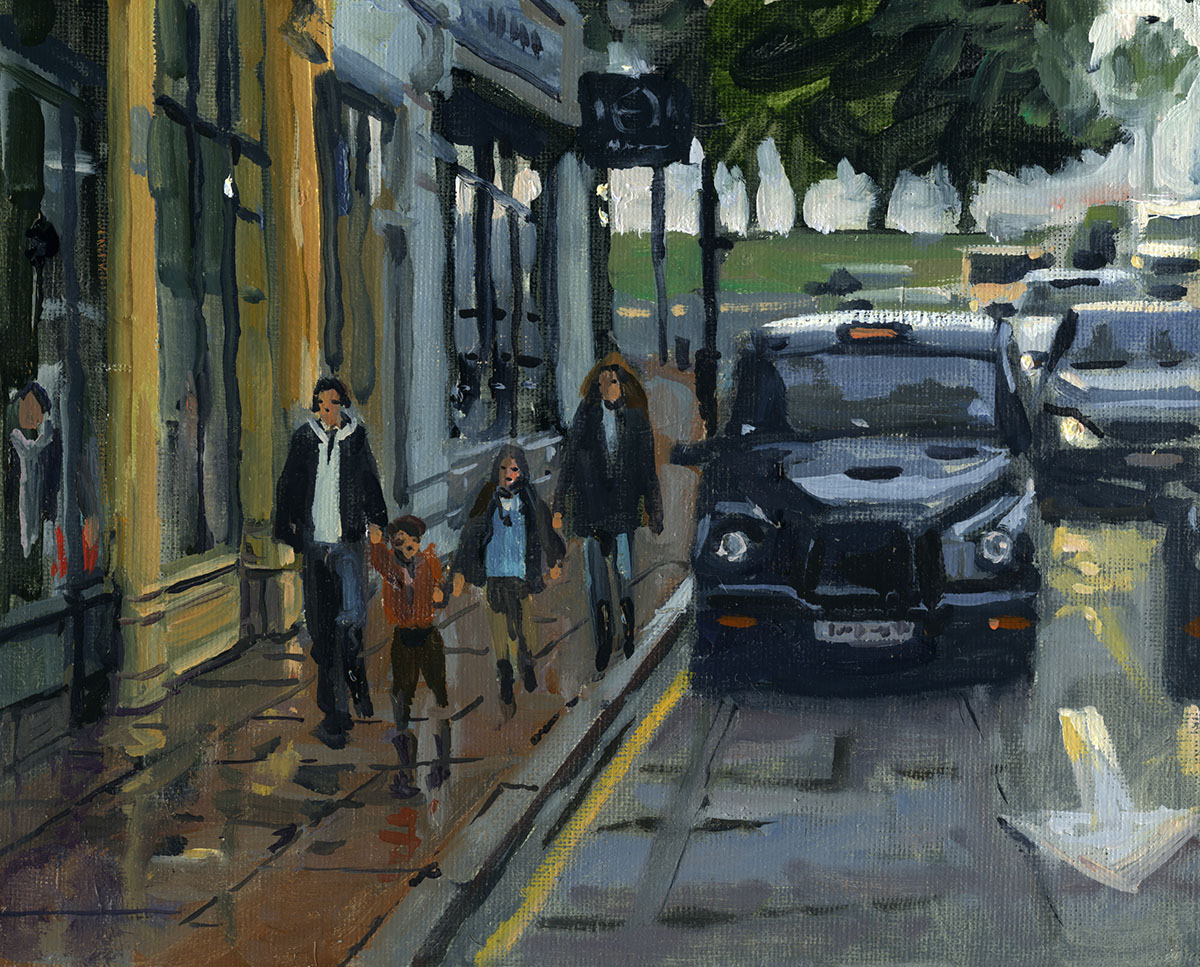
This is Blackheath. I am always interested in spots where you can get that “in the road feeling” here the pavement kicks in so you can get a view straight up

the hill. I don’t quite know why, but this gives a very active view, as if you feel that in real life you would need to move or get run over! Sadly I got most of the Taxi

done on the spot… I have more or less memorised that familiar shape. The family group are from the same place on a different day. Pleased with this one

though it has a joinedupness that has been slightly eluding me recently. 8in by 10in.

.
Greenwich, London, Naval Hospital, plein air, painting

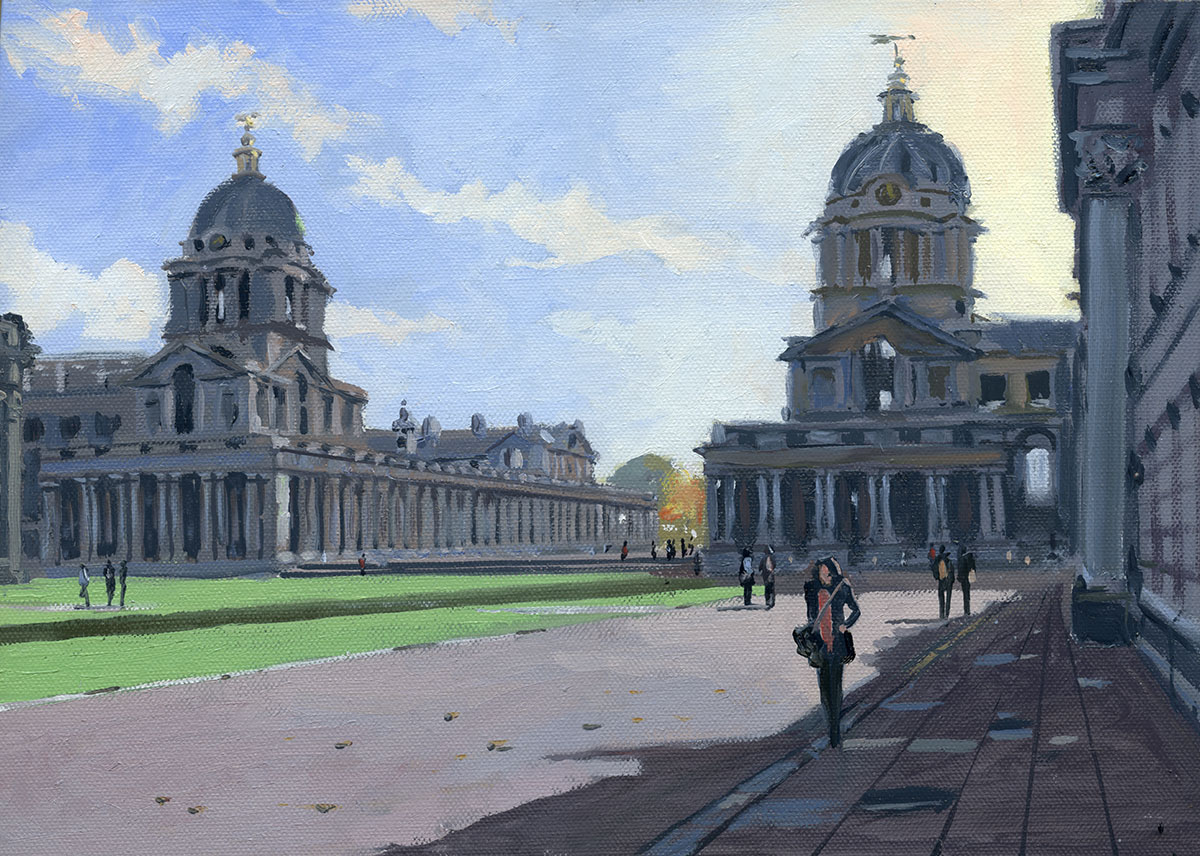
Having lectured two fellow painters on drawing this out I fancied having a go myself. Here is a case of a plein air that could do with a bit of tinkering in

the studio. In order to get the whole lot done in reasonable time I had to lay in the buildings in a flat tone and add a couple of detail layers on top. This

has resulted in rather a dead feel. The left hand range could do with less definition and some “hero” nearby figures are needed to stop the picture running

off on the left hand side. If I can get it right I quite fancy doing an all singing and dancing studio painting of this. 10in by 14in.

.
Greenwich, Millenium Dome, Thames, plein air.

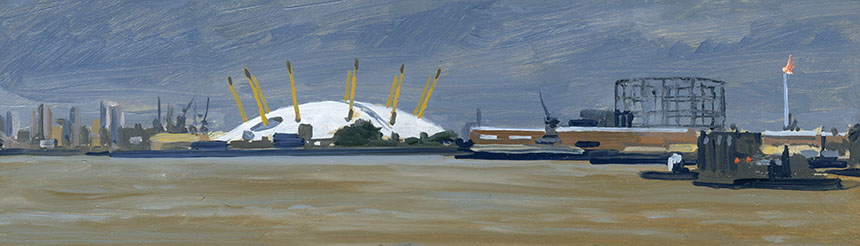
A very quick sketch as the rain was coming, with plenty of wind! I couldn’t resist the outrageous tones of the river and the sky. Only 15min.

.
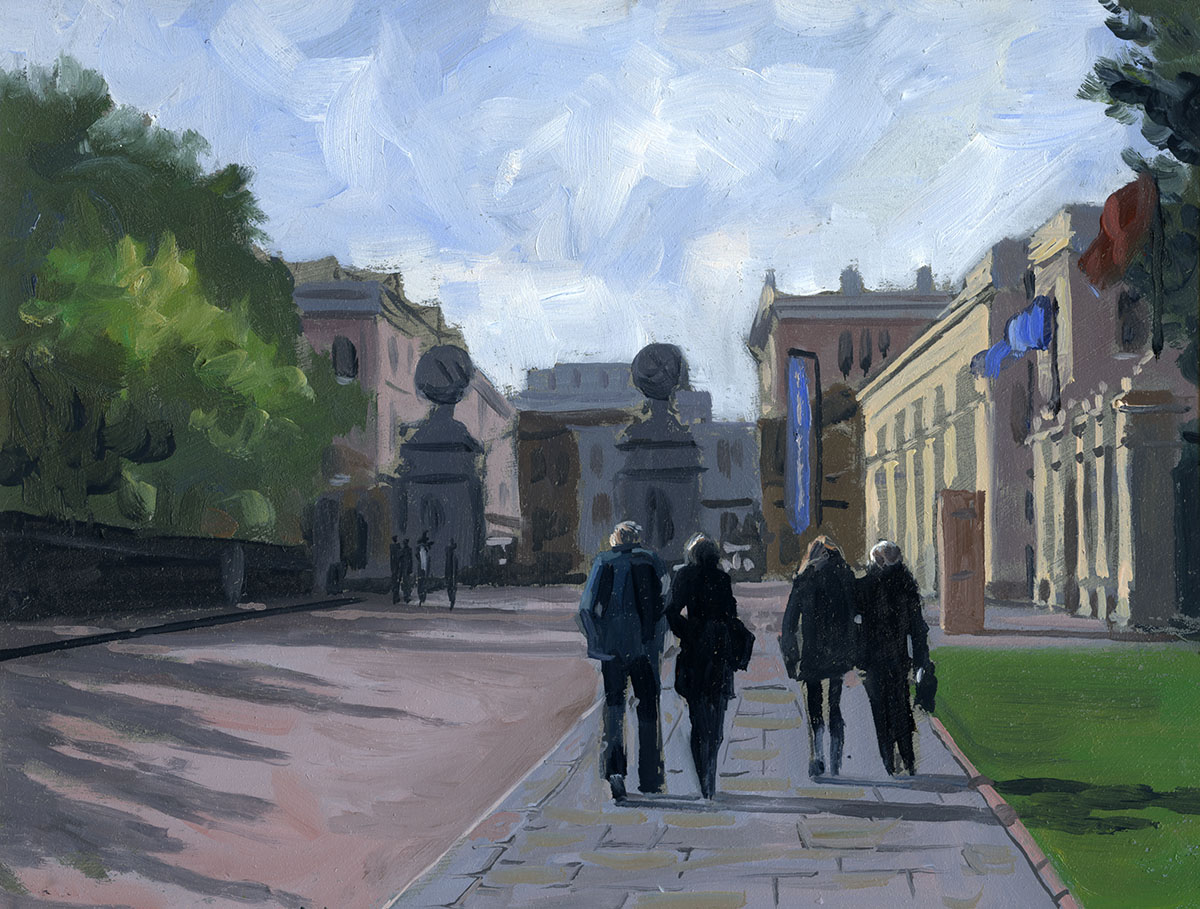
Greenwich, London, plein air, oils, painting

Here is one of the mongrels I mentioned. I arrived with this as an almost finished work done from reference. I ended up re working the road and pavement.

I also lightened the sky and took out a fair bit of colour. The main improvement came in the overall unity. I should have scanned the first state but I’m afraid

I didn’t think to. On the other hand people would have probably only told me the early version was better! 8in by 10in.

.
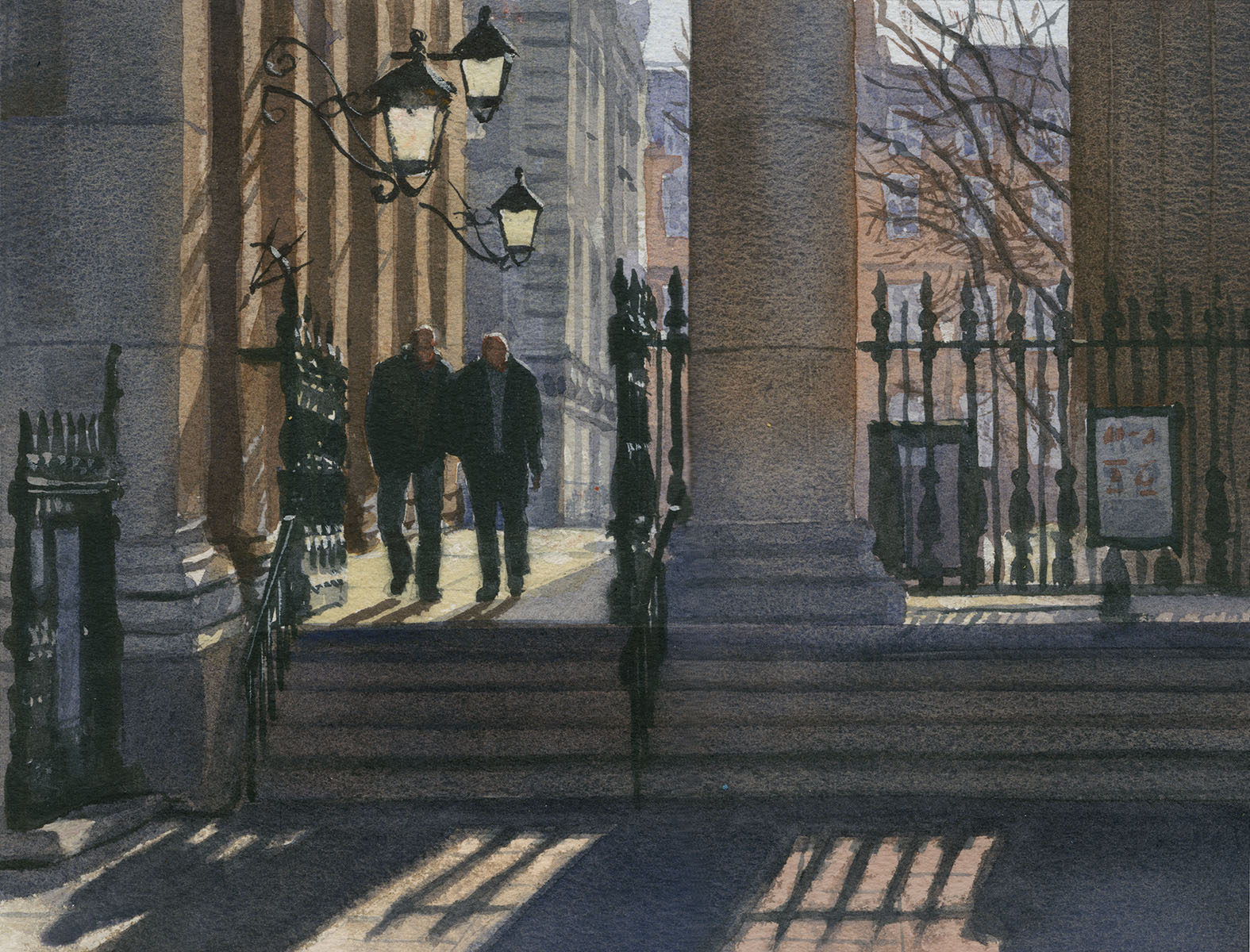
St Martins, London, watercolour

This is St Martins on Trafalgar Square. Done from a photo taken last year. Very pleased with the feel of this one, a possibility for the open exhibitions.

Watercolour, 8.5in by 11in.

.
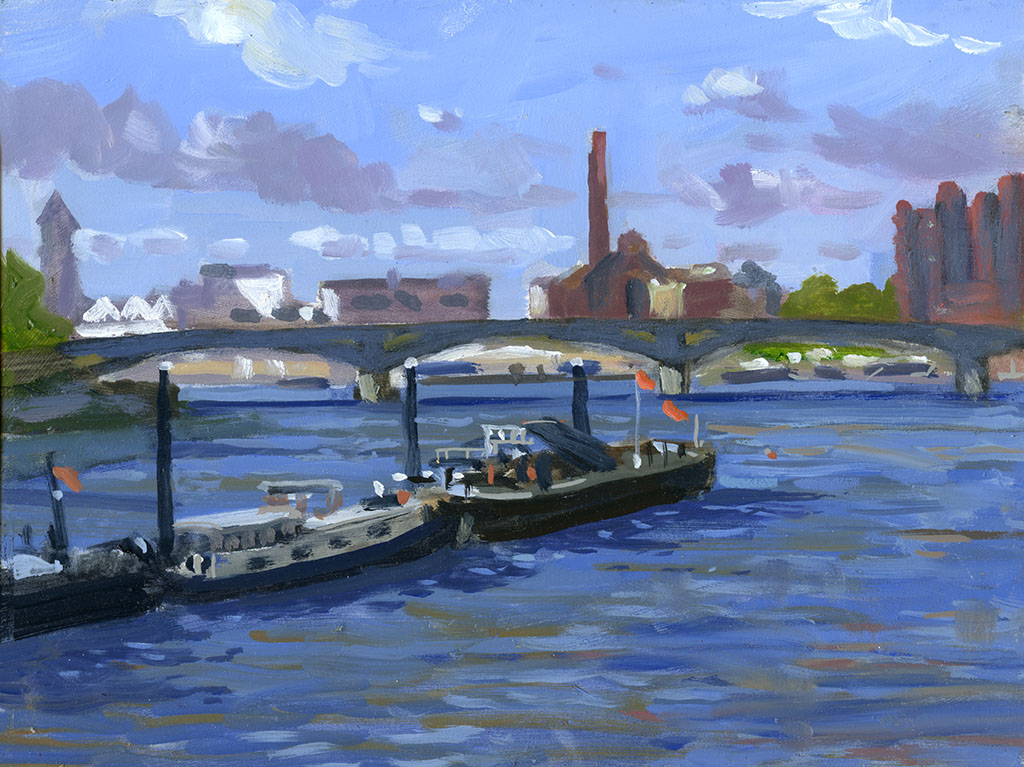
Thames, London, plein air, river

A day in Chelsea with the Brass Monkeys. A wonderful crisp and breezy November day. I love the low light at this time of year, it is OK to paint most of

the day unlike the summer months. I tried to keep this very simple just putting in the vital things to set the scene. 8in by 10in.

.
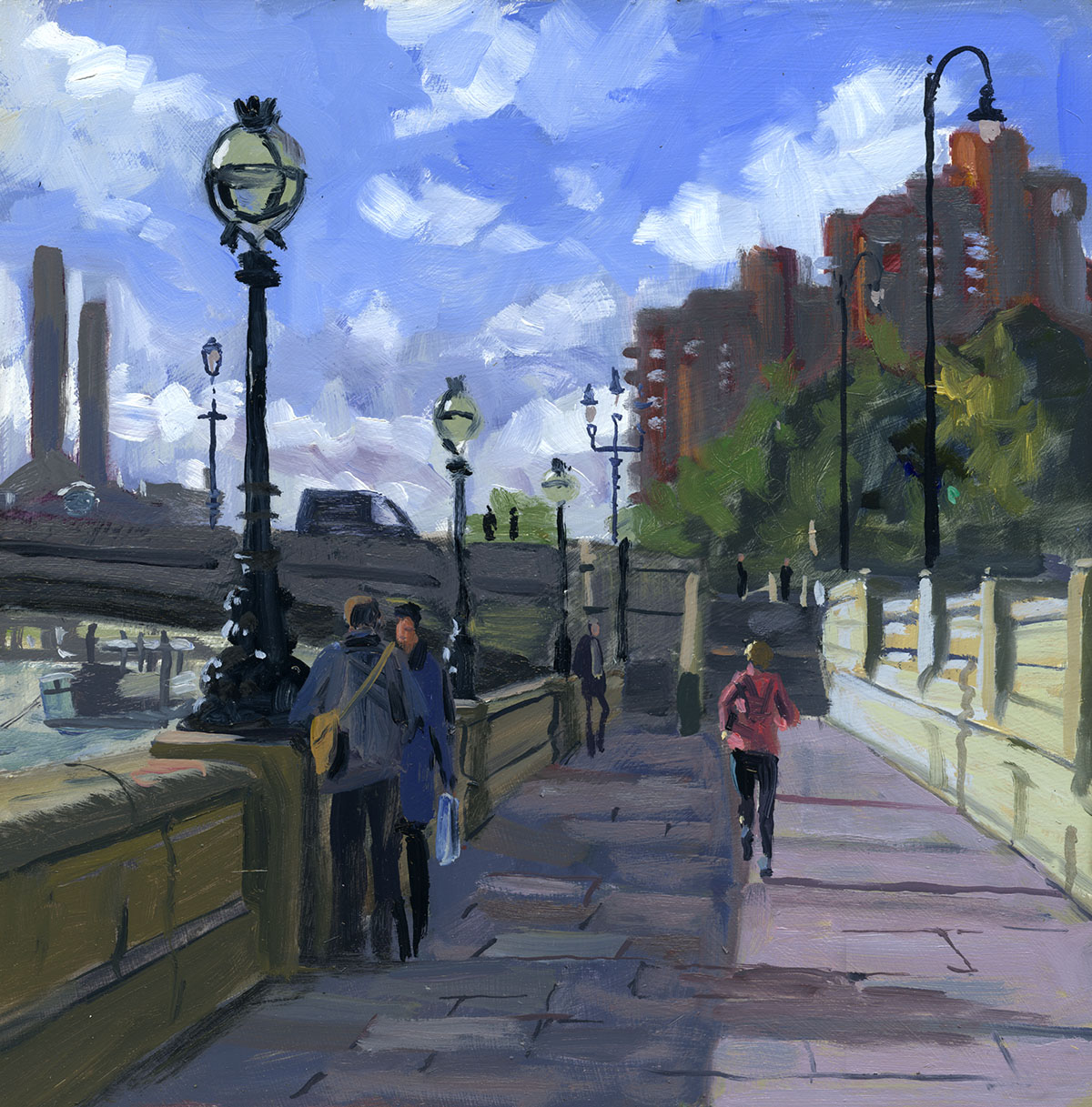
Thames, london, river, battersea bridge, plein air, painting

Second one I loved this little bit of the embankment and the way the shadow divided the composition. I took some square boards with me it is easy to stick

to a few standard formats so I am going to vary board proportions more I think. 10in by 10in oils.

.
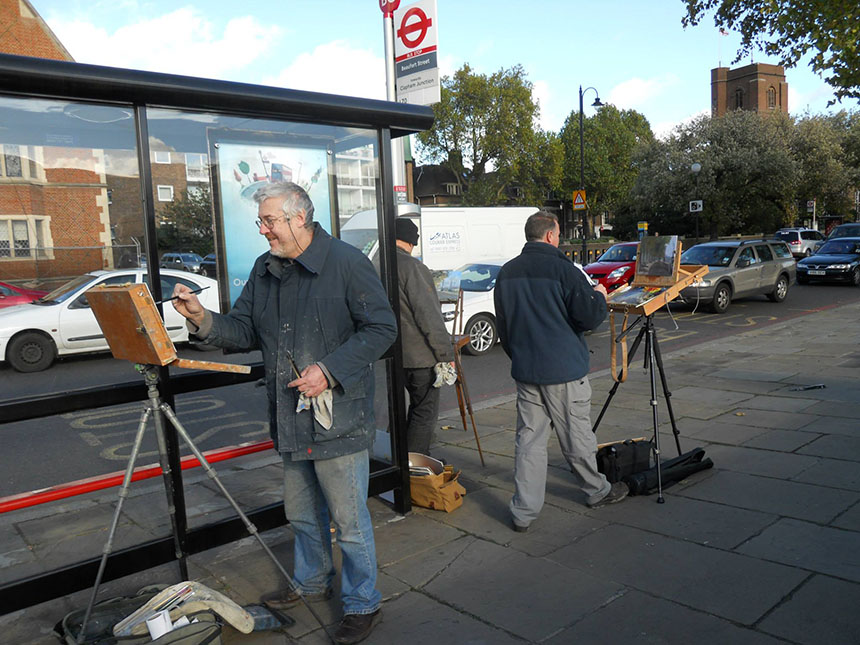
Rob Adams

Here I am painting the last one, I look like I am having fun! Photo by Terry Preen. In the background Tony Lawman and Graham Davies.

October 1, 2013

Imagination and Some Reflections on Reflections

Imagination is something I use differently nowadays. In the past much of my work was derived from my imagination. For work I had to paint things that either didn’t yet exit, had never existed or didn’t exist anymore. Painting from life however doesn’t require the subject matter to be conjured up from the imagination. There it is in front of you every detail in place. So much so indeed that I spend most of my mental effort winnowing out the important bits from the mass of information that the world presents me. Imagining stuff away is one way to think of it I suppose.

I do wonder though if I have rather gone too far down the road of the literal. I don’t want anymore to paint things that are implausible but that does not necessarily mean I need to paint the world just as it presents itself to me. I feel I need to perhaps adjust the way I evaluate scenes. I need a bit more “That scene would be great if…” and if an idea presents itself there is no real reason why I shouldn’t act on it. I was in Jermyn St a few week ago and it rained making the scene very beautiful with the wet street bringing the sky tones down into the road and pavement surfaces. Alas I had no camera with me. A few days later I had to visit it again and the light was very much the same but it was dry. The rain made all the difference though and Jermyn on a grey day with no rain didn’t inspire me. I took photos nonetheless and am considering making the street wet using imagination rather than observation. Part of me though says this would be untrue to the scene.

There is I suppose a question of degree here. I quite often see people paint a scene on a grey day as if it is sunny. Indeed some painters seem to always paint the same day whatever the real meteorological conditions are. This doesn’t mean to say the paintings aren’t nice enough it just causes me to be a little puzzled. However I think in Jermyn St case there is a decent reason to re-imagine the scene, after all I did see a possible painting on the wet day. I cannot however claim to have enough of a photographic memory to recall exactly how it was. So I am left with either waiting for a wet day and returning or just imagining the rain.

As I am keen to get on with this one I will have to go about this somewhat as I would do for an entirely imagined illustration. I will get reference of other wet days on different streets and work out what the reflections would do. It is actually quite easy to work out where reflections will fall. Below is Jermyn St sans reflections.

This is typical of how I plan a studio picture. I have arranged the figures etc and blocked out all the salient information without getting into any real detail. I have also shifted stuff around a bit to reinforce the diagonals as the composition is almost square. I now need to rough out my reflections. As a general rule anything reflected is mirrored about a line where it touches the ground plane. There’s a sentence to make you think! Below is that simple rule carried out.

Take a moment to see what is going on here. The red indicates the lines about which things are mirrored. So Our nearby couple are flipped vertically about their feet. As are the next two figures. You can also see the line I have flipped the post box about. The car is parked level with the tree so I have flipped both the tree and the car about the same line. This tells me where the dark reflection of the tree will fall in the road. Obviously because all the surfaces are rough not like glass none of these reflections will be perfect which gives me quite a bit of leeway. I will also stretch the reflections a little further down as it is a rule that the rougher the surface the further the reflections will stretch down. This is especially true with water so I will do another little sketch to show why this is so.

Here we have a simple scene with a maritime flavour. A fishing boat on a day where the sea has gentle swell and our painter on the shore. If you follow the blue line you can see that close to the boat a fair bit of the wave will reflect the boat and only a small part of the sky. So that near to the boat the reflection will be pretty solid with only thin slithers of sky. If you follow the red line however you should be able to see that less of the wave will reflect the boat making the reflection a slither of dark in mostly bright reflected sky and also that you can still catch glimpses of reflected boat quite close to the shore. This is what stretches the reflection down, it is also what causes the reflection to fade out as the chances of a bit of ship appearing in the reflection diminish. Above I have scribbled a rough idea of the result.

As an aside you often see a bright streak cut through the reflection, this is where the wind has ruffled the water so that small ripples cross the larger waves at an angle. These ripples reflect mostly sky with only a very small line of boat so they appear bright in comparison. If the sun is say of to the right they might catch the direct rays of the sun and appear considerably brighter than the surrounding sea.

.

Jermyn St, Mayfair, London, Oil painting, rain

Here is the Jermyn St painting mostly done. I shall leave it to consider for a week or two before glazing here or there to either knock back or strengthen. I

always seem to need that time to give emotional distance with studio paintings. 20in by 20in oils.

.

Bugsbys Reach, London, Thames, O2 Dome, Plein air

This is the wonderfully named Bugsbys Reach near Greenwich. A blustery and changeable day with the Wapping Group. When the light is changing rapidly

oils is far easier than watercolour, you can dash in the the sudden shafts of light on the water when they occur. Any plein air is really an impression of a

period of time not just the snapshot of one single moment. 10in by 16in oils.

.

Thames Barrier, London, plein air, oil painting

Next I went further East and panted the Thames Barrier, a very hard bit of drawing I wish I had had a wider board. Not one to frame but good practice.

It was very windy for the last half hour forcing me to paint with one hand steadying the pochade. 10in by 12in oils.

.

St Martins Lane, London, watercolour, plein airAn experiment using white acrylic and watercolour. I deliberately laid in the washes too strongly as I intended to add lights after. The acrylic is better

I find than gouache as it gives cleaner whites. Also you can overlay washes to tint it. I was careful to use a cheap sable for that bit of the work as acrylic

is death to brushes! Most of it is plein air but I reworked the figures a fair bit. All in all a good way of painting city subjects as they can be too much for pure

watercolour making it slow and so you can miss the passing light. A small pot of premixed acrylic adds nothing to the weight of my kit. I pre mix it to the

consistency I like and put it in a screw top jar, I also put a ball bearing in so it will mix when shaken. It is of course St Martins Lane, 1/4 sheet.

.

newport, pembrokeshire, wales, boats, sea, watercolour

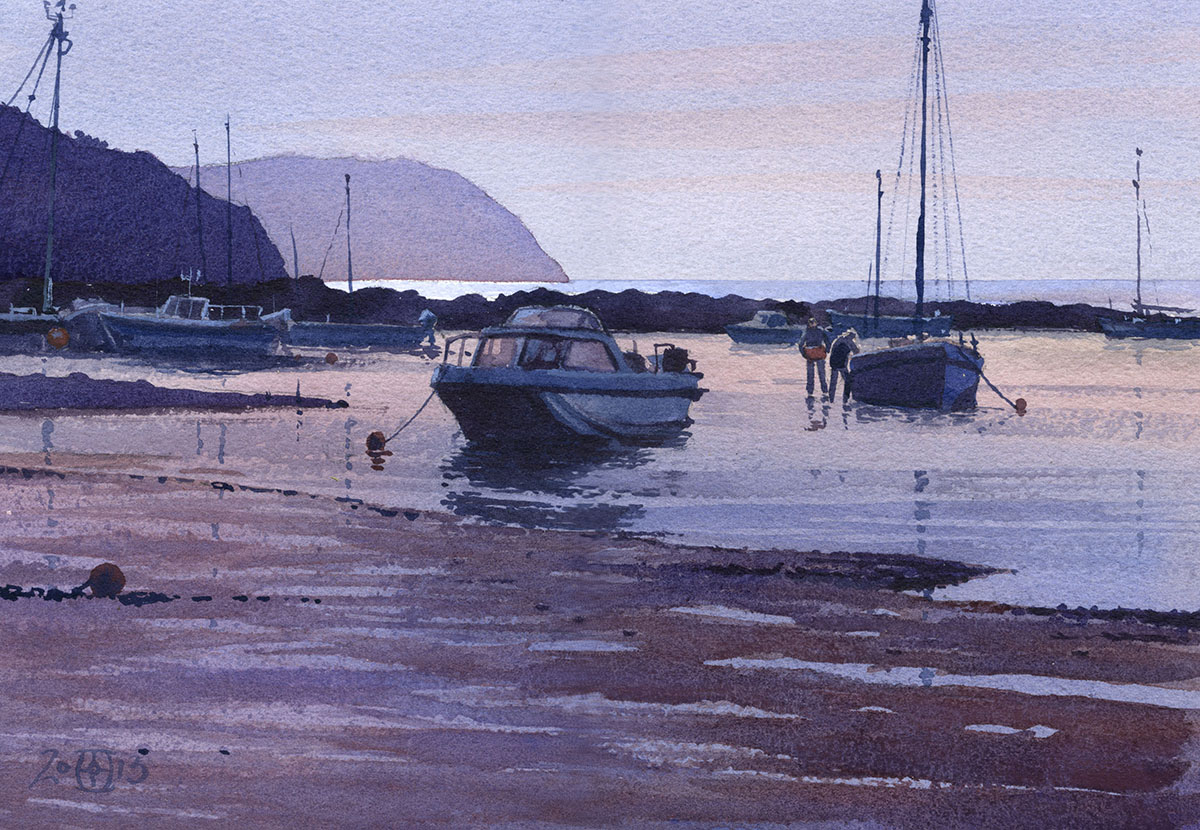
This is Newport in Pembrokeshire. An exercise in keeping those washes clean! I had to be very careful to keep the tones close and subtle.

1/4 sheet watercolour.

.

Isleworth, thames, watercolour, plein air, river

The last meeting of the season for the Wapping Group. This is a hazy morning on the Thames at Isleworth. The haze stayed most of the day which made

the light really interesting and allowed for quite leisurely working. 1/4 sheet watercolour.

.

Isleworth, Karl Terry, Derek Daniells, Rowan Crew

Here’s a picture of them hard at work. Near to far Karl Terry, Rowan Crew and thinking about starting Derek Daniells.

.

Isleworth, the london apprentice, thames, watercolour, plein air, wapping group

The tide was far down allowing us to sally forth onto the fore shore. This allows some great perspectives on the buildings on the bank. The pub is

The London Apprentice at Isleworth. 1/4 sheet watercolour.

.

Isleworth, thames, watercolour, plein air

Last one. Done in my Moleskin as the light faded. To finish the day we went into the pub for the traditional Wapping Group end of season meal of whitebait.

Not for some but I rather like it. Very pleasant to end the day with food, beer and banter!

« Newer PostsOlder Posts »

Powered by WordPress

error: Content is protected !!