Rob Adams a Painter's Blog painter's progress

August 26, 2015

Art and Architecture

What a blight the so called “International style” of architecture has been on our planet. It has wiped out all local and ethnic styles of building the world over. People hoot and howl if their spoken language is threatened by a Lingua Franca but hooteth not when their vernacular style of building is wiped off the map. Europe has for the most part just surrounded their historical centres with a ring of dreary concrete leaving the old encysted by the new. Britain due to the unfortunate rise of the town planner in the fifties and sixties has lost a great deal more. If you took photos from around the world of recent everyday urban developments and removed any signs in Photoshop then I doubt if anybody could place them geographically. So how did this appalling state of affairs come about, how did it happen that what was once considered the greatest of the arts was reduced to engineering and quantity surveying?

Before the invention of architects as distinct profession most structures and all vernacular structures were built by tradesmen. In medieval times a “Master Builder” was employed on the greatest projects. We know little of most of these men, the most famous are more properly military engineers since that was area many of the really big projects were being carried out. Leonardo, Michelangelo and many others drew elaborate bastions with all the lines of fire drawn in. In our towns and villages however the builder was your man. He operated I dare say via tradition that was slowly pushed forwards by the desire of their clients to embrace new fashions. These fashions were mostly imported by the aristocracy and royalty and slowly made their way into the everyday vernacular styles.

To this end many books of architectural detail were printed, which were in effect catalogues that a builder or client could choose from. Outside of building for display most utilitarian structures were simply made along traditional lines from local materials. The result is for the most part unintentionally harmonious but varied and if destinations favoured by tourists are any guide still pleasing today. We rather cruelly and disparagingly refer to the effect as “pretty” or “quaint” but no such intention was intended in their original construction. It is interesting how when architects try and fake this organic and empirical development the result is lack lustre to say the least. The arts and crafts developments are the most convincing as they have an agenda of their own and mostly do mot seek to mimic but to make a new form from an old idiom.

Vernacular building design has always followed a step or three behind the styles of the great projects of any time. The great Renaissance and Baroque revolutions first appeared in the big cities paid for by the church and nobles. It is interesting to not that although we started to have architects they were all artists first and foremost. Bramante, Bernini, Michelangelo and others were all high achieving artists in their own right. Today that is far from the case. I was initially going to be an architect and applied to do a degree. In the run up I went and worked for various local architects my father knew. I soon realised most architecture had no art in it whatsoever but a great deal of accountancy. In truth most of the projects would have proceeded better with just a builder and an engineer, the architect was just an irritation.

So it is that in our age we see feats of engineering but not of art. Our cityscapes have no consistency of overall form, but a deadening uniformity of detail and material. This is not by the way a call for change, we are too late architecture is dead and will not be returning. There is a tendency for people bemoaning the visual state of our built environment to recommend a return to Tudorbethan or Mock-Georgian but this is painfully naive and where it is tried fails due to there being no one with the visual training to make it convincing. No there is no going back, buildings are going to be by the hugest of majorities soulless and ugly for the remainder of man’s existence. The reason for this is not the great projects by the “Starchitects” but the innumerable small developments by jobbing architects who have for the most part no interest in the history of their craft or any decent training in composition, massing, decoration or proportion. So however good a modern building is it will inevitably drown in the vast ocean of workaday dreariness. Indeed anything that is at all good makes the surrounding clutter seem emptier of beauty by comparison. Still architects do keep the market for black polo necked jumpers and expensive round spectacle frames afloat.

We actually have laws to prevent buildings looking beautiful. The regulations that control sill height and window size mean that most fenestration will be ugly. That of course tends to preclude any facade from being at all elegant. The manufacture of windows to standard sizes of clumsy proportion and design puts the final nail in the coffin. Should we care? Well probably not. The generation that does care is ageing fast and the next will not understand what I am complaining about. Past styles are fodder for theme parks and film designers only and not to be ever seen again in our everyday built environments. Who should we blame for this visual poverty that future generations must live with? Well building has to some degree always been about enclosing practical space for the least possible cost. This is where the International Style delivers without question. Building has also always been a display of prestige, but now we tend to be swayed by post code and whether there is a 2 acre underground gym. We are interested in contents rather than any external appearance. You may rail against the horrid boxy uniformity of a Bovis estate, but though the buildings are of execrable design they are cheap enough to make so that a far higher proportion than in any other age can live in their perfectly adequate and convenient comfort.

Now that is of my chest and on to yours I can post some paintings. After a stint of watercolour back to the oils again.


Okeford Hill, Dorset oils, painting, art

A panoramic view from Okeford Hill. I did a small watercolour a year or so ago of this and decided to make a larger studio oil from it. The result wasn’t great so I went back to the location with the studio painting. I was very lucky in that the cloud shadows were adding splashes of light across the valley which looked great. With that and a new sky the whole thing is much improved. Oils 12in by 26in.
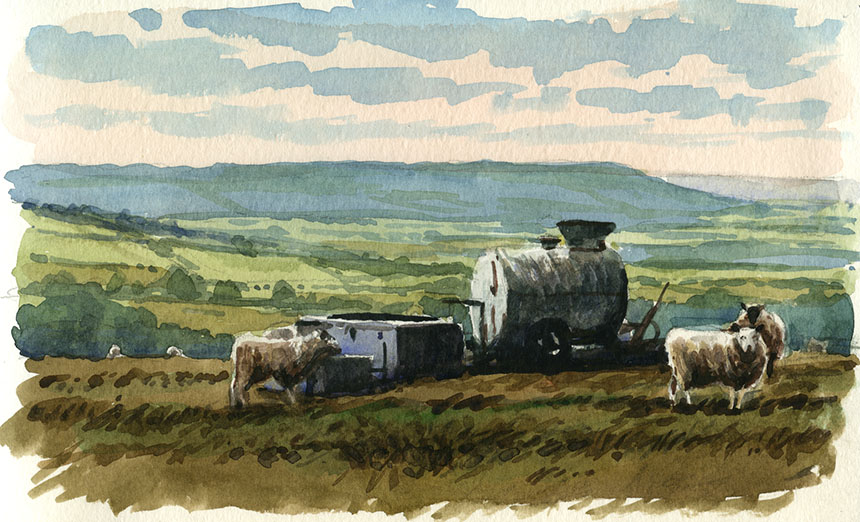
Okeford Hill, Dorset, watercolour

Here is the original watercolour, I worked from both this and photos taken at the time. I don’t much like working from just a photo, it seems to be easier if I have drawn or painted the scene however slight the sketch. The thing is that doing the looking fixes memories in your head that re-emerge when you come to paint in the studio.


Dorset, Hambledon Hill, oil painting, art

Hambledon Hill with a threatening storm. Another done from a previous plein air watercolour. I didn’t need to revisit the site this time. It would have ben pointless in any case as the lighting was everything. Oils 12in by 12in.
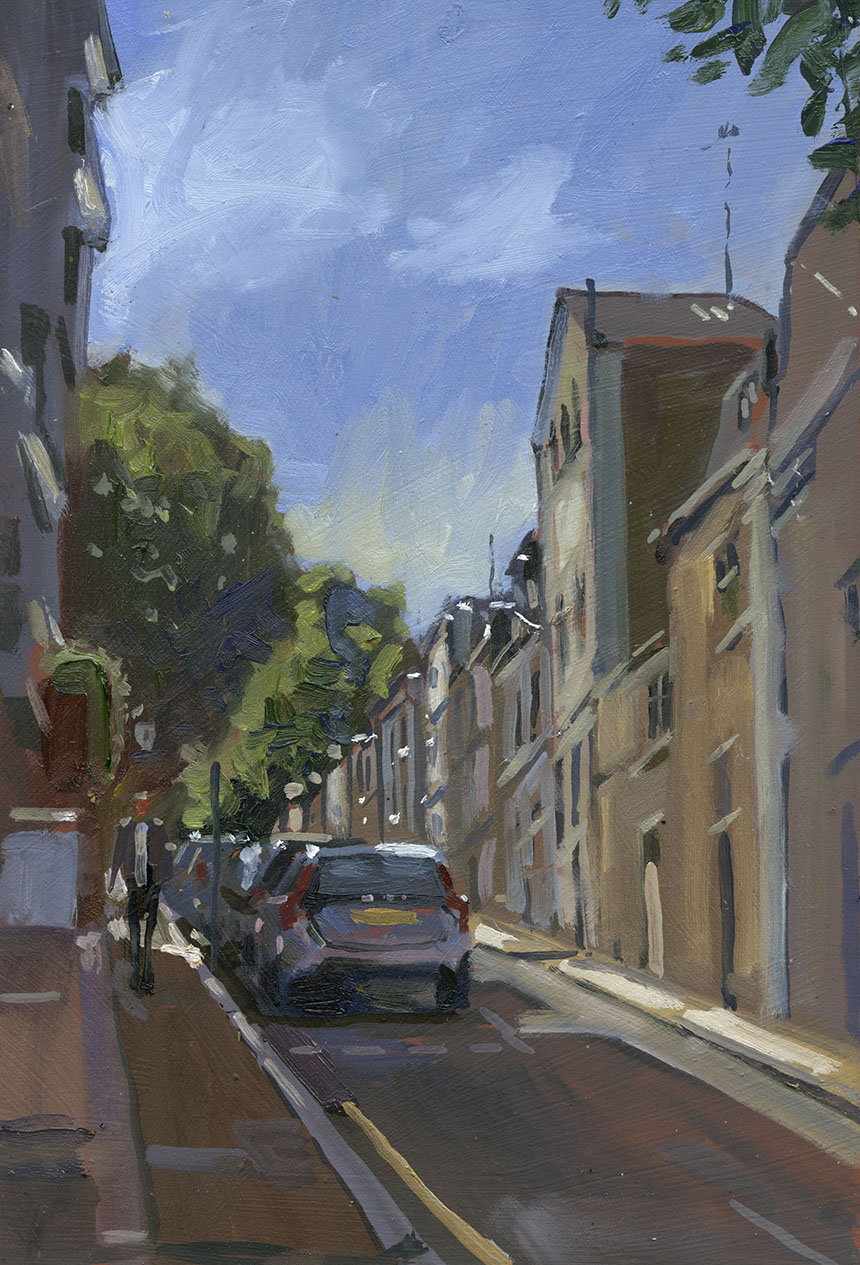
 

Nottinghill Gate, oils, plein air.

I am still visiting London to paint with the Brass Monkeys, this is Notting Hill Gate. This was  a struggle as the light was varying constantly. I might cut this down to a square format as the stuff at the top is bringing nothing to the party. With the best will in the world it is very hard to make the best compositional decisions when racing to get some small part of what you see down. That any of them ever turn into a decent picture is a miracle! Oils 12in by 8in.


London, plein air, Notting Hill, painting, art

Another from the same day. Not quite sure what this needs… will probably go into a drawer to be found only after my final demise! Oils 8in by 12in.


Surrey, oil painting, plein air, art

Somewhere in Surrey… a very quick sketch, but a great scene. I am experimenting with surfaces at present. I have decided that the primed MDF I have been using is too limited and I don’t much like the “feel” of the paintings done on it when varnished and framed. The quality worryingly reminds me of hand made place mats! 6in by 12in Oils.


Romsey Abbey, Hampshire, plein air, oil painting, art

The same day and 60 mile East. My friend Steve Alexander was busy painting the interior so I went and stood in the drizzle to do this. I love trying to catch the day however gloomy. Whether anyone would ever want the resulting daub on their wall is of course another matter! This is Romsey Abbey in Hampshire. 6in by 12in Oils.
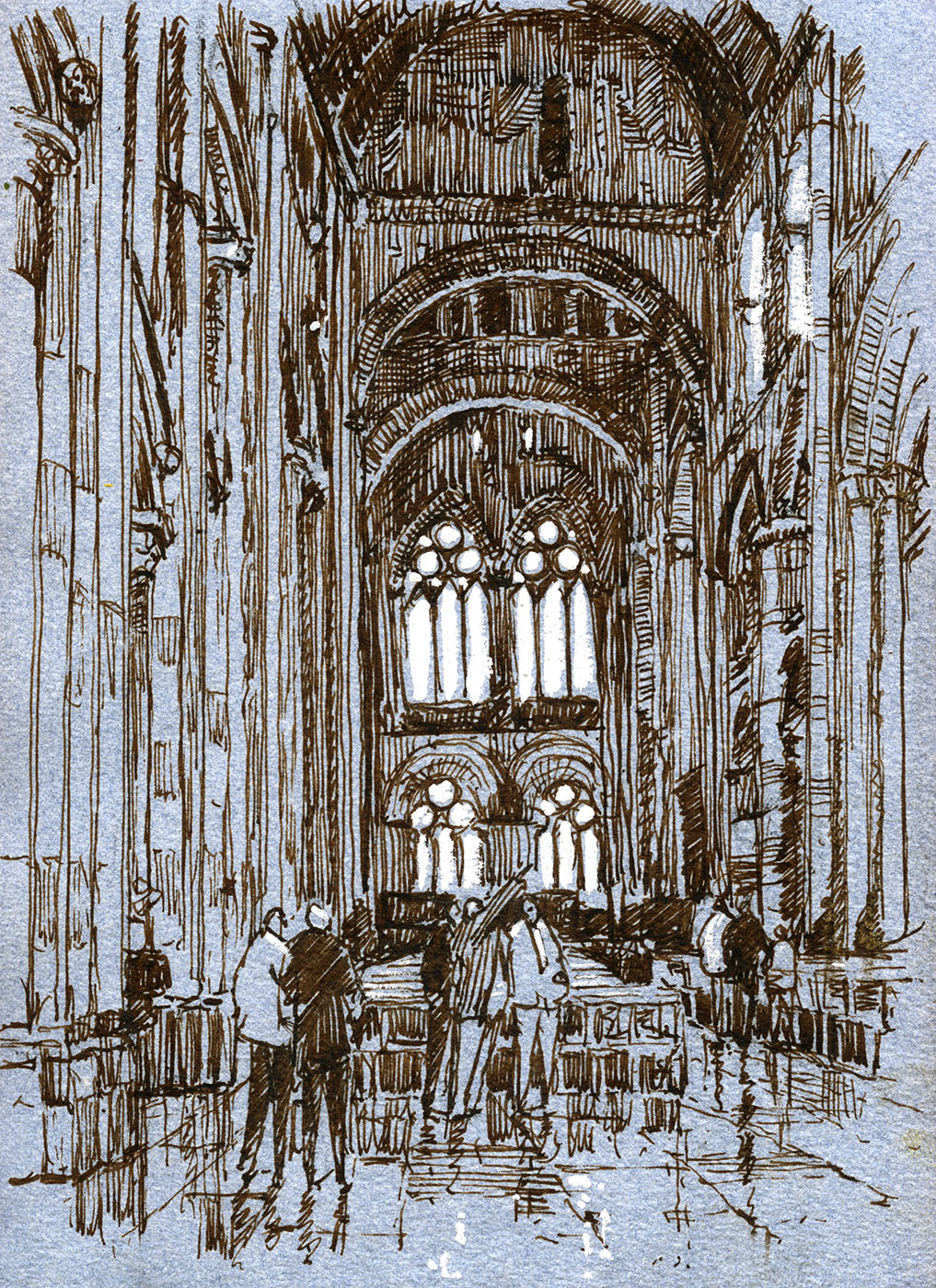
 

Romsey Abbey, pen and ink, drawing

Before doing the grey day oil I did this quick sketch of the interior of the abbey. Romsey is one of my favourite buildings it has a wonderful scale and elegance. When tackling such a subject it is very important to start in a manner that is practical. I could have made an accurate architectural drawing, but that would have taken too long. The charm of these sketches is in some part due to the constraints of time and media. I am always amazed at just how much you can express of a very complex subject with relatively few lines. Pen and Ink.
 

Shroton, Dorset, Plein air, oil painting, art

Steve had accompanied me back to Dorset so we set out to paint the day away. This is Shroton in Dorset a mile or so from me. The forecast had been for rain but this is what we got instead. I rather like the double square as a board proportion especially for landscape. Oils 6in by 12in.


Shroton, church, oil painting, plein air, art, dorset

Next up was Shroton church. I love pictures of graveyards and so do other artists I know… but no one will ever buy one! I just had fun with this I didn’t want to over elaborate a very simple scene. There was a figure but it fell to centrally and so got expunged. Oils 8in by 10in.

Fontmell Down, Dorset, plein air, oil painting.

We next went to the wonderful Fontmell Down. Unfortunately there was a herd of very rumbustious bullocks in the field so we had to retreat. On the plus side though I got some wonderful photos of them with the down in the background which will in due course be a studio painting.  10in by 12in Oils


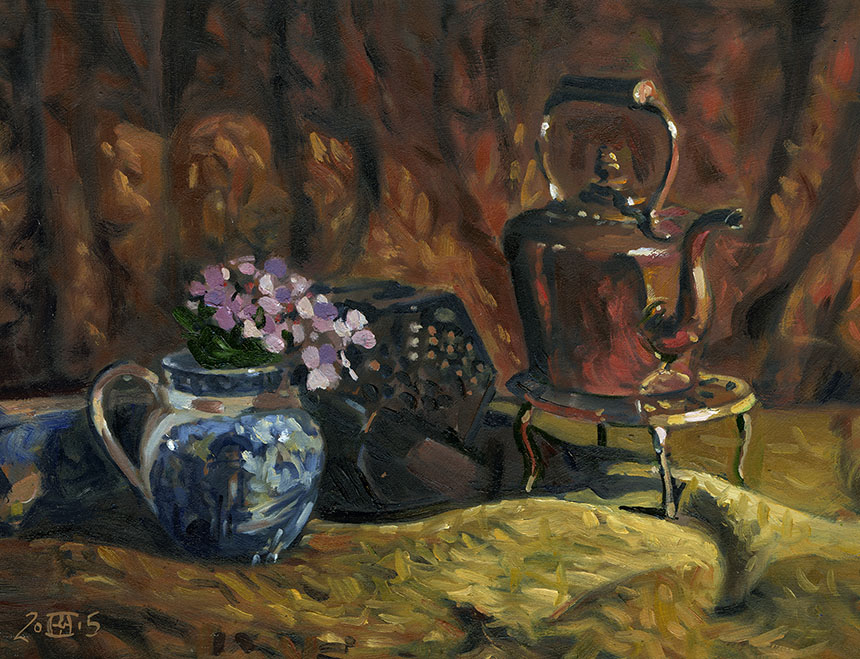
Still life, kettle, flowers, oil painting

Now, as they say, for something completely different. As the rain had well and truly arrived Steve and I set up a still life. I have only done 3 or four such paintings in my whole life. Not because I dislike them but just never got around to doing any. I must do more and Dorset will no doubt supply plenty of wet days in which to paint them. There was a loaf in the picture too, but it was too close and I eventually painted it out. This meant waiting for the area to dry a bit so I had to set the whole thing up again just to finish the table cloth. Great fun though and very good practice to try and capture the various surfaces without getting fussy. I am not much of a fan of “dutch” style over finished still lives. Oils 12in by 16in.

I have an upcoming exhibition so I have been framing pictures like mad. My first solo show so very nervous!

exhibition

July 17, 2015

France the Oils and Vivre La Revolution

Filed under: Dorset,France,Painting,Surrey,Uncategorized — Tags: , , , , , , , , , , — Rob Adams @ 10:37 am

I was watching an excellent documentary about Bohemians by Victoria Coren recently. It was full many of the usual slightly sad cases with an overweening egotism undermined by the worm of insecurity. As I watched a very odd thought crossed my mind, these tear up the rules, live my life without reference to others types were all rather similar. They were all different and mold-breaking in much the same way, they all seemed to cleave to the same view: that individuality was all. Indeed none of them seemed capable of uttering any sentence that did not focus around the words “Me” or “I”. All these claims of special individuality were undermined I felt by the odd way they mostly seemed very conformist to their self advertised type. They all wanted to break rules but even more importantly to be seen by others to break them.

How awful I realised to be born of a generation where all available rules have already been torn up and discarded. We are not shocked by boys dressed as girls, or any conceivable sexual permutation. You might offend with overt sexism or racism, but no one is really going to be shocked or surprised. It must be like being a school child who having realised an ambition to be sent to stand on the naughty step finds that the rest of the school including the teachers are already there. I was especially touched by a set of art students studying painting. They spouted the usual guff about their art being oh so important, how they expressed their inner selves and broke all the rules, all the time not realising that they were actually being conformists. That is how we expect and require artists to be nowadays. One young lad spreading red paint over a canvas in a desultory manner plainly felt he was being daring by referring to genitalia and dressing like a watered down recently weaned version of Francis Bacon. He was however just regurgitating the guff he had been taught, he had plainly not thought about the ideas he was espousing, he had just accepted unquestioningly what he had been taught.

Art and the idea of being an artist ran like a thread through the program. Because if you are breaking rules and and making society face up to its own hypocrisy then that is what you are? Right? Well if the number one rule is not to respect rules then you are in a bit of a dilemma. No one cares a fig if you break bygone rules. If you declare all rules are made to be broken then once they are all torn up where do you look next? Why is it that artists in particular should be required to do all this rule breaking? Well as with fashion I suppose at least they are fairly harmless rules, easily discarded without much effort mental or otherwise. A brain surgeon who declared he or she would break all the rules would be distinctly worrying, a painter less so.

It is hard not to come to the conclusion that none of the so called taboos broken by the art revolution were much to write home about. The artist cries out, “I abhor figuration, I shall work in pure colour and form.” It must have been nice to live in an age where such a cry would be met with horror, but even when such poses were first struck it was not exactly a major apple cart that was being over set. So you are going to put some paint on a canvas a bit differently… hardly seismic in the larger scheme of things is it? Painting is actually quite a humble trade. It is difficult as are many things, but not as important as plumbing or dentistry. If you paint a picture in what ever style that gives others a small moment of pleasure then the job is well done. If you want to shock and scare a few horses then perhaps you have chosen the wrong activity.

The whole business is made more complex for the poor souls studying art in that art is no longer what they study. They strive instead to become shamanic figures who are expected to produce supposedly talismanic objects. Artists have been pressed into service as a make-do replacements for druids and priests. We no longer believe that a bit of mumbling and a sprinkle of H2O gives an object any healing properties and thus, more to the point, increased retail value, but we do seem to believe that a random object backed up by impenetrable art-mumbling adds cachet and investment potential. Both are to my mind superstitions founded on the imaginary “special” qualities of certain individuals in society. It is nice of course to say, “I am an Artist” and immediately get a status upgrade from shabby middle age bloke to interesting aesthete. It is very pleasant for collectors, curators and assorted oracular types to be able to gaze at a clumsy daub and pretend to discern imaginary philosophical depths and spiritual qualities. Which is of course why the whole circus will stay on the road.

For the artist today it is perhaps a relief that all the sacred cows are now slaughtered, and their entrails theatrically and well and truly trodden into the ground. I don’t have to look for any assumptions to challenge, or taboos to threaten. There is no need to seek out the new just for the sake of it, so fashion and style can be ignored. All I need to apply myself to is the simple task of doing a difficult and hard to learn thing well. Also striving to each and every time to do it just that little bit better. Artists who just paint pictures should realise a few hard facts. Nobody needs what you do. What you do is entertainment. You are not advancing human thought in any important way by choosing to carry out this activity. If no one likes what you do it is not the fault of the audience but of the performer. There is never again going to be an age where you can claim to be misunderstood, “The world is just not ready for me.” etc, those times are past and will not be returning for the foreseeable future.

Well now I have that off my chest a few paintings of elsewhere then France…

Richmond, plein air, painting, art


Firstly Richmond. I got this all blocked in and almost done on site but messed up the road overstating the relative brightness. It is so easy to see ground surfaces almost as bright if not brighter than the sky. In actual fact this is almost never so except when there is the direct reflection of the sun in a wet surface, or when black storm clouds crowd the horizon. In all other cases the sky will be brighter than any ground or wall surface. I check this as I have said before by making a small ring with finger and thumb and looking through it flick quickly between different areas. This will immediately tell you what is lighter or darker and roughly by how much. In the studio I scanned my too light road and repainted it 3 tones darker which improved the whole picture hugely. 10in by 12in oils.


Stour, river, dorset, plein air, landscape, painting

An unresolved one here. I find this sort of picture very hard. I have painted everything adequately, but it is at the end of the day boring. I considered adding a canoeist, but whenever you have such thoughts it is probably a sign that the painting should be consigned to the bin! The story of this picture was the reflection, but that was upstaged in reality by the field, a problem which will not be resolved by adding watercraft or hippos to drag the eye back to the river. 12in by 20in oils.


Le Croisic, nocturne, oil painting, France, plein air

France at last! This is the harbour in Le Croisic. On previous visits I have struggled with oils and the first I attempted this time did not bode well and was wiped off. This one I painted after eating and drinking so I was relaxed and bashed the whole thing in in 25min or so. I was very pleased that I had got the coloration mostly right, just a little strong in hue. 10in by 14in.


Le Croisic, salt pans, oil painting, France, plein air

Le Croisic again. I wanted to paint the salt pans which are one of the main features of the area. My problem was I could not get a backdrop I liked. On the way to the salt pans I saw a great view of Guerande and I had the idea I might combine the two… so foreground and background are about 1Km apart! Only a very slight sketch but I enjoyed painting it. 6in by 10in oils.


Le Croisic, France, boat yard, plein air oil painting

I walked back to the town along the shore as the tide was out. This brought me into the local boat yard. I was very taken by this “into the light” subject and also delighted that there was the shade of a huge mobile boat lift to paint from. All very quick to do I actually mixed all my tones before starting which is something I often forget to do but I always find makes life a lot easier. It probably took me as long to mix the tones as it did to paint the picture! It was only as I left the yard by the road that I saw the sign forbidding entry to the general public… 8in by 10in oils.


Le Croisic, France, oil painting, plein air

More Le Croisic. I rather over tidied this later, but was pleased that I got resolved an issue that had been plaguing me in this bright light that seemed to bounce around everywhere. I wiped my first painting of the town because all the shadowed buildings went muddy and dirty. In this one I found a solution by mixing Quinacridone Magenta with various earth colours. This allowed me to get the feel of shadowing, contrast and age of the surfaces without the end result being grubby. 10in by 12in Oils.


Honfleur, France, Plein air, oil painting, church

This is Honfleur. I was really starting to enjoy the oils now. This tremendously bright morning scene was such fun to paint. I was in an awkward spot with shopkeepers setting up around me so I splashed it in as quickly as possible. I won’t mess with it as I love the feel and immediacy of it. I decided against people as it seemed to suit the, early morning before many folk were about, feel. 10in by 10in Oils.


Honfleur, France, plein air, oil painting

Honfleur again. A complex scene for a small painting. I really wanted to catch the intensity of the light on the square. I had to be very quick, no longer than 45min as the sun was coming round on to the facades which changed the whole scene beyond recognition. 7in by 10in Oils.

That’s it just the Watercolours to come…

« Newer PostsOlder Posts »

Powered by WordPress

error: Content is protected !!