Rob Adams a Painter's Blog painter's progress

October 1, 2013

Imagination and Some Reflections on Reflections

Imagination is something I use differently nowadays. In the past much of my work was derived from my imagination. For work I had to paint things that either didn’t yet exit, had never existed or didn’t exist anymore. Painting from life however doesn’t require the subject matter to be conjured up from the imagination. There it is in front of you every detail in place. So much so indeed that I spend most of my mental effort winnowing out the important bits from the mass of information that the world presents me. Imagining stuff away is one way to think of it I suppose.

I do wonder though if I have rather gone too far down the road of the literal. I don’t want anymore to paint things that are implausible but that does not necessarily mean I need to paint the world just as it presents itself to me. I feel I need to perhaps adjust the way I evaluate scenes. I need a bit more “That scene would be great if…” and if an idea presents itself there is no real reason why I shouldn’t act on it. I was in Jermyn St a few week ago and it rained making the scene very beautiful with the wet street bringing the sky tones down into the road and pavement surfaces. Alas I had no camera with me. A few days later I had to visit it again and the light was very much the same but it was dry. The rain made all the difference though and Jermyn on a grey day with no rain didn’t inspire me. I took photos nonetheless and am considering making the street wet using imagination rather than observation. Part of me though says this would be untrue to the scene.

There is I suppose a question of degree here. I quite often see people paint a scene on a grey day as if it is sunny. Indeed some painters seem to always paint the same day whatever the real meteorological conditions are. This doesn’t mean to say the paintings aren’t nice enough it just causes me to be a little puzzled. However I think in Jermyn St case there is a decent reason to re-imagine the scene, after all I did see a possible painting on the wet day. I cannot however claim to have enough of a photographic memory to recall exactly how it was. So I am left with either waiting for a wet day and returning or just imagining the rain.

As I am keen to get on with this one I will have to go about this somewhat as I would do for an entirely imagined illustration. I will get reference of other wet days on different streets and work out what the reflections would do. It is actually quite easy to work out where reflections will fall. Below is Jermyn St sans reflections.

This is typical of how I plan a studio picture. I have arranged the figures etc and blocked out all the salient information without getting into any real detail. I have also shifted stuff around a bit to reinforce the diagonals as the composition is almost square. I now need to rough out my reflections. As a general rule anything reflected is mirrored about a line where it touches the ground plane. There’s a sentence to make you think! Below is that simple rule carried out.

Take a moment to see what is going on here. The red indicates the lines about which things are mirrored. So Our nearby couple are flipped vertically about their feet. As are the next two figures. You can also see the line I have flipped the post box about. The car is parked level with the tree so I have flipped both the tree and the car about the same line. This tells me where the dark reflection of the tree will fall in the road. Obviously because all the surfaces are rough not like glass none of these reflections will be perfect which gives me quite a bit of leeway. I will also stretch the reflections a little further down as it is a rule that the rougher the surface the further the reflections will stretch down. This is especially true with water so I will do another little sketch to show why this is so.

Here we have a simple scene with a maritime flavour. A fishing boat on a day where the sea has gentle swell and our painter on the shore. If you follow the blue line you can see that close to the boat a fair bit of the wave will reflect the boat and only a small part of the sky. So that near to the boat the reflection will be pretty solid with only thin slithers of sky. If you follow the red line however you should be able to see that less of the wave will reflect the boat making the reflection a slither of dark in mostly bright reflected sky and also that you can still catch glimpses of reflected boat quite close to the shore. This is what stretches the reflection down, it is also what causes the reflection to fade out as the chances of a bit of ship appearing in the reflection diminish. Above I have scribbled a rough idea of the result.

As an aside you often see a bright streak cut through the reflection, this is where the wind has ruffled the water so that small ripples cross the larger waves at an angle. These ripples reflect mostly sky with only a very small line of boat so they appear bright in comparison. If the sun is say of to the right they might catch the direct rays of the sun and appear considerably brighter than the surrounding sea.

.

Jermyn St, Mayfair, London, Oil painting, rain

Here is the Jermyn St painting mostly done. I shall leave it to consider for a week or two before glazing here or there to either knock back or strengthen. I

always seem to need that time to give emotional distance with studio paintings. 20in by 20in oils.

.

Bugsbys Reach, London, Thames, O2 Dome, Plein air

This is the wonderfully named Bugsbys Reach near Greenwich. A blustery and changeable day with the Wapping Group. When the light is changing rapidly

oils is far easier than watercolour, you can dash in the the sudden shafts of light on the water when they occur. Any plein air is really an impression of a

period of time not just the snapshot of one single moment. 10in by 16in oils.

.

Thames Barrier, London, plein air, oil painting

Next I went further East and panted the Thames Barrier, a very hard bit of drawing I wish I had had a wider board. Not one to frame but good practice.

It was very windy for the last half hour forcing me to paint with one hand steadying the pochade. 10in by 12in oils.

.

St Martins Lane, London, watercolour, plein airAn experiment using white acrylic and watercolour. I deliberately laid in the washes too strongly as I intended to add lights after. The acrylic is better

I find than gouache as it gives cleaner whites. Also you can overlay washes to tint it. I was careful to use a cheap sable for that bit of the work as acrylic

is death to brushes! Most of it is plein air but I reworked the figures a fair bit. All in all a good way of painting city subjects as they can be too much for pure

watercolour making it slow and so you can miss the passing light. A small pot of premixed acrylic adds nothing to the weight of my kit. I pre mix it to the

consistency I like and put it in a screw top jar, I also put a ball bearing in so it will mix when shaken. It is of course St Martins Lane, 1/4 sheet.

.
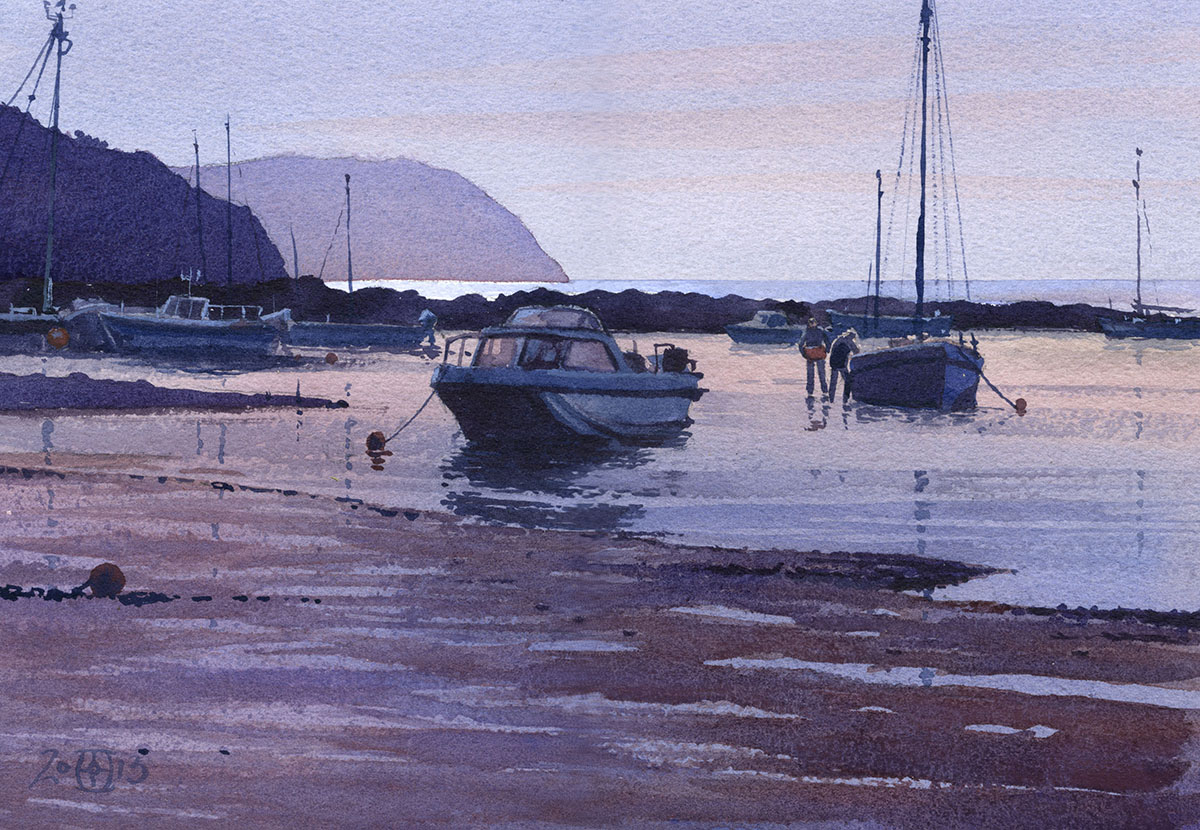
newport, pembrokeshire, wales, boats, sea, watercolour

This is Newport in Pembrokeshire. An exercise in keeping those washes clean! I had to be very careful to keep the tones close and subtle.

1/4 sheet watercolour.

.

Isleworth, thames, watercolour, plein air, river

The last meeting of the season for the Wapping Group. This is a hazy morning on the Thames at Isleworth. The haze stayed most of the day which made

the light really interesting and allowed for quite leisurely working. 1/4 sheet watercolour.

.

Isleworth, Karl Terry, Derek Daniells, Rowan Crew

Here’s a picture of them hard at work. Near to far Karl Terry, Rowan Crew and thinking about starting Derek Daniells.

.

Isleworth, the london apprentice, thames, watercolour, plein air, wapping group

The tide was far down allowing us to sally forth onto the fore shore. This allows some great perspectives on the buildings on the bank. The pub is

The London Apprentice at Isleworth. 1/4 sheet watercolour.

.

Isleworth, thames, watercolour, plein air

Last one. Done in my Moleskin as the light faded. To finish the day we went into the pub for the traditional Wapping Group end of season meal of whitebait.

Not for some but I rather like it. Very pleasant to end the day with food, beer and banter!
August 22, 2013

Style Wars

I have sort of touched on this previously but a few conversations this week have sort of focussed me on the issue. People both painters and  people who enjoy looking at paintings tend to like some things and not others. Painfully obvious of course. The problem is that they also tend to go further and lean towards believing what they like is worthy and what they don’t enjoy as worthless. I myself have plotted an erratic course through the landscape of art and at different times have liked and loathed many different styles. Now however we are in an age where nearly everything in the history of painting is available at the click of a mouse.

I have a large collection of art books which now never leave the shelves as there is better and wider information online than most of them contain. Indeed I have seriously thought of getting rid of them as they are almost never looked at. The books do provide another service though. They plot the course of my interests of things visual over the years. There are books on anatomy, carpets, Irish castles and insects, to name but a few. I can still recall the excitement when I found a book that inspired. I remember the fascination of delving through George Bain’s book on the construction of celtic art, which sent me on an orgy of drawing key patterns and brain boggling interlacements. That indeed was the pattern, discovery followed by practice and then on to another focus of interest. My library is quite wide and eclectic, consider how much more grist there is available for my mill compared to that of Rubens, but is still a mere slither compared to what is available online.

Young artists today are faced with a blizzard of imagery from all of mankind’s long history of visual creation. Search engines place everything on an equal footing, they don’t care about quality or provenance only keywords. With this in mind I wonder if it is now almost impossible to do anything wholly new. We have as it were mapped out most of the terrain available to explore and only a few ever reducing (and not necessarily interesting) corners are still left uncolonised. This I cannot help but feel spells an end to the linear flow of art history much loved by academics and critics. The same thing has already happened to some extent in music. A teenager’s iPod can contain everything from Bach to Led Zeppelin to some very current offering. They have essentially treated all that was available as some kind of cultural buffet and filled their plates with whatever took their fancy. This in turn has had an effect on music production which might draw from a hugely diverse mix of influences. The same is becoming true with painting I suspect.

This I cannot but help feel spells the end to both the contemporary and the so called modern. When a categorical term becomes so inclusive that nothing is excluded then its usefulness has as far as I can see ended. The establishments at all ends of the art spectrum are bravely battling to hold back the tide, but like Canute they are likely doomed to fail. The hard thing from my point of view is to envisage what the landscape might look like once the dust has settled. I’ll make the attempt to work out the possible results though this will likely be risible once the reality is there to be considered!

Firstly, I think your idiom of painting will in the future be entirely a matter of choice. Much in the way you might choose a medium or a composition. Already you see many artists who do both abstracts and representational. This could well be the norm in the future.

Secondly differentiation of whole categories of subject matter, type of execution, styles or idioms into high and low art may end. All the flavours of painting available which are currently assigned a different degrees of worthiness or status may therefore be equalised. It always makes me chuckle when I see auction and exhibition catalogues use the word “important”. My immediate feeling is to whom, sez who and why?

Thirdly a more useful way of assigning merit might well occur. At present we have what the Art critics say is good, what the Collectors collect, and what the Curators select. Notice we don’t have what the public likes in there. Now however we have the potential to assess better than ever what the public likes. What is more we could narrow it down to what different sections of population appreciate. The tastes of visually naive and the sophisticated and their different likings can be separated out. This in turn could be used to supply rankings of relative merit in varying idioms. No method of course would be without flaws and unfairness, but it would not be hard to be better and indeed more fair than the current elitist regime.

I wonder as well what categories of painting might be useful, here is a wild stab at it:

Expressionistic, the painting of feeling and emotion.

Observationalistic, the recording and fixing of perceived reality.

Imaginistic, the painting of dreams and imagination.

Analystic, the painting of texture, pattern and structure.

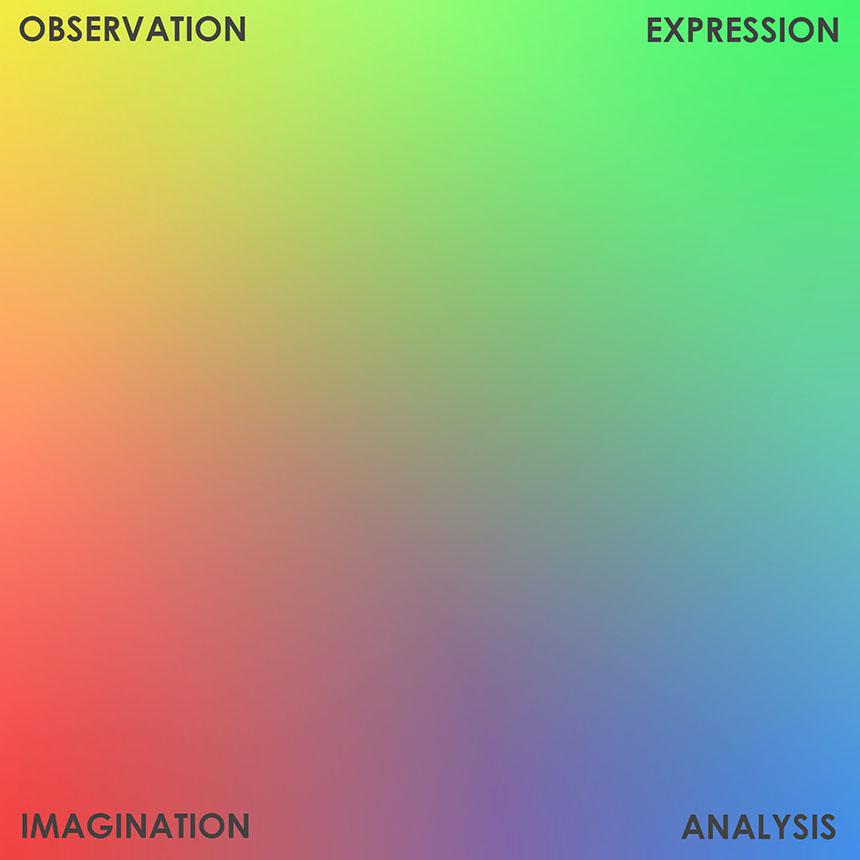
I don’t see any of these as exclusive, each might in some circumstances be a subset of one of the others. So a work might have any combination of each in any order. Each might be further broken down so that “Imaginistic” could contain Surrealism, Illustrative and perhaps Metaphysical content. It is very hard to visualise, I gave considerable thought as to whether there were any other possible categories. If anybody can think of a manner of painting that would fall outside of all these categories then I would be delighted and intrigued. At first I wondered if Symbolic was a category but on the whole I think it can be contained within Imaginistic and Analystic. We could maybe sink to the depths of a diagram at this point, I can only apologise for this new low, but it shows the possible interactions better than words can…

.

Diagram

As we are painters I have chosen a colour chart approach! You can see by the way the colours mix we can have any shade or mixture of my four elements. You might I hope place any painting you know approximately in this space. Plein air for example would be leaning towards the Observation corner, with a good dollop of Expression a certain amount of analysis and only a small dose of imagination. Surrealism would have a large proportion of Imagination with maybe less of the other three. This is not I am at pains to point out a diagram of all Art, where for example would you put photography? Perhaps in Observation, I did consider Perception and Experience as that heading but felt them a little too broad. The observation is done mechanically, but the decision to observe was made as in a painting. If anybody can think of a painting that falls outside these bounds let me know what it is and why, don’t mind my wild theorising being shot down in the least. One other thing I pondered was how I should arrange the influences around the square. Unfortunately none are ideal. A truer arrangement would be in 3D with each influence placed at the corner of a tetrahedron! Enough mad theorising some paintings!

.

Faversham, Kent, plein air oil painting

I have been going out of a Sunday with friends Tony Lawman and Graham Davies to paint which is very much fun. This is Faversham creek. 8in by 10in.

.

Faversham, Kent, oil painting

Don’t quite know what to think of this one, needs softening and merging somehow. The tonal contrasts are too brash. 10in by 14in oils.

.

Faversham, Kent, oil painting

Last one of the day and the best too. Faversham Creek again, the day steadily improved. 10in by 12in oils.

.

Faversham, kent, oil painting

Faversham again but painted last winter I would guess… I was sorting all my plein air stuff into locations when I came across this, the foreground wasn’t

finished, so a plein air I would guess, but I have no memory of painting it at all! I obviously didn’t like it at the time! 10in by 20in.

.

Tower Bridge, London, Thames, HMS Belfast, oil painting, Wapping Group

A day out with the Wappers, there were two more oils but I scraped them off, the light went horrible and flat. 16in by 10in oils.

.

Pool of London, Thames, watercolour

I should have stuck to watercolour sketches for the rest of the day. There’s a lesson for me, don’t paint unless the subject grabs you!

.

Queensborough, Sheppey, Kent, plein air

Another day out with the boys. This is Queensborough on the Isle of Sheppey. Lots of great subjects this is 10in by 16in. I did an earlier one but it is in

surgery I might post it if it survives!

.

Queensborough, Sheppey, Kent, watercolour

Last one from Queensborough, I liked it there lots to paint the town is paintable too.

« Newer PostsOlder Posts »

Powered by WordPress

error: Content is protected !!