Rob Adams a Painter's Blog painter's progress

May 11, 2011

Spring Greens and Life Drawings.

Managed to misplace my Blog password so a bigger gap in posts than I would like. I have been painting the spring which has been like no other I recall. Now I am painting regularly every few days I am noticing the changes in the seasons day to day far more than I have in recent years. Another unexpected bonus to the painting lark. My studio work alas is at a standstill. I know I must make a next step but am not sure just what the direction ought to be. The world has enough pretty views and enough gritty urban ones for that matter, indeed adding another work to any genre seem a pretty vain act. I know this is foolish of course, but nonetheless I have always needed to feel there is a new discovery to be made in each work, which is easy in a plein air but harder somehow in a studio work. It is no real use to do a painting that is merely an exhibition of skill, any more than a piece of cabinet making that is just about the joints used and serves no use would be. It must have beautiful craft and also be beautiful in purpose such as a chair. With chairs the purpose is straight forward, but with a painting less so. I might do for example a painting to please another, to adorn their walls. I know several very fine painters who do just that, they paint when there is a commission to do so but not otherwise. For me I have always painted “for myself” as well as commercial work, which when I was working a great deal was almost as a sort of relaxation I could hardly wait for the gaps in my schedule. Now I have mostly eschewed commercial work it is not so easy to create as somehow a reason is needed The answer I feel is that the value has to be in finding myself enriched by the experience of  doing a painting. So I have to take on some subjects that are more demanding, not complicated but I think more nuanced… we shall see!

For now here are a few  plein air watercolours and a slew of life drawings. I have built a nifty watercolour slash oil painting attachment for my tripod to allow me to paint standing or sitting in either medium and as many different formats as possible… which will be the subject of a very nerdy post all by itself.

Watercolours can be clicked for larger version.


.

Watercolour, ringwood, river, avon, plein air, painting

14in by 10 in. I have decided to paint a little larger in my outdoor watercolours so it was a deep breath and out with the bigger brushes. I used a 1/2in flat a fair bit in this one which is fine as long as you don’t get square edges in places you would prefer not. This was a gorgeous spot on the River Avon in Hampshire.

.

Child Okeford, Dorset, watercolour, plein air, painting

The spring is so advanced with everything extremely verdant. Usually I steer clear of brilliant greens but I could really see no alternative. I have tried to add a little red to every sunny green and a little ultramarine to all the shadowed hues. The result is still quieter in hue than reality but not I hope too eye wrenching as painted greens can often be. This path is in Child Okeford Dorset.

.

Hever, castle, garden, italian, watercolour, plein air, painting

Back home and the day was so beautiful I set off to Kent. It was very windy so I did this which was sheltered under a gazebo. The light was very crisp and clear and the textures of the old and worn hedges fascinating to to try and catch. Again my brush wandered into greens I don’t often touch.

.

Westerham, kent, watercolour, painting, plein air

A quiet road near Westerham Kent. This composition appeared many times along the way but not anywhere where I could paint it without being run over! Eventually I stopped on a wider bit so I could paint protected by my car! The light through the trees was fantastic and I underlaid all the shadow areas with a wash of ultramarine moving to prussian blue for the road.

.

London, Thames, greenwich, watercolour, plein air, painting, river

A sad story here, I got up at dawn to paint the river and did this in beautiful morning light. But a few days later when doing another in the studio I knocked my water over and swamped this one as it lay on the table. At least I scanned it before its demise. Lastly a few life drawings to finish off.

.

life drawing, nude, figure, pastel

.

life drawing, nude, figure, pastel

.

life drawing, nude, figure, pastel

.

life drawing, nude, figure, pastel

.

life drawing, nude, figure, pastel

.

life drawing, nude, figure, pastel

.

life drawing, nude, figure, pastel

.

life drawing, nude, figure, pastel

.

life drawing, nude, figure, pastel

.

life drawing, nude, figure, pastel

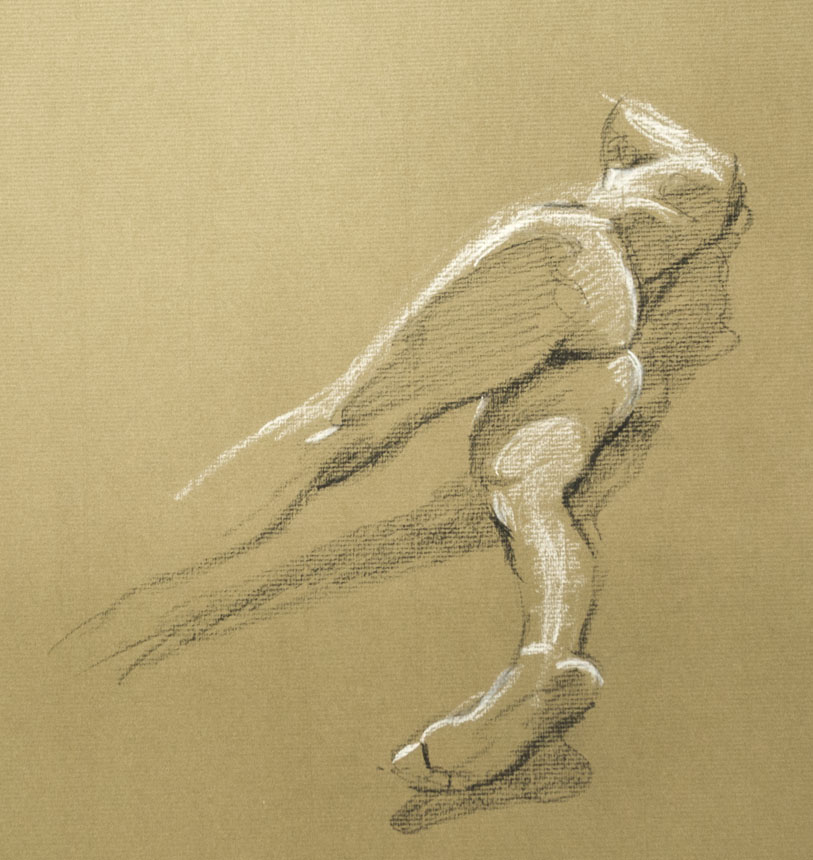
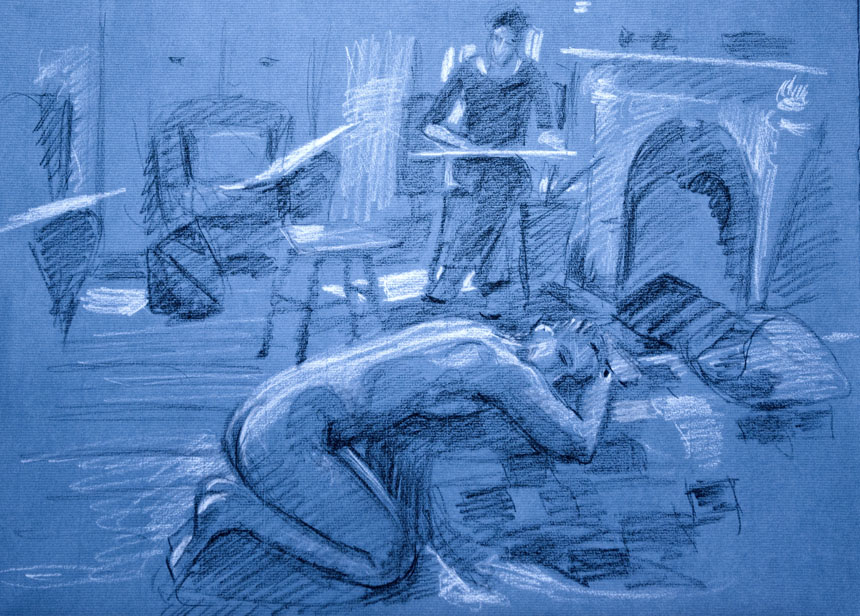
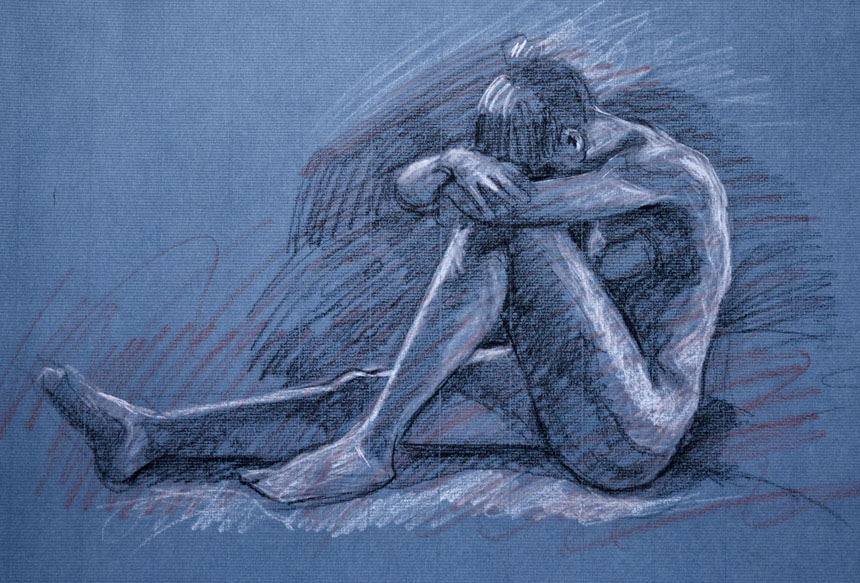
I am enjoying life drawing at present. I have reduced the colours used to just black red and white, the traditional trois crayons though I need to use the red more.

April 19, 2011

The Problem With Columns

Filed under: Drawing,How to do,Perspective — Tags: , — Rob Adams @ 12:42 pm

This is the second of an occasional series of posts about perspective. Many people believe that geometrical perspective, single point, two point and three point are actually an accurate representation of what we see. Cameras see in this way after all so it must be right mustn’t it? Well actually no, it is a compromise as are all methods of making our very three dimensional world fit conveniently on a flat surface. Here I am going to deal with a very old problem that perplexed Renaissance artists as they struggled to find solutions to the problems of illusory painting. Vredeman de Vries and other artists published learned books full of geometrical construction but certain problems seemed impossible to resolve. Columns were a big feature of architecture of the time and they often occurred in long arcades, perfect fodder for the perspective method you would think. However it turns out that round columns are exactly the type of object that causes the neat geometrical rules to fall apart. What I intend to do here is highlight the issues as clearly as I can and then point the way to the various solutions that later artists arrived at. It is a sad fact that all modern books on perspective that I have seen do not even seem to realise that the issues are there, let alone giving any practical advice to overcome them.


.

perspective, drawing, tutorial

Here we have a plan view of a simple set up consisting of a row of columns, a cube and a green triangle which marks where our viewer is standing. Below is what we get if we construct using one point perspective what that viewer would see.

.

perspective, drawing, tutorial

Well here we are, at first glance it seems sort of OK. Look more closely though and we have some problems. In our plan we can clearly see that all the columns are the same size. That does not however seem to be the case in our perspective projection. The column on the far left is a lot wider than the one straight in front of us. Worse when we look at the plan the far left column it is actually further away from us and should appear smaller not larger. Something is plainly awry. Looking more closely still the base of the far left column seems oddly tilted. This is exactly the result a camera would give on a fairly wide angle lens giving a viewing angle of about 70 degrees. So when you wonder why you looked so fat in that group photo this is the cause and in future you would be best to make sure you are in the middle  of the line! Lets take another case.

.

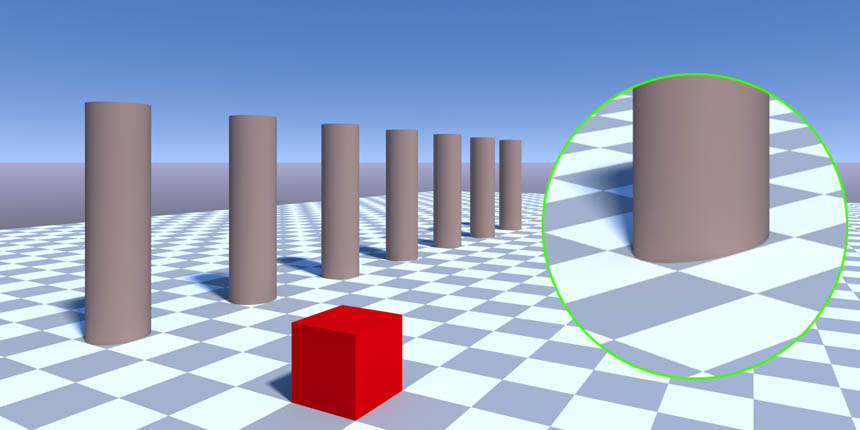
perspective, drawing, tutorialHere is the plan of a simple set up, as before the green triangle marks our viewpoint. We often get rows of things receding from us, looking down a romanesque church nave would be an example. Below is how traditional two point perspective renders the scene.
.

perspective, drawing, art, turorial

Once again at a quick glance it all seems well but a closer one shows that the left column again shows problems. These are clearer still when we isolate that part as in the green circle. There is a weird tilt which is plainly not how we would really see the base of such a column. If you then tried to add capitols and bases you would find it very hard to get them believable. Below is an example from an old perspective manual by Jan Vredeman de Vries printed in 1599.

.

perspective, drawing, tutorial

As you can see the problem is still present, and remains over the centuries up to the present day. This is because there is no right way to solve this problem. Whatever we do it will still be wrong. The trick is to be pragmatic and make the unavoidable departures from how we really see the world as subtle as possible. Lets look at the dilemma more closely.

.

perspective, elipse, drawing, tutorial

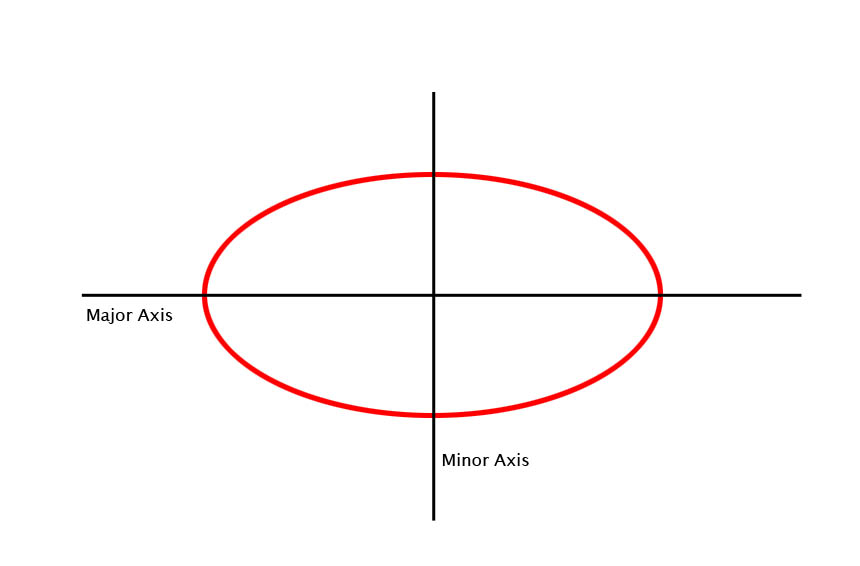
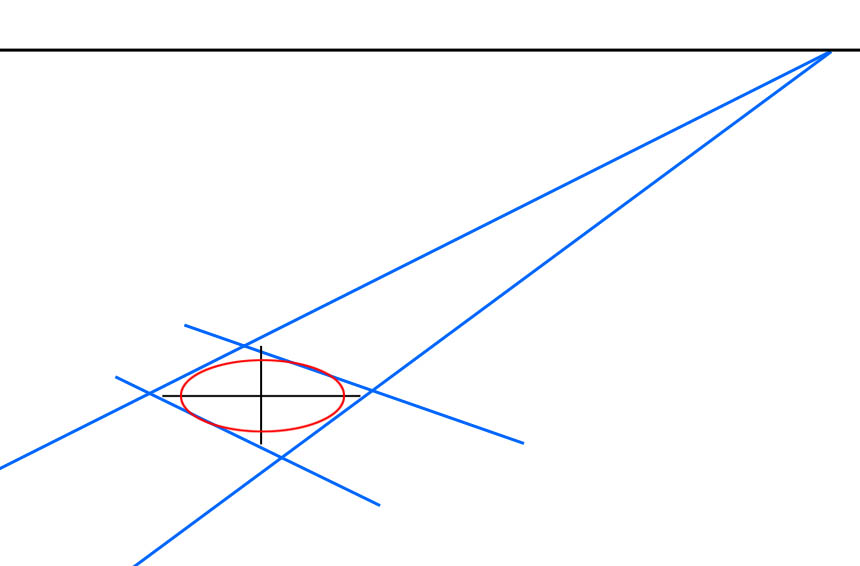
Here is our old enemy the ellipse, I won’t go into how to construct one as there are many methods freely available on the web if you are interested. In the real visual world as seen by our eyes when, for example, we look at a coffee mug on the table or any circle that is parallel to the ground, the major axis of the resulting ellipse is always parallel with the horizon line. Try it, put a plate on your table and slide it around. But cameras and 2 point perspective construction produce ellipses that have the major axis tilted. It is this that produces the odd distortions. All we can do is come up with a compromise, a sleight of hand adjustment that is not perfect but improves the believability of our drawing.

.

ellipse, perspective, drawing, tutorial

Here is a circle constructed in two point perspective. The problem is that cross and the ellipse with it need to be parallel to the horizon line to look right to the eye. Yet at the same time it needs to fit into the blue box.

.

ellipse, perspective, circle, drawing

Here is our compromise. The winners are the ellipse which is now properly aligned to the horizon and also a wee bit narrower to correct for the first problem of “fattening”. The losers are the chequer board floor on to which the column no longer perfectly fits. But as you see the mis fit is quite small and far less worrying to the eye in my opinion. Below is the correction applied.

.perspective, circles, drawing, tutorial

It would be easy to tweak the lines of the floor to make the adjustment less noticeable, but I have left it alone as it shows where the changes have been made. Returning briefly to the very first example of the over wide columns left and right one solution here is to make all of the columns the same as the central one. Again a compromise that may throw up other problems but a good starting point. Chequer board floors of course make the whole problem worse. When I was designing for television advertising I once put a chequered floor into a shot that was to be filmed on a wide angle lens. The cameraman was not at all happy and the Director made me paint it out! The next instalment on perspective matters will be how to place arches, doors and windows into buildings in a scene by a few rule of thumb tricks.

« Newer PostsOlder Posts »

Powered by WordPress

error: Content is protected !!