Rob Adams a Painter's Blog painter's progress

August 16, 2013

The terror of white walls

Here is an area where I make mistakes repeatedly, and with the cost of mouldings expensive ones too. So I have been eyeing up other people’s choices with much interest in the past year or so. Here is the problem: Most gallery and household walls including my own are white. White is unfortunately just about the most unflattering hue to present a picture against in my opinion. Imagine the National gallery old masters hung against bleak white walls, even worse imagine them all “gallery wrapped”!

My instinctive tastes are inherited from my parents and I suppose reflect the 40’s and a bit of their parents taste from the 1890’s thrown in. So I tend to frame for an imaginary room with green William Morris wallpaper and possibly gas light. The results when placed on a white wall I have to admit to myself have not been pretty. I have used up most of my poorly chosen moulding and am trying to not make the same mistakes again, but am not exactly confident as to how I should go about it.

Another factor that makes matters worse is that a large 6ft wide abstract in primary tones will look great as just a bare canvas. It is beefy enough to hold its own against that wilderness of white. A 14in by 10 in plein air however does not stand a chance! It needs therefore some protection against the wall surface dominating and this means a frame. Also I need a standard frame I can’t go framing each oil painting separately, especially if they are ever shown together, there is nothing worse than a motley collection of varied frames.

The first thing that occurred to me is that looking at what others do the moulding needs to be quite substantial, around 100mm. Also it needs to be quite simple, no vine leaves! It does however need some depth to it so that it springs from the wall. I have seen quite a few framing jobs that essentially put a 6in white plank around the picture which I don’t like. Another factor is cost I am going to paint the frame so there is no point in buying an expensive moulding. To find a moulding that fulfils all these requirements is not easy!

Firstly some paintings, the usual mix of OK, so so and dire! I really must stop just painting whatever is around on days out. If nothing presents itself then just keep on looking until something does, don’t just paint because that is what you are there to do. Every time I sit down and paint something that doesn’t really grab me the results are poor, it is just time and materials wasted. It is I suppose unreasonable to expect to find a worthwhile subject every time you go out, especially if the light is no good. Better to come back having done a lot of looking and no painting than with dross that wasn’t worth the doing! So I will if I can stick to doing quick watercolour or small oil sketches if I am at all uncertain of the worth of the subject and only set to with the oils on a bigger panel if there is a good chance of a worthwhile painting. I have been pressing on with some larger pictures, they get easier the more I do. I don’t know why I find a 24inch wide canvas forbidding, it seems absurd since I have spent a large chunk of my life painting things 40ft across, but there it is.

.

Northumberland Avenue, London, Oil painting, city, urban

This is Northumberland Avenue 22in by 16in. Based on my plein air sketch last week and associated photos. I am getting better at transferring the

plein air colour and feel to a subject after the event. First I adjust the photo to look as much like the sketch in tone and colour as I can. This makes the whole

process a lot smoother.

.

Charing Cross Road, Rain, London, oil painting, urban, City

Another biggy, this is 24 by 18in. I did a plein air of this a year or so ago it was only 7in by 5in done hand held. I was very pleased with it and knew it

would make a good picture. Great fun to paint as I was pretty sure the result would be worthwhile. I’ll put the small sketch below for comparison.

.

Charing Cross Road, London, Plein air, oils

I really tried hard to keep the feel but not be too slavish in my reinterpreting it.

.

Sunbury, plein air, oils, Thames, river

Here is a prime example of a painting that I should not have bothered painting! There is nothing particularly wrong, it is just boring and not worth a

painting. A small watercolour in my sketchbook would have done the job. It is Sunbury on Thames 14in by 10in oils.

.
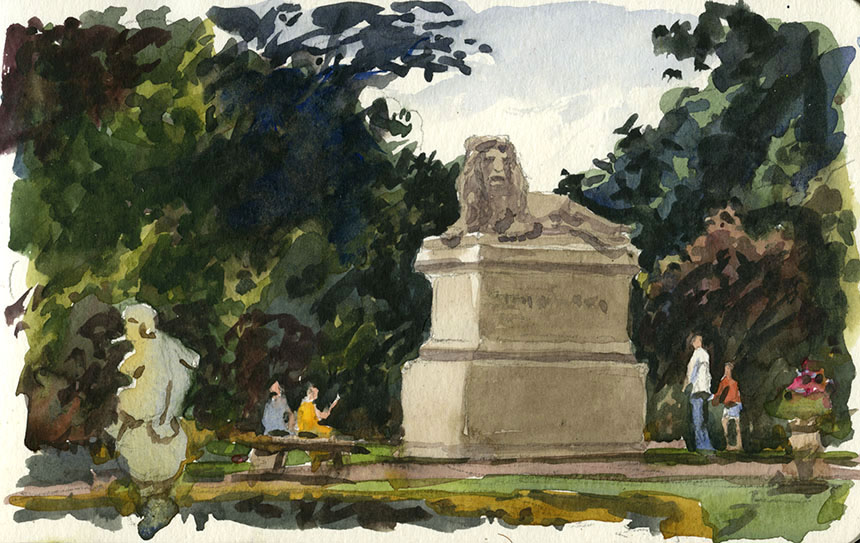
Sunbury on Thames, knot garden, plein air, watercolour

Here I did the right thing, the quick sketch serves the subject perfectly, which makes the 20mins well spent!

.

Richmond Hill, Thames, plein air, oils

Driving back from Sunbury I took a wrong turn and ended up going over Richmond Hill. Seeing this who could resist? It was such a relief to be sitting in

front of a fantastic subject. I’m not sure that this does it justice, but the photos I took do it even less! 15in by 7.5in Oils.

.

Now back to those pesky frames, non frame nerds can back away!

.


As you see from the dimensions it is quite substantial and stands out from the wall 53mm. It also has a rebate that will take a canvas, many mouldings have a small rebate so the canvas

bulges out the back which makes fixing annoying. My next move is to try and work out what the finish should be. This is far from easy and not something I am confident about, so I

decided to treat it the same way as any commercial job. To this end I built myself a simple gallery space in 3D and hung my virtual pictures on the wall! With today’s technology I can

test different arrangements and see which will do the job best. This should mean less messing around when I come to actually paint them. Fortunately 20 years in the scenic art world has

given me the technical skill to apply finishes professionally. Due to this experience I also can make up the frames, which is just as well as the moulding is too big for any Morso! I’ll put a

series of images to show the development.

.

Here is my virtual gallery. I have made the computer model of the frames in scale. In olden days when we had deep red wall paper these gold frames were

just the thing… But on white gallery walls they look pretty grim.

.

Here I have simply painted white leaving the gold as an accent. Better already I hope you will agree. A little dead looking though.

.

I next tried grey and white as I have seen others do. Quite nice but very utilitarian and the white does not suit pictures with quite dark tones.

.

The same grey with gold accents. This works better and I will go with this. I can vary the grey depending on the tonality of the picture.

.

I added a slightly more realistic lighting to my model and tweaked the grey. Next I have to refine in the real world!

.

Here it is, a terrible photo but you get the idea. This frame has about 10 coats of paint as I experimented! I will I think do a lighter weight version for the

10in by 16in and below but this should look better than my previous attempts in an exhibition environment.

July 11, 2013

Working from Photos, Working from Life

It is a subject many artists are sensitive about. I am a bit myself, if I am to be honest. There is nothing more disheartening than the supposed compliment: “It’s just like a photo!”. Just as with tracing there is a hint of the cheating about it. Just as with tracing there are pitfalls that come with using photographic source material, but that does not mean you should not use them, only that you need tactics to avoid the difficulties that they can cause. There is I feel a problem with working only from photographs and never from life. Though I am sure there are artists that overcome the hurdle. My main issue would be with those who can work from photos but cannot paint easily when sitting in front of a real subject. I would encourage all such painters to give it a go and paint from a first hand view rather than the processed flat image that a camera produces.

Once again it is not so much about what it does to the canvas but what it does to the artist. Painting from life gives you a set of tools and a perspective that will in my opinion lift your studio work even if it is mostly derived from the photographic image. You may not produce anything but scrap in your work from life, but the experience will enlarge your perspective and make you look at other work with a more educated eye.

For many years when working as an illustrator I was dependent on trawling newspapers, books and magazines for reference photos of whatever it was that I was commissioned to paint. Then there was the laborious process of merging this various information into a coherent image. My working sketches were done on tracing paper and often had many layers as I juggled with different elements. I had a vast Grant Enlarger the size of a fridge that enabled me to blow up and reduce images. All in all a cumbersome process that I grew to dislike. On my days off I would go out and sketch in watercolour and enjoy the blissful simplicity of just painting what was before me. It is only now when I am trying to establish myself as a picture painter that I find myself using photographs to do paintings to please myself. Before this period I had only painted ten or so “Studio” landscapes from photos all my other work was plein air.

Oddly this means I come fairly fresh to the act of painting framable pictures from photos. There is not the problem of disparate elements, I am working from images of scenes I have captured myself. It makes me very aware of the gulf between a photograph and a painting,  also how rare a thing a photo that will make a good picture is. When I was first out and about I snapped anything that took my fancy; but doing a lot of plein air in the last few years have made me much more selective. The other thing is that my “painting antennae” have become much more sensitive. I habitually squint and assess the tonal balance of possible subjects. I now only take a photo if it passes the simple squint test, IE does it simplify into a pleasing pattern. Bit by bit I have become better at selecting bits of the real world that have that certain something.

Once I have my photographs home I find that 90% can be ditched. Once they are away from the subject they have lost their resonance. Just a few then are “possibles.” Every now and again I get a very likely candidate and that will go on to the next stage. I am not that interested in doing paintings that I could easily do directly. What I am looking for is some ephemeral moment that was there just for a few seconds, a trick of the light an arrangement of figures and occasionally a figure that can hold a whole picture together as a focus. These also are rare things. Indeed very few pictures of people look “right”, to be useful they need a certain balance and above all a good silhouette. I trawl through photos looking for them and put them in a separate file. I might stay in one place once I have found a scene I am interested in and photograph passers by for 20 min or so. I just watch the LCD on the camera as the people pass and capture likely moments. Then when I come to make the painting I have plenty of likely subjects to populate the picture!

The main thing I need to decide is what the painting is to be about and hone that focus, it is easy to get distracted during painting and stress areas that need to be quiet and unassuming. For me also mood is very important and I often shift the palette from the original to bring a colour harmony to the picture that the photograph didn’t have. Tone also needs to be adjusted to support the composition. As you can see by this list it is much more straightforward to paint a scene from life! It is in my opinion pretty worthless to just to copy from a photograph. All the photo-realists, hyper-realists and droves of amateurs doing photographic pencil renderings leave me completely cold. To copy a photo takes far less skill than interpreting one. The former is mostly time and patience the latter is skill and experience.

A bit of everything in this post. Studio, plein air and life drawing. Alas most of my time has been taken up doing commercial work so less pictures than usual.

.

Soho, London, bicycle, sun, oil painting

A sketch for a bigger painting, somewhere in Soho I think. This is 14in by 10 in but the final one will be 36in across. I am trying to do preparatory paintings

like this for all future studio works as it should make painting the final one that much easier.

.

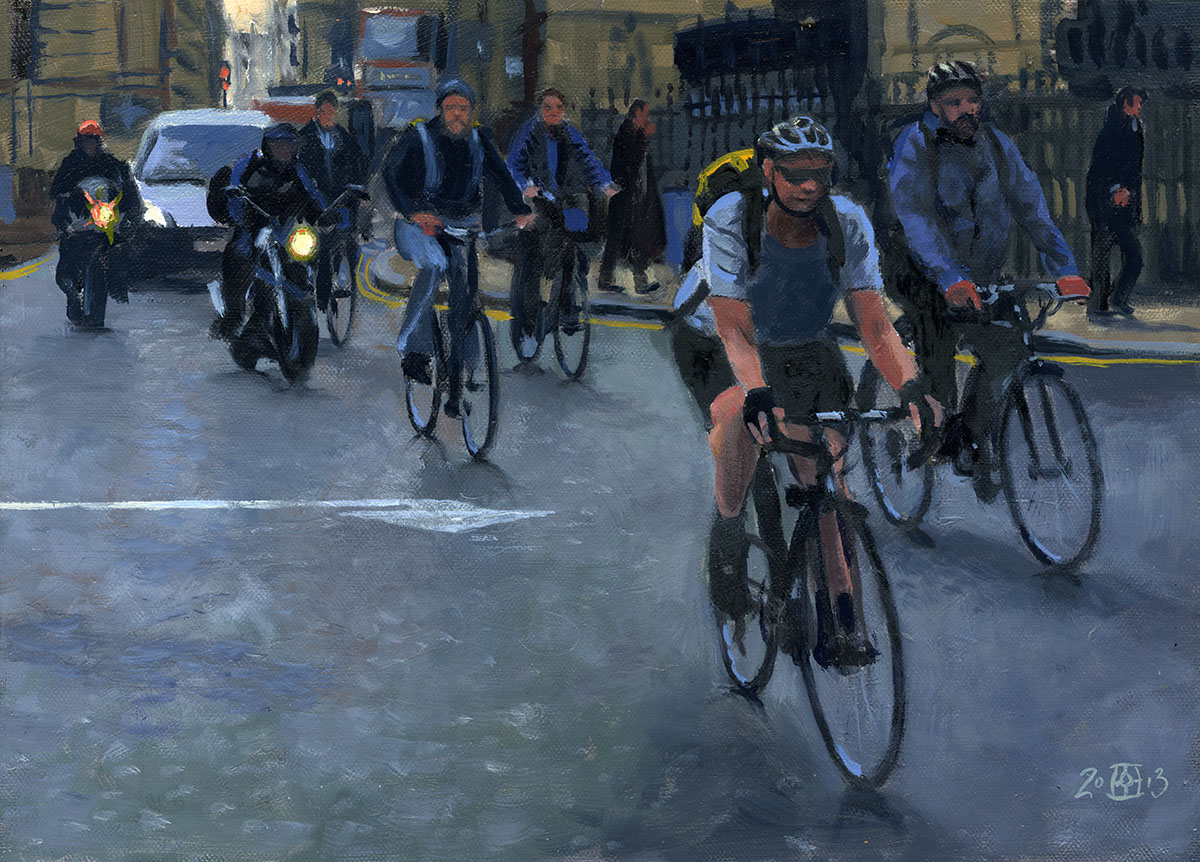
Cyclists, bicycle, Royal Exchange, London, City, oil painting

Another 14in by 10 in sketch. I stood for quite a while photographing the morning rush at the Royal Exchange in the heart of the City. When the lights

changed it was like the beginning of the Tour de France with the cyclists and motorcycles away first! I have a couple of others of these planned. I rather

like the odd mood because it is very early and the people all quiet and self absorbed despite pedalling fiercely. Below the snap that I took it from.

.

Royal Exchange

I have shown the whole frame here so you can see what I have done. The little group of commuters was perfect so I left them alone, just playing with the

tones to enhance the mood.

.

London Memorial Gardens, Embankment, plein air, oil painting

Back to the plein air. A wonderful day out with the Wapping Group. This is London Memorial Gardens near Charing Cross. I got there early so this is

7.30 am. A constant stream of people on their way to work, no tourists at this hour. About 10in by 10in. I have since muted the green on the left a little.

.

Whitehall Gardens, Big Ben, London, Park, Plein air, oil painting

After a coffee I moved straight on as the light was super. This is Whitehall Gardens , and unusual view of Big Ben. 14in by 10in.

.

Victoria Tower Gardens, Houses of Parliament, plein air, oil painting

Took on a monster here! Something not quite right but good practice. This is Victoria Tower gardens. 14in by 10in.

.

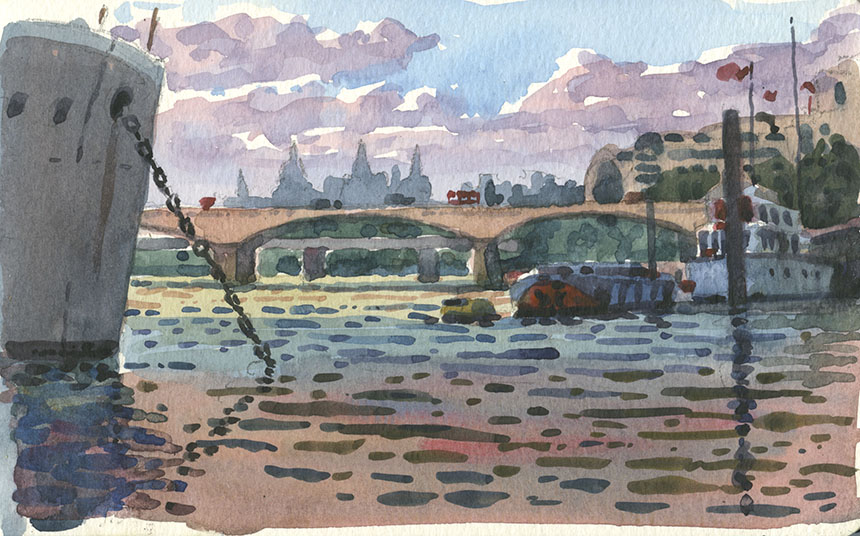
Thames, watercolour, plein air

I couldn’t resist a quick watercolour sketch, even though I am meant to be practicing the oils.  I was chased up the steps by the tide as I did this. 7in by 5in.

.

Nude, Life drawing, figure, charcoal

Only one session of life drawing left after this. This is done in brown charcoal.

.

Nude, life drawing, charcoal

More experimenting, I am starting to get the hang of this charcoal stuff a little more.

.

Life drawing, nude, charcoal

I am getting the balance of broad fill and detail better, which makes the drawing hang together more. 20min.

.

Life drawing, nude, charcoal

Another one I am pleased with, using the side of the sticks more works well on the rough newsprint. 30min.

.

That’s it I’m off doing the Pintar Rapido….. so wish me luck!

« Newer PostsOlder Posts »

Powered by WordPress

error: Content is protected !!