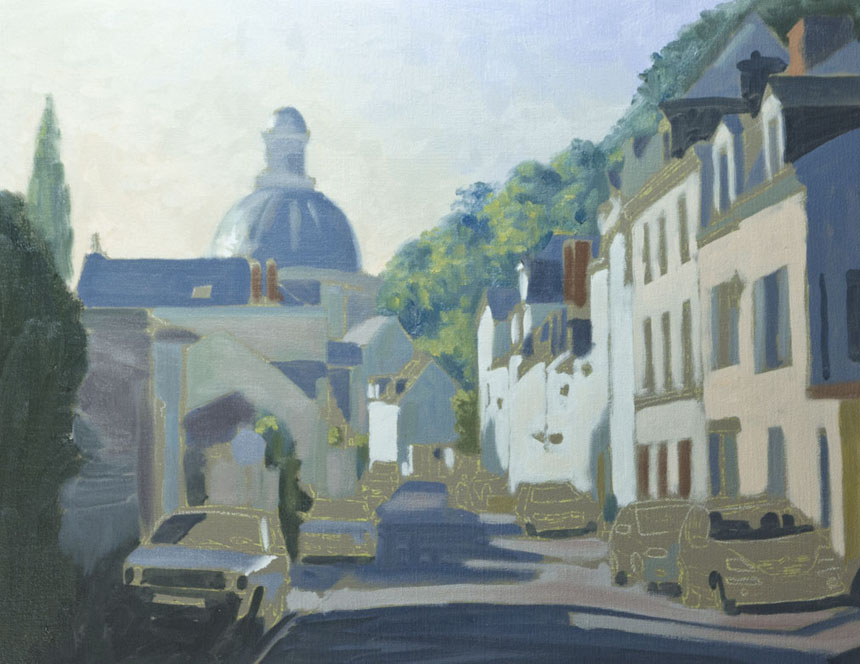
I have been trying to squeeze painting in between earning a buck or two to pay for more painting expeditions. Not ideal, it doesn’t take much real work to ruin your life! Base ingratitude on my part as I am very fortunate in having clients that work around my only occasional availability. At some stage I must try and sell my paintings, but the whole process of hawking your wares and the concomitant framing, delivering and marketing reminds me too much of the time I spent trying to get established as an illustrator. From that experience I know only too well how long it takes to establish yourself in any market. In many ways I have been hugely spoilt, for most of my career I have had the certainty of payment for my work… the only downside being I didn’t get to choose the subject matter. I intend to put work into some open exhibitions this year as an easy way of putting a toe in the water. As soon as you consider selling your paintings you have to decide which market you are in. Do you sell a lot of paintings for a small amount, or a small amount for a higher per picture price? Getting this balance right is key. I am quite prolific and I don’t do the sort of picture that takes weeks to complete it is rare for a picture to take more than a day. So I am inclined to position myself towards the more economical end. I have no real hope of earning a living wage selling my wares, nowadays there are so many amateurs/ semi professionals of extremely high standard that the market is pretty crowded. On the plus side it is an astonishing era in which we live, from my flat in South London I can broadcast my work to the world. On the downside there are so many signals pervading the digital aether that to be noticed is far from easy.
One way of drawing attention is to shout, the weird, the wonderful, the disgusting, the frightening are ways to be loud, include these in your output and you would, you imagine, draw attention. For some this is true, but for most they are lost in the resultant hubbub. For me as I get older I am less impressed by exhibitions of prowess in exquisite detail, or wild imagination, which is pretty rich considering I have earned a fair bit of my living doing just that. Now I seek an indefinable something that echoes the world I find myself in and what seems to best suit that aim are hints that define but leave room for the appearance of interpretation. I say appearance because I am not in the business of supplying fodder for people to exercise their imaginations on, go look at lichens on a rock, cracks in a wall or a Jackson Pollock if you want that. I am not in any way denigrating that activity I love lichens, clouds and even enjoy the odd moment of Mr Pollock, but it is not my stock in trade. There is much talk of impressionism, especially amongst plein air painters. I am tempted, I admit by that, but something makes me draw back. Impressionism grew out of two things: The arrival of the mechanically produced image that froze a moment and the scientific discovery that primary colours will mix in the eye to produce any hue you wish. This territory was pretty swiftly explored and wore itself out with the pointillists. Impressionism did however bring to the fore something else that had more worth in my opinion. The saying of a lot with a little. Visual poetry, spare lines of verse rather than a novel with its complex unfolding of plot and character. This has been around forever, from the wonderful animals delineated on the walls of caves to the drawings of Michelangelo and on to the watercolours of Singer Sargent. I think we forgot this in the west for a while, only to be reminded by the influence of eastern art and thought.
So there it is commercialism can go hang, I intend to follow my own course in as selfish a way as I can. I have spent decades painting for others so I intend to paint myself into a potentially very poor grave painting for myself! That’s it for rabbit, on with some paintings.
.

A visit to Blackheath Village. The forecast was for rain but none turned up. I was slightly in the way here and expected to get moved on, so I painted as fast as I could with no prior drawing out. The result is nice enough but would have been better if I had done the drawing carefully before starting in with the colour. Still sometimes it is fun just to “go for it” and trust to fortune.
.

We have had some beautiful evenings and the light on this particular evening was wonderful. I took a lot of care over the relative tones here as I knew whether the painting worked or not would depend on the subtle contrasts. I might subdue the sky left and right a little, but we will see.
.

A day out with the “Wappers” in Whitstable. I arrived early as the forecast was for a dull second half of the day. Not much to say about this one, it needs a dog walker coming along the path I think. Which would be true to life as they passed by in droves, dog walkers are early risers in Whitstable!
.

The light flattened out very quickly and I was left struggling for subjects. This would be a great scene given the right light, but I am still quite pleased to have got quite an acceptable painting from such an unpromising view. I have exaggerated the colours and tones but only as much as I thought was needed and no more so as to retain the feeling of flat light.
.

I nearly didn’t start this but I’m glad I did now. I thought such a divided composition would be poor, but in the event it is the strongest point of the painting. The water was very tricky and took quite a few wiping offs for me to get what I wanted.
.

Last one of the day, the light had started to do interesting things. One challenging thing about painting ships is that they tend to up anchor and away when you are in the middle of painting them. Just as the blue gravel carrier did when I was painting this.
.

An experiment with granulation. I thought the effect was suited to a nocturne and it did, but I rather overdid the effect. I learnt a lot about the whys and wherefores of granulation by doing this. In the most simple terms the more gum arabic you add to the colour the more it granulates. With ultramarine if you over do it the effect is slightly like a soot storm! Still it suites an urban scene pretty well.
.

Back to my old haunts. This is a plein air sketch for a larger picture, it went so well I will have difficulty making the final version better. This is one of my main challenges I face at the moment, to transfer the immediacy of a plein air to a studio painting without it being a sort of pretend plein air.
.

I’m quite pleased with this one, it is almost the first studio picture where I have got the balance almost right. A few tweaks to come once it’s dry, but on the whole a step forward.
.

Some fantastic evenings I did a quick colour note, and took some photos when passing over London Bridge. A much painted scene but I just couldn’t resist.A half sheet of Arches so larger than I usually paint, I am rather fond of the double square format.
.

A plein air upon Blackheath, I must do more paintings here, the heath is surrounded by interesting buildings and a subject can be found in almost any light. This is just a simple house portrait but nothing wrong with that in my book. About 12 in by 10 in.