Modernism is inextricably bound up with the historical period of its genesis. It is a reaction to a world where the goal posts have abruptly moved. The industrial revolution was the historical event, but its effects only became overwhelming in the 1840’s and later when it impinged upon every part of life in the countries initially effected. The driver was of course the successes of scientific thought. A systematic investigation of the natural world had resulted in a seismic change.
It is perhaps impossible in our age to understand how slow the evolution of society was before that point. There had of course been waves of religious ideas causing turmoil, wars and the other frictions from populations rubbing up against each other. Everyday life had however hardly changed. Its pace remained constant tied to the turning of the seasons. A medieval person would have noticed changes if moved to the 18th century, but perhaps not ones that ran very deep.
The age of manufacturing and mechanised transport changed all of this. Previously intellectual changes had only effected the upper reaches of society and the higher echelons of the church, but had left the bulk of the rural population unchanged. The industrial revolution however uprooted whole swathes of the poor and put them into a whole new circumstance.
It also vastly enlarged the middle classes as new areas of expertise were created. No longer just the blacksmith, the tanner, the joiner and the cooper, a whole new set of trades and associated skills appeared. These new occupations had no prior traditions and were evolving year by year which was an entirely new thing. Many in this new group of consumers were fascinated by new discoveries and the world outside their everyday environment.
Artists responded to this by supplying imagery of far distant lands and the curiosities they contained. Painters still painted subjects from legend and history, but with less and less confidence. Slowly that content withered and as we see with Turner and before him Claude, is finally overwhelmed by the imaginary stage sets that used to be merely the settings for classical dramas. There were of course romantic yearning glances into the rear view mirror, such as the Pre Raphaelites, but in a way they only reinforced the conviction that those days were gone forever.
Having mostly adapted to the disruption caused by the cheap reproduction of imagery the arrival of photography meant that the painters and their purpose to society were finally and irrevocably undermined. The result was a wild and exciting attempt to remake art. It was going to serve a new world. It was going to carve a niche for itself in tandem with mass production. It was going to supply the intellectual and spiritual grist to the industrial mill. The only problem being that industry did not feel the same way.
If you look at the writings of the time many seemed to believe a new and better world was to be made from the old. We still pretty much have those beliefs today although they are becoming strained. Change was to do its work and then plateau and have an end in a new and improved world for all. We have modified this a little to a dream of sustainability and living in a new harmony with the planet and each other, despite it being against all the rules that govern living things. Evolution requires that any creature that gets the upper hand multiplies until it runs out of resources or something more potent evolves.
During this time there came the idea of constant revolution. First imagined by political thinkers to prevent any future subjugation of the workers by capitalist forces, it has slowly become our everyday life. We are slowly waking up to the realisation that change is never going to settle down into a new equilibrium, or not one we will survive. So change itself becomes the only unchanging thing.
Modernism was perhaps expected to become the new vernacular. A better and more rational way of doing things that would sweep away the superstition and inertia of the old order. It was to gain something from the methods of science. Individual areas could be examined and explored. As with Newton splitting light the components of art could be separated out into elements, examined and a new understanding reached. So artists could take colour, feeling, form, narrative or any other possible attributes of an art object, as their central subject.
In architecture and industrial design the science overwhelmed the art. Buildings are practical things with budgets and many other constraints. Modern architecture might be labeled modernist, but might be better termed as pragmatist. Due to their importance as personal status objects cars and electronic devices are perhaps the most successful blending of art and science, they may perhaps be what is placed in the art galleries of some distant future.
Whatever we make it is about the “now” speaking to the times yet to come. Should we think of art as a radio station transmitting to the future? All art after all speaks the future in some way even if it is to the near future of the contemporary. A painting is made for the future gaze of another, in a similar way in which a flower blooms in the anticipation of the future attention of some hoped for bee.
So the question for artists is maybe what sort of “flower” should we paint. We can look at previous blooms that have created a buzz and attempt to emulate their success, or we can make a new flower in the hope that it might just be the future bee’s knees.
There is no answer of course, but it is an age where we can produce work in any manner we wish. Everything is old fashioned as soon as it is finished. There is no meaning left in the words, traditional, contemporary, new or indeed art. A change we perhaps haven’t yet quite caught up to is that the age of “-isms” and “-ists” is well on its way to being dead and gone.
So what is to become of all the art we produce? Those who collect and deal in art and populate our galleries have no interest in quality. The works themselves are only tokens of symbolic value in a game of oneupmanship played by the wealthy. For this use indeed measurable parameters of quality are a disadvantage, a possible weakness that might be assessed and then criticised. You can call for change all you want but I suspect it will not happen. It is easy for art schools to train an artist with no skills or any future need for them. The art investment world and the subsidy bodies, both governmental and charitable, need work that is free of the potential for concrete appraisal. The relationship is mutually beneficial and I see no way it will end.
The real art of our time may come from the commercial and amateur worlds, alas most will not reap much of a reward of either money or official recognition in their lifetimes. All artist’s work will from now on always be remembered though. There can be few painters who are not leaving a trail of digital images strewn across the internet. How this overwhelming tsunami of paintings past and present will effect the future is hard to say, but I begin to feel the result might be stagnation.
I have been distracted by painting rather than blogging recently so a miss mash of paintings… to follow.
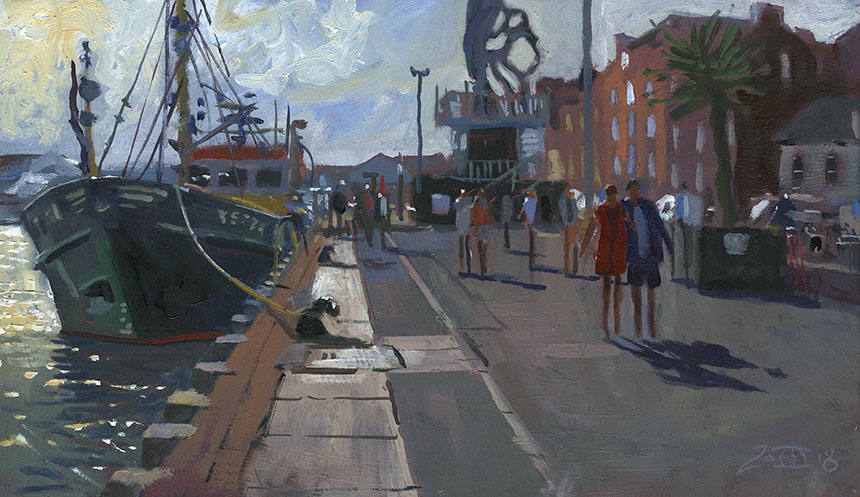
I have been concentrating on the oils recently with an eye to improving my compositional choices. I sometimes tend to go with the obvious view when faced with a scene to get down before the light changes. This is Poole Harbour and a glorious dazzling late afternoon. I spent an age getting the relationship between the pavement and the shadows to be thrown upon it right. If the pavement was too light then the highlighted strips would lack punch, too dark and the shadows wouldn’t describe the bright sun. 14in by 8in Oils.

After fish and chips in the pub I set about this view. Odd how a very ordinary scene can be transformed by good light. Here I worked hard at getting the underlying tones in a good relationship that explained the time of day. 16in by 10in Oils.
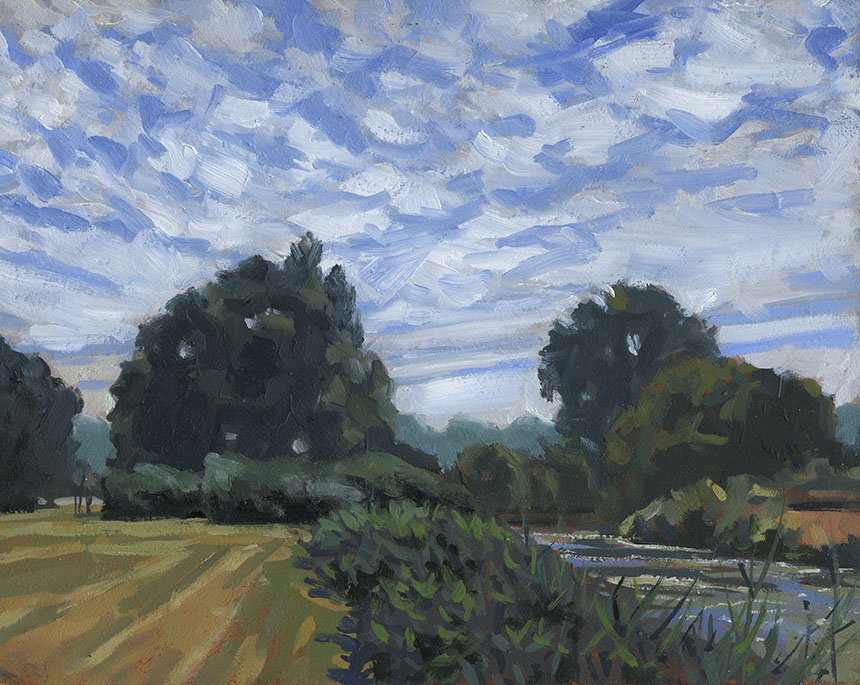
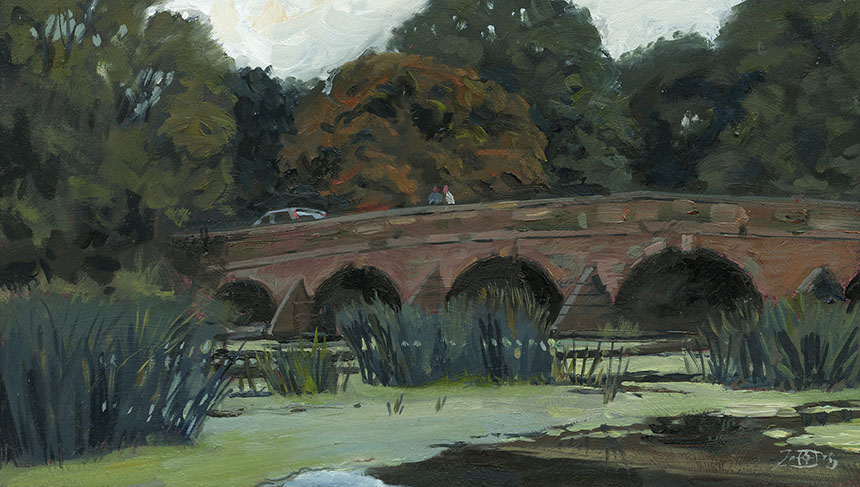
We were kindly invited to paint at Simon Gudgeon’s Sculpture by the Lakes with his sculptures set in an extensive park. The day was blindingly hot and bright with the sun high in the sky. Eventually I found this corner where the river Frome borders the gardens. 10in by 8in Oils.

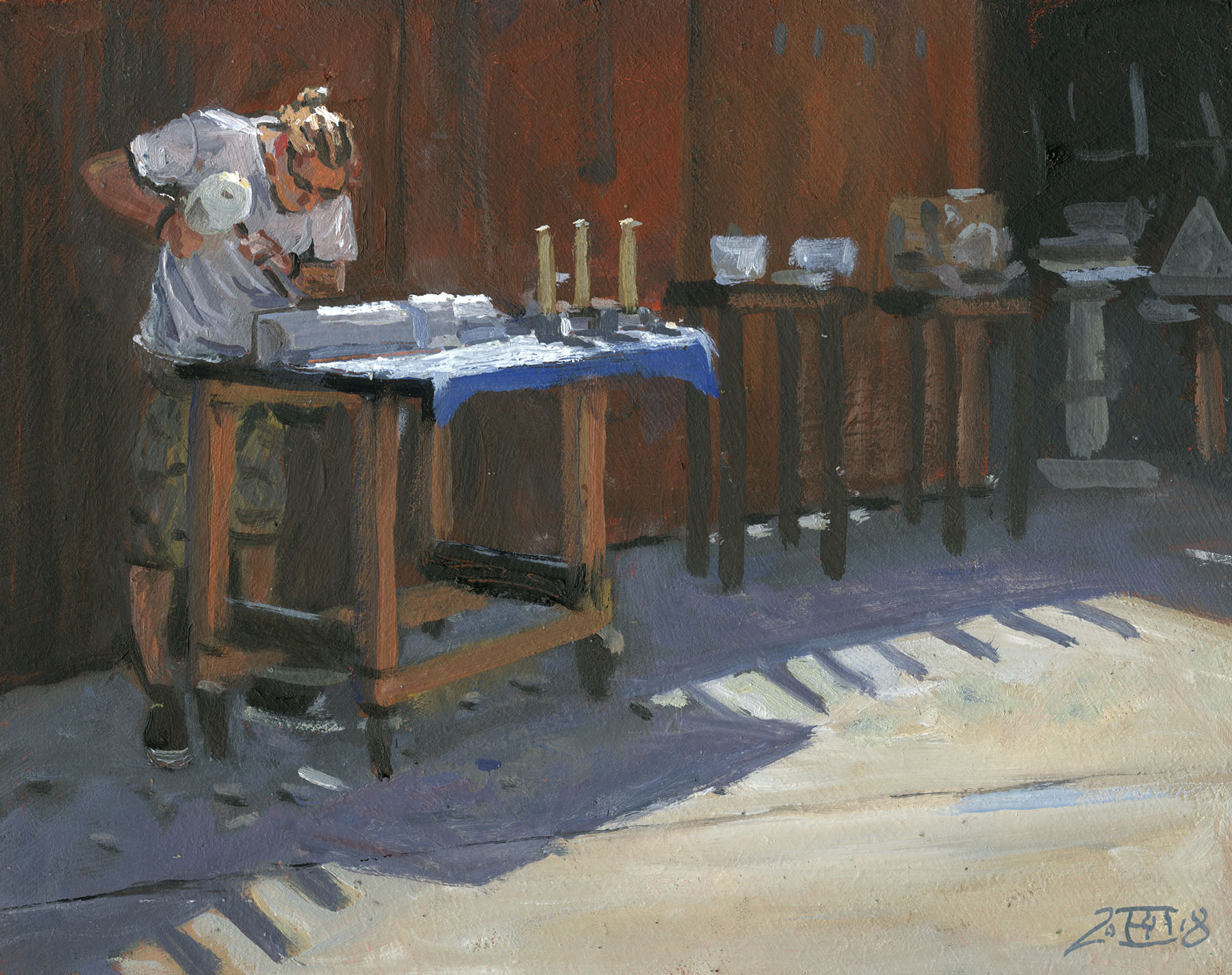
I was going to seek shade but I was attracted by a stone carver working near the cafe. The light was just coming over the steel wall and catching him in brilliant light. Very hard to catch this sort of subject en plein air so there was a fair bit of fiddling once I got home to get it to work properly. 10in by 8in Oils.

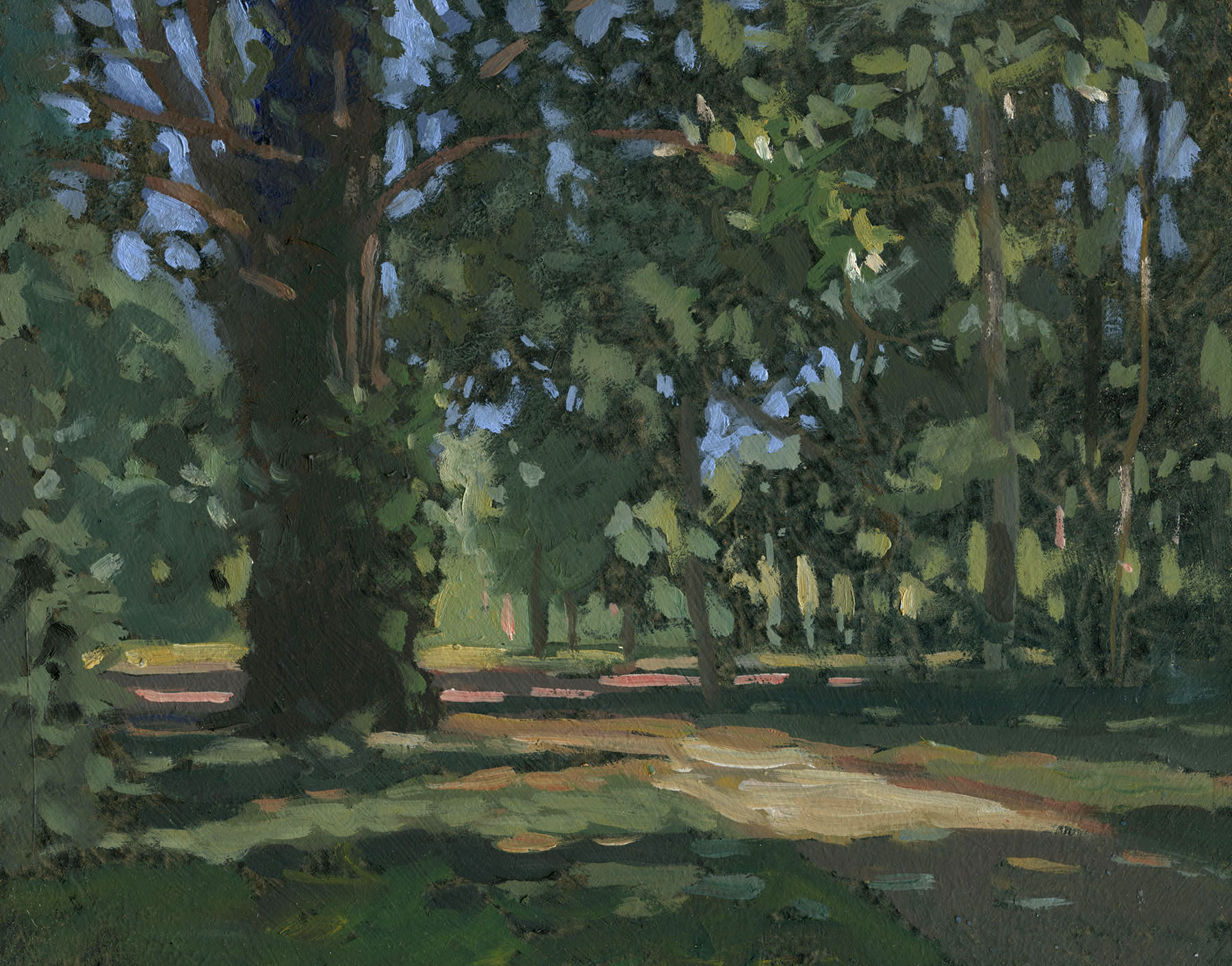
I decided a shady spot was needed next so chose this simple view. I started on a dark blue grey board so most of the shadowed areas are left unpainted by using negative shapes. Great fun and I completely lost myself in it. 10in by 8in Oils.
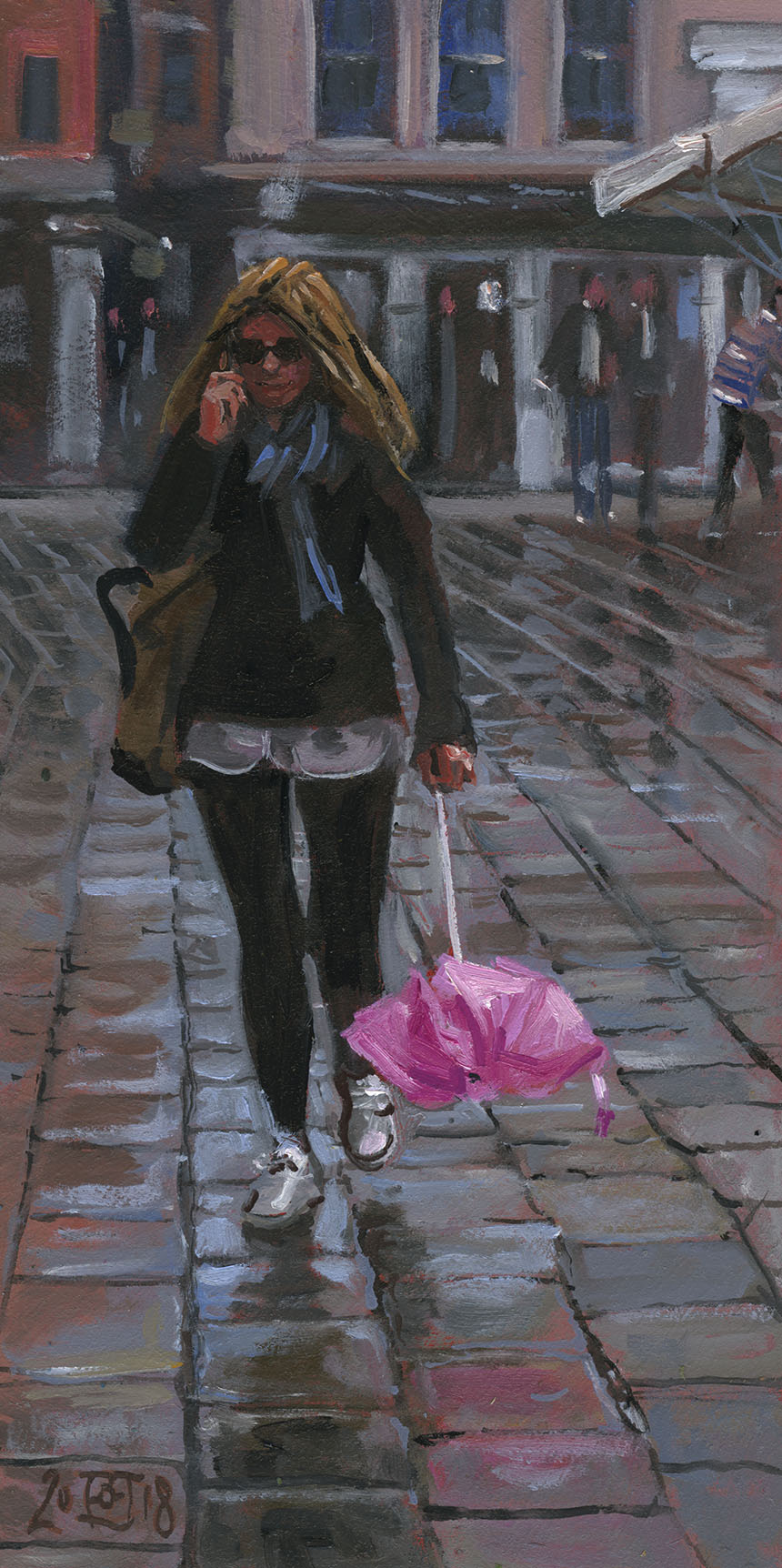
I had a few started but not finished paintings of Venice, so I spent a day trying to make something of them. This had a different figure in it and was rather boring. I had however taken snaps of passers by at the time so this lady with the lurid brolly took my fancy. Since I scanned it I repainted the background too so almost none of the original left! 6in by 12in Oils.
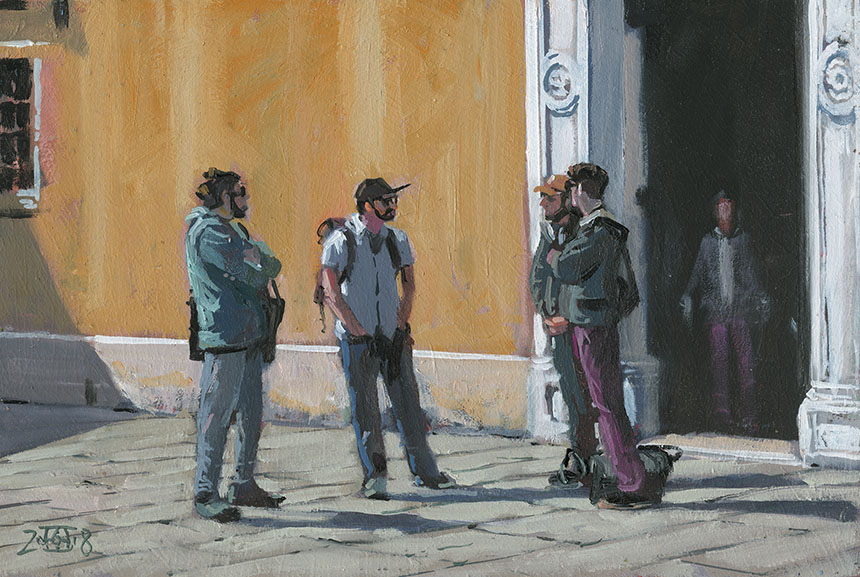
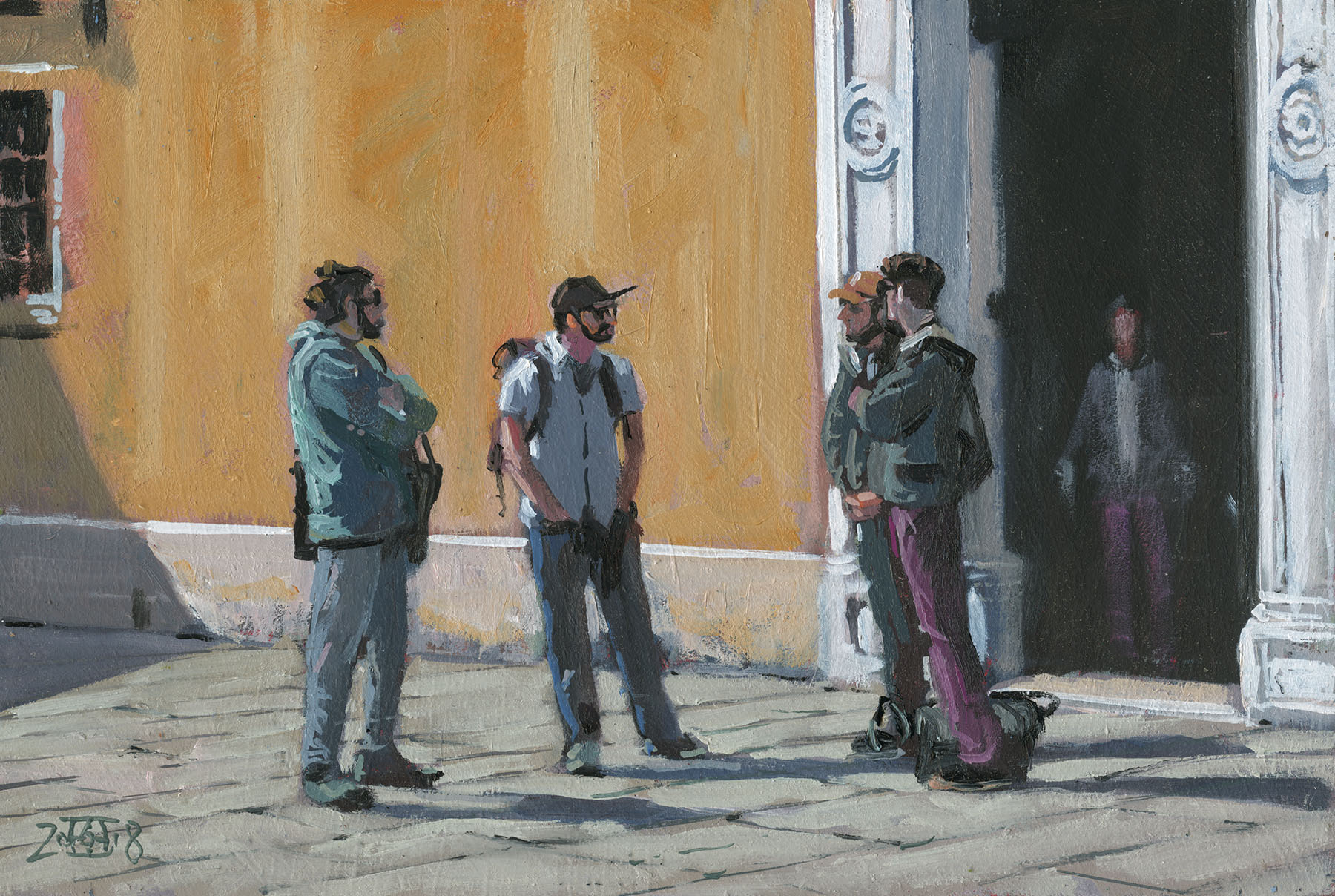
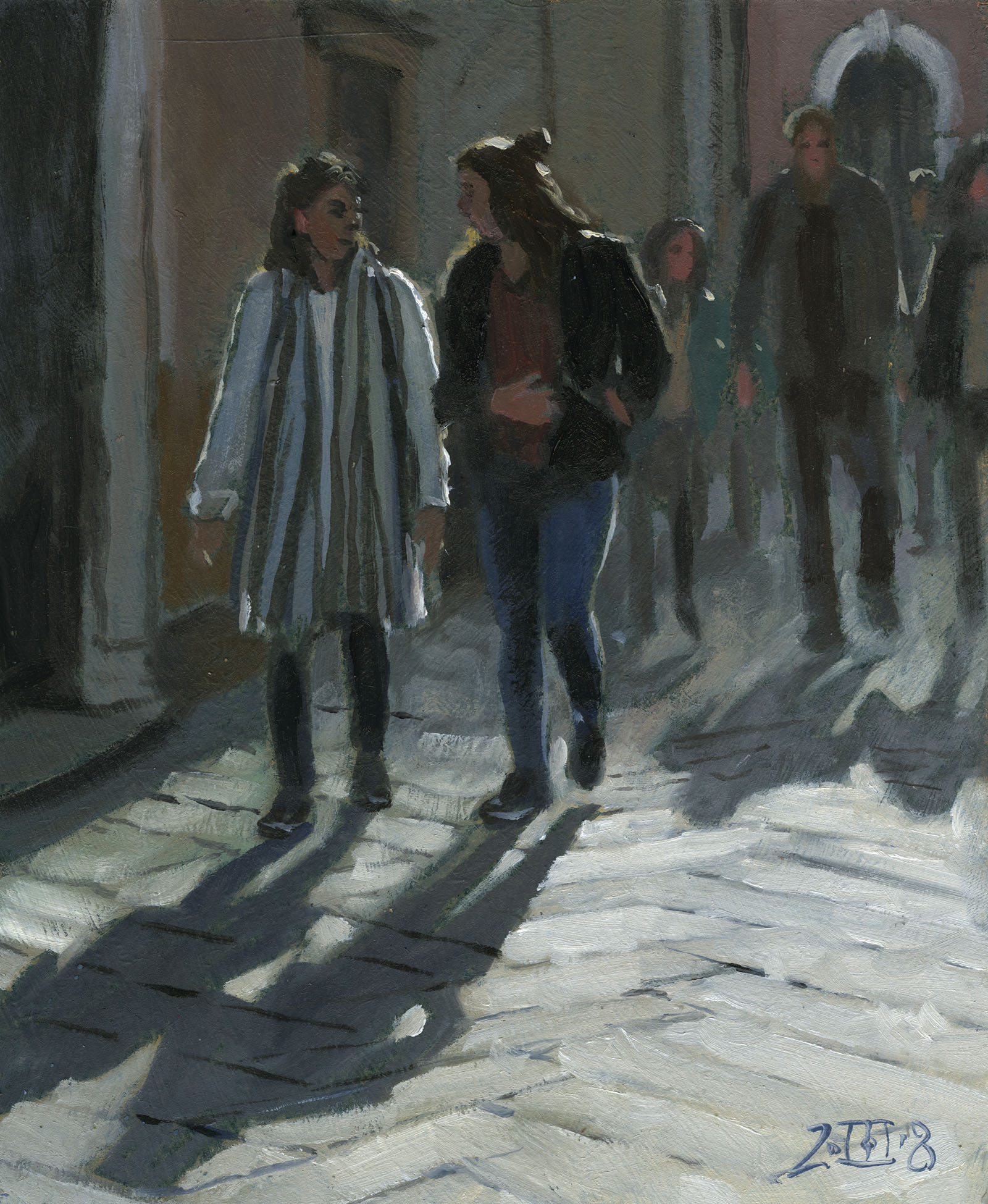
I was very taken by these 4 Venetian students chatting outside their college. I very quickly painted their silhouettes on the spot but they moved on too quickly for anything more. I was lucky really the stayed as long as they did. With my subject gone I filled in the background and had to finish the figures from phone snaps. 10in by 8in Oils.

Another Venice one to finish off. I started this then realised it was just too busy where I was set up, so had to abandon. I had cribbed the figures from a phone snap any how so had the info to finish. This is what I started with.
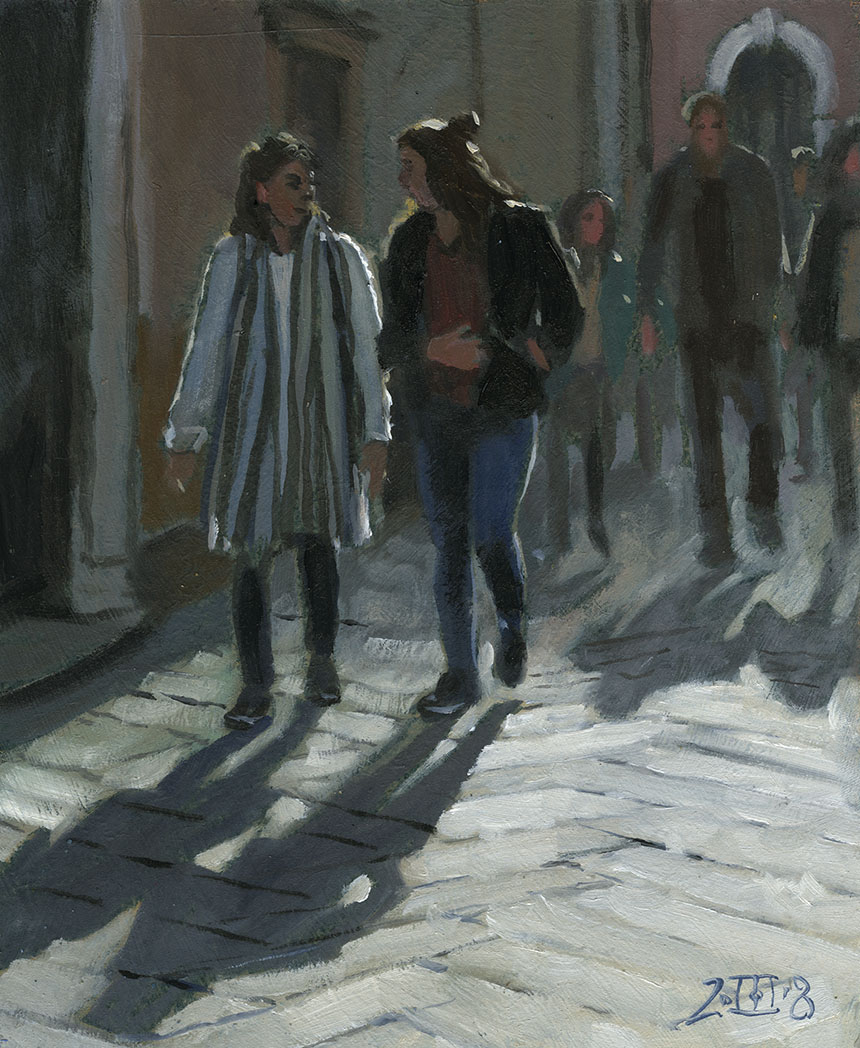
Here’s the end result, the main problem was not taking it too far and loosing the mood. 8in by 10in Oils.
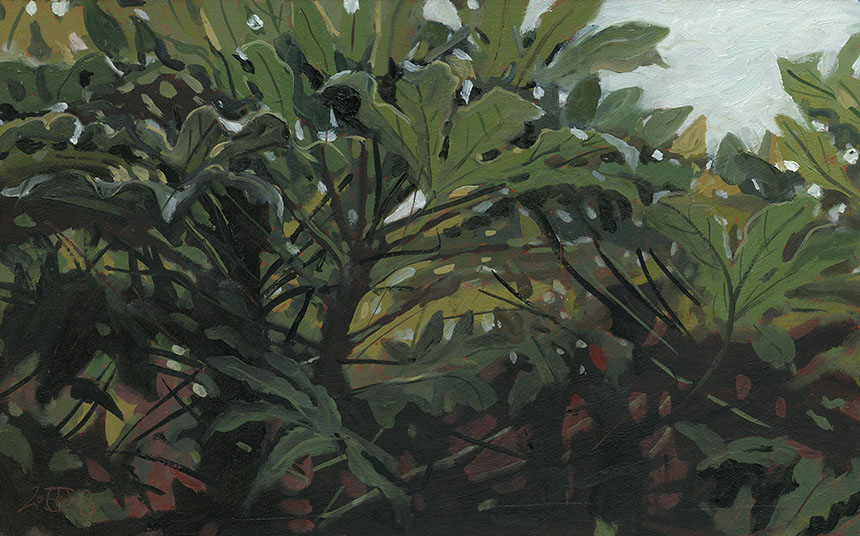
Something a bit different for me… I have been meaning to paint in my garden for a while. To find my subject I got an empty 16in by 10in frame and wandered about framing bits of random shrubbery until I found something I liked. Got a crick in the neck doing this though. I started on quite a dark ground and put in the brightest areas first. Then I added the darks and finally the greens and browns. It is important to remember to draw at each point, it is oh so easy to start slapping paint on with out getting full value out of the brushstrokes. 16in by 10in Oils.

I found my next subject almost between my feet. I actually left the frame on the grass as it helped me see the tones. To do the grass I painted random dark negative shapes on my ground and then added a couple of layers of yellows and greens on top. 12in by 6in Oils.

Let’s get up at dawn and go painting at Hengistbury Head… that was the plan. So 7in the morning staggering out on to the beach semi conscious to attempt to paint. The light was very soft and subtle so I didn’t jump straight in but thought it through a bit. The headland needed to be dark enough to stand forward against the sky but still not above a 50% grey in tonal strength. I loved the joggers and the dog walkers so just stood for while taking photos of them was they passed. Once home I settled on these two joggers which brought my strongest dark and brightest light together. 14in by 10in Oils.

A pause for breakfast and then we explored the views of Christchurch priory from across the river. As I worked I hoped for a dash of light to hit the tower. No such luck so I left it unlit… I could have made one up I suppose, but that would not be cricket… 10in by 8in Oils.

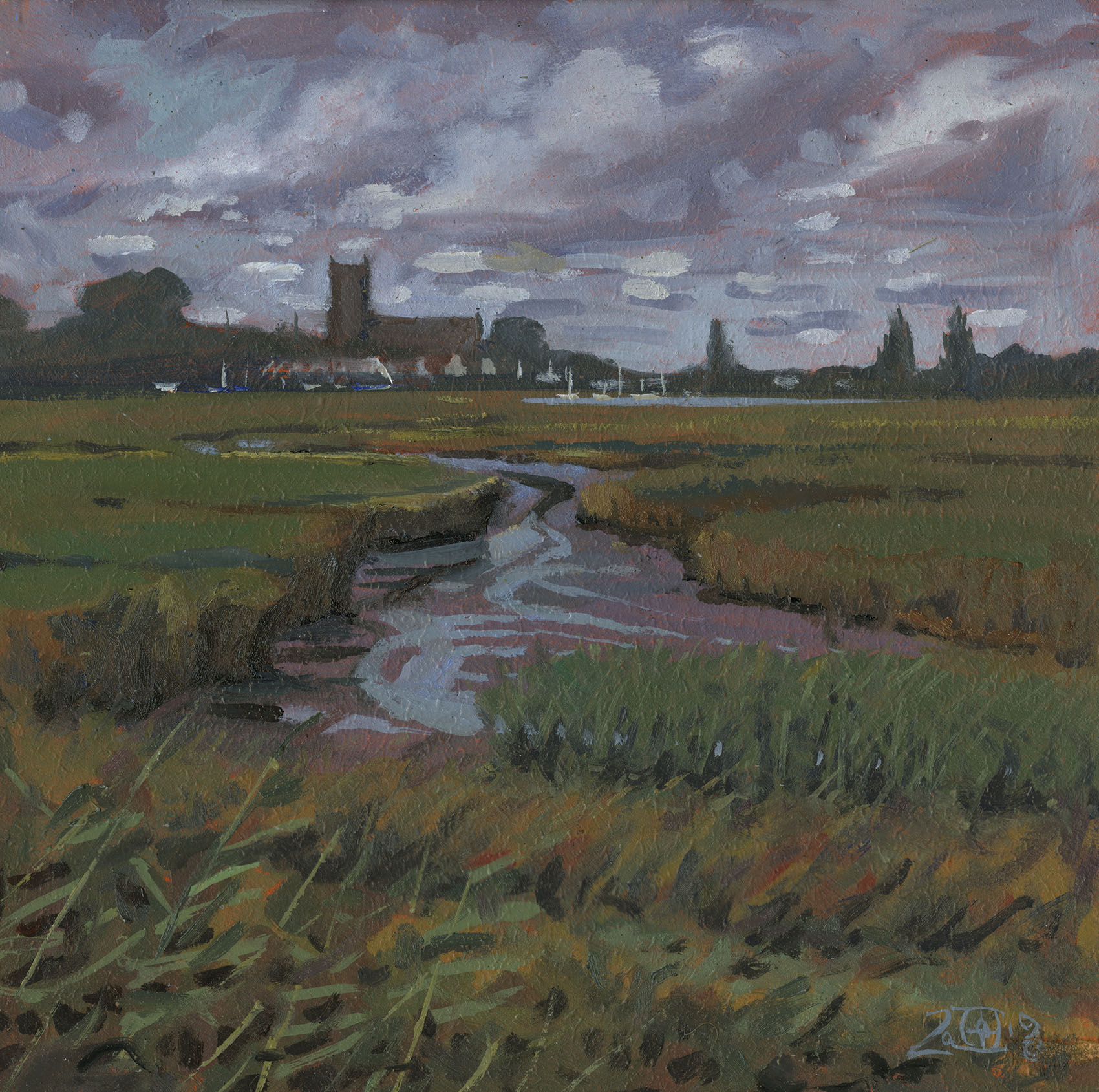
Another view of the Priory from across the marshes this time. I must go back here to paint late in the evening as I suspect it would be lovely. The hard part here was organising all those pesky greens and not getting any of them too lurid. I have recently added an Emerald green to my palette instead of viridian which is a wee bit scary. Still is always interesting to change your palette around, too many painters always use the same set of colours which means their pictures tend to look similar in mood whenever or wherever they paint. 10in by 10in Oils.
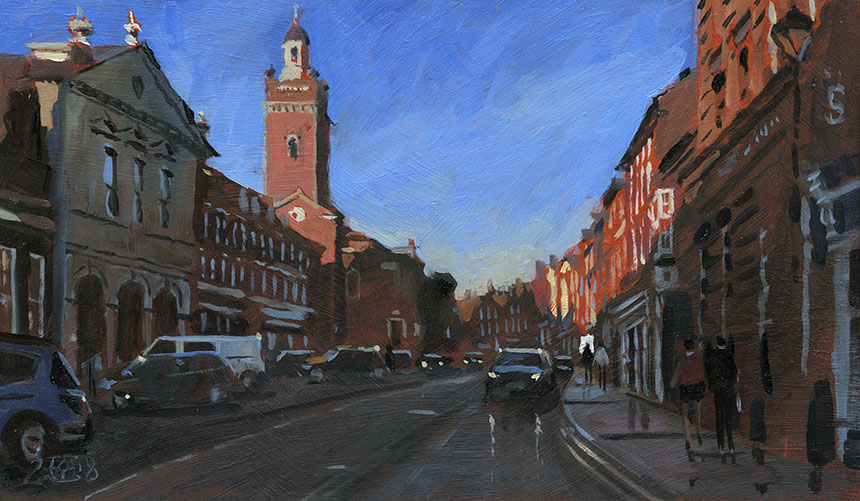
I was coming out from judging the local art show in Blandford Forum when I was greeted by this sight! I took a few phone snaps and went back a day or so later. I reckoned I would not have much time so I roughly drew it out on the board from my snaps and blocked in the whole of the buildings with a dark glaze. I’m glad I did because it was a real rush with the shadows climbing up the buildings at a terrifying rate of knots! 14in by 8in Oils.